
Review · ACROPOLIS TOURS
Athens & Acropolis Highlights: Greek Mythology Small-Group Tour
The best part of this Athens tour is the way it turns broken stones into stories. You do not simply look at the Parthenon. You hear why Athena became the city’s patron, how Dionysus shaped Greek theatre, and why the wingless Nike was meant never to leave Athens. Myth gives the ruins a human voice, while the guide adds the historical setting.
I like the small-group format, capped at 15 people, and the clear route from Hadrian’s Arch to the Acropolis and Ancient Agora. I also like the practical teaching style reported from guides such as Irene, Michael, Dani, Maria, and Chrysanthi, who use questions, printed images, shade stops, and short breaks to make a demanding site easier to follow.
The main drawback is cost and effort. The $54.42 tour price does not include entry fees, so an adult who needs both the Acropolis and Ancient Agora tickets pays about $104.42 before food or drinks. The walk includes steep climbs, stairs, and uneven stone, and one person found it hard to stay with the guide in a larger-than-expected group.
Key points to know before you book
- Mythology is the organizing theme: Expect stories about Athena, Nike, Dionysus, Hephaestus, and the gods tied to each monument.
- The route covers two major sites: You visit the Acropolis and Ancient Agora, with the tour ending at the Temple of Hephaestus.
- Admission is extra: Budget €30 for the Acropolis and €20 for the Ancient Agora, as stated for the four-hour option.
- The group is limited to 15 people: This is more personal than a large coach tour, though group control still depends on the guide.
- Plan for a physical walk: You will handle a steep Acropolis climb, stairs, downhill stretches, and uneven surfaces.
- Bring only the basics: Backpacks, large bags, and strollers are not allowed at the Acropolis.
Why mythology changes the Acropolis visit
Athens can be hard to read at first. The Acropolis is grand, but its temples are partial, crowded, and scattered across a rocky hill. A good guide gives each building a purpose, a god, and a story, so the site becomes easier to understand.
This tour focuses on the link between mythology and civic life. Athena is not presented as a distant figure from a school textbook. She is the city’s patron, tied to victory, craft, wisdom, and the identity of Athens itself. Nike, the goddess of victory, appears in a smaller but memorable setting, the Temple of Athena Nike.
The storytelling also reaches beyond the gods. At the Theatre of Dionysus, you learn how performances by Aeschylus, Sophocles, Euripides, and Aristophanes first reached Athenian audiences. At the Agora, politics, trade, justice, religion, and everyday business come together.
That combination is the tour’s real value. You get architecture, legends, and early civic life in one walk. If you already know Greek mythology, the guide can add details about cult statues, temple design, and ancient customs. If the subject is new to you, the stories give you a simple framework for remembering the sites.
Several guides have been praised for turning complicated material into plain explanations. Irene used questions to help reinforce the main ideas. Dani added extra details for visitors who already knew the gods. Michael reportedly broke the climb into short stages and used fun stories to connect mythology with ordinary Greek life.
More Mythology Tours in Athens
- Athens: Acropolis and Mythology Highlights Small Group Tour
★ 4.8 · 2,275 reviews - Athens: Mythology Tour for Families
★ 4.8 · 173 reviews - The History of Athens: Greek Mythology Private Tour
★ 5.0 · 138 reviews
Starting at Hadrian’s Arch and the Temple of Olympian Zeus
The meeting point is near Hadrian’s Arch, at Leoforos Vasilisis Amalias 50, a central location between the Acropolis and the Temple of Olympian Zeus. The tour begins with the great temple from the outside, so you should not expect an included interior visit here.
You spend about 15 minutes discussing the Olympeion, once one of the ancient world’s largest temples to Zeus. Its surviving columns give you a quick sense of the scale ancient builders attempted. This is a useful opening because it introduces both the ambition of Athens and the role of Zeus in Greek religion.
The stop is short, which suits the four-hour schedule. You get context without using too much time before the Acropolis. The tradeoff is that this is mainly a viewing and storytelling stop, not a long exploration of the site.
The Acropolis climb, with the Theatre of Dionysus below
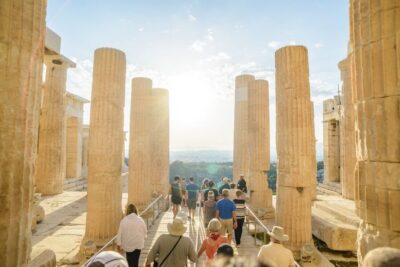
The Acropolis receives about an hour and a half, making it the center of the experience. The path involves a steep climb, steps, sloping ground, and uneven stone. Wear sturdy walking shoes, carry water, and bring a hat. Several guides have been praised for pausing in shaded places and breaking the climb into manageable sections.
The Theatre of Dionysus appears as part of the Acropolis visit, with about 15 minutes set aside for it. This is where the connection between Greek religion and theatre becomes especially clear. Dionysus was linked to wine and the grape harvest, and his theatre became the setting for works that still shape drama today.
You are not just looking at ancient seating. You are standing where major plays by Aeschylus, Sophocles, Euripides, and Aristophanes were first performed. That makes this stop particularly useful if you enjoy literature, theatre, or the way public festivals shaped ancient society.
The theatre can also help you understand the scale of Athenian public life. Performance was not a private hobby. It was tied to religion, civic identity, and large public gatherings. A guide who explains those links can make the stones below the Acropolis feel much less remote.
Athena Nike and the meaning of victory
The Temple of Athena Nike is small compared with the Parthenon, but it rewards attention. You spend about 10 minutes here, learning how Athena was worshipped in her victorious form alongside Nike, the goddess of victory.
The detail about the wingless statue is one of the tour’s most memorable mythological points. The idea was that Nike should never fly away from Athens. It is a compact story, but it explains how myth could express a city’s hopes for military success and permanent protection.
This stop also shows why a guide helps at the Acropolis. The Parthenon naturally draws your eyes, but smaller buildings can carry some of the clearest ideas about Athenian religion. Your guide can direct your attention to the structures you might otherwise pass without noticing.
More Acropolis tickets and guided visits:
- Athens: Acropolis & up to 5 Archaeological Sites Combo Pass
★ 4.4 · 12,619 reviews - Athens: Acropolis Ticket with Optional Audio or Live Guide
★ 4.2 · 11,055 reviews - Athens: Acropolis, Parthenon & Acropolis Museum Guided Tour
★ 4.8 · 9,316 reviews - Athens: Acropolis and Parthenon Guided Walking Tour
★ 4.6 · 5,882 reviews
The Erechtheion and Parthenon
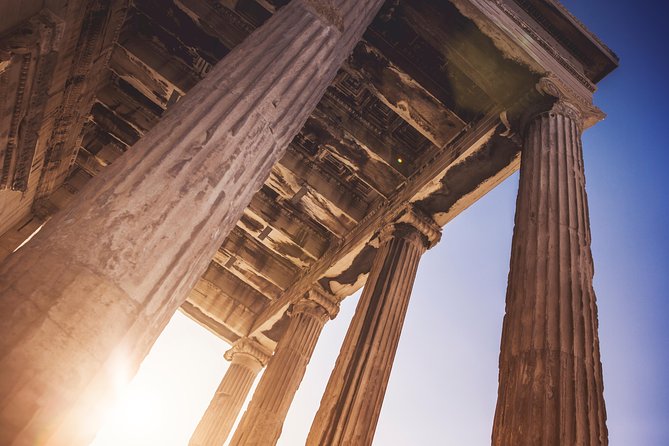
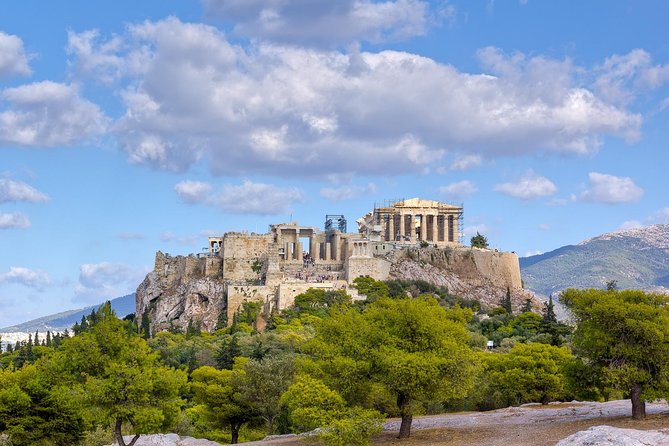
The Erechtheion takes about 10 minutes. It was built to house the ancient wooden cult statue of Athena and to honor Athens at the height of its power. Its unusual design differs from the regular order of the Parthenon, and its connection to Athena makes it central to the city’s religious identity.
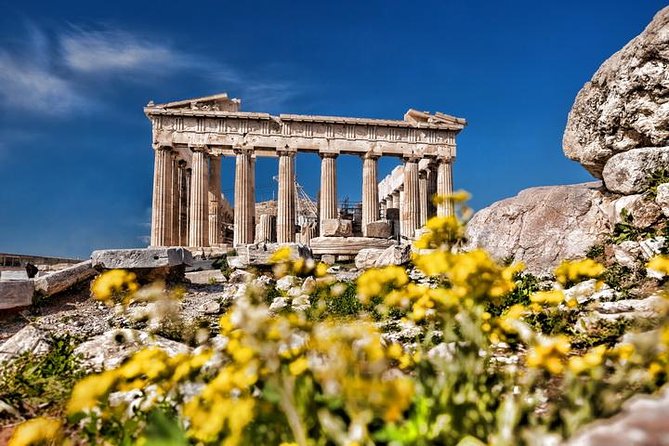
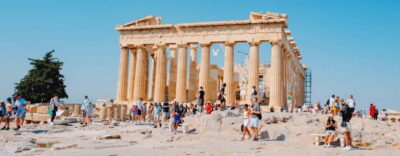
The tour then gives the Parthenon about 20 minutes. Built in the mid-fifth century BCE, it was dedicated to Athena Parthenos, Athena the Virgin. The temple is also a major example of the Doric order, known for its restrained, sturdy form.
Twenty minutes is enough for a guided overview, but not enough for every architectural detail. You will learn the main facts, hear the mythological connections, and have time to take in the building. If you want a long, quiet study of the Parthenon, plan to return on your own.
The advantage of a timed stop is that the group keeps moving. The Acropolis can become crowded, and the morning timing is useful. One person found that leaving earlier meant avoiding a sharp increase in crowds later in the day. The disadvantage is that you have less freedom to linger at every monument.
Guides have used printed images and visual aids to show how the buildings may have appeared in ancient times. That can be especially helpful because the ruins do not look like the complete temples they once were. Ask questions as you go, since several guides have been praised for handling both basic and highly specific questions.
Walking down to the Ancient Agora
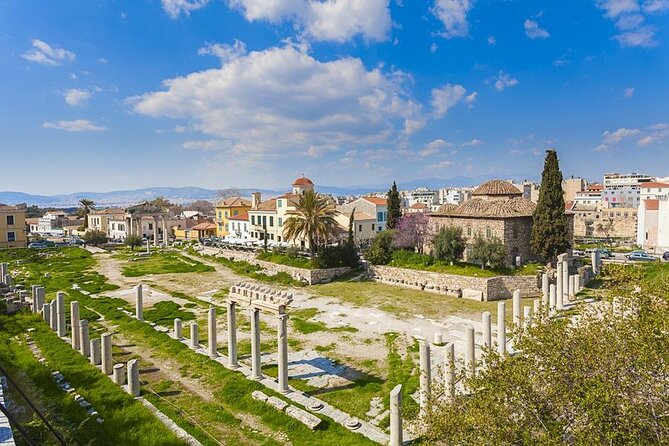
The tour continues to the Ancient Agora for about an hour. This was the political, commercial, administrative, social, religious, and cultural center of Athens. It was also a place of justice, so the site helps explain how the city worked beyond its sacred hill.
The Agora gives the tour a welcome change of pace. At the Acropolis, the focus is on monumental temples and the gods. Here, the focus shifts toward people, institutions, trade, public debate, and civic decisions.
This is where the mythology theme becomes part of a broader picture. Ancient Athenians did not separate religion, government, business, and culture in the modern way. The same public space could support worship, legal matters, commerce, and political life.
The four-hour option includes the Ancient Agora entrance, but the fee is separate from the tour price. The listed cost is €20 per person. If you only want the Acropolis portion, confirm the option you choose carefully, since the four-hour route is built around both major sites.
Ending at the Temple of Hephaestus
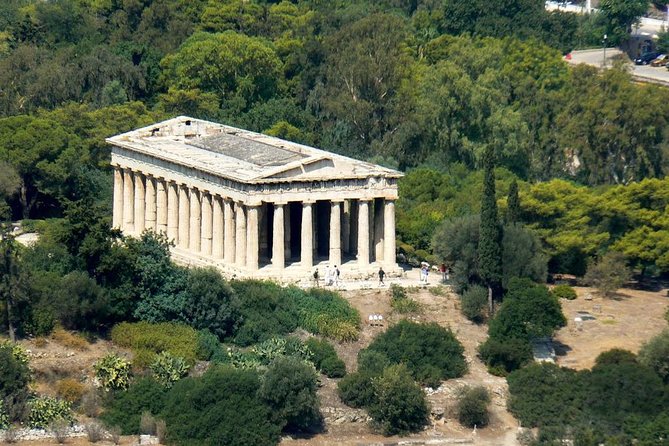
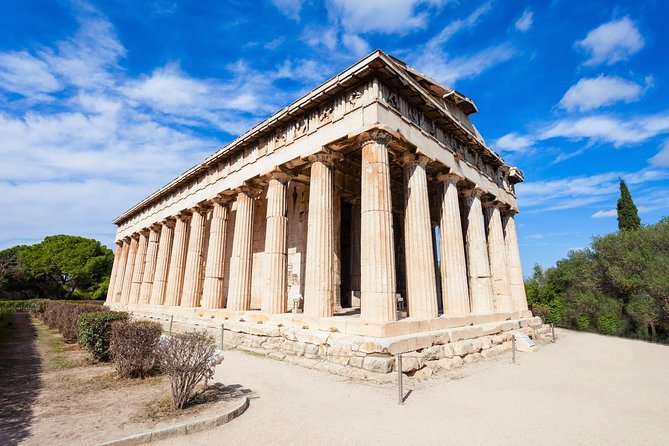
The final stop is the Temple of Hephaestus, described in the tour details under the Temple of Aries heading. Hephaestus was the god of metalworkers, while Athena Ergani protected potters and cottage industries. That pairing fits the Agora, where merchants, craftspeople, and shop owners worked.
This is one of the best endings possible for the route. The Parthenon is the famous temple, but the Temple of Hephaestus is among the best-preserved ancient temples in the world. You can look closely at its design and ask how a temple functioned, rather than simply admiring a distant silhouette.
The tour ends at the Ancient Agora of Athens, Athens 105 55. There is no transfer back to your hotel, so you should plan your next stop from the Agora area. The central location makes it practical for continuing on foot or using nearby public transportation, though no private transport is included.
What the $54.42 price really buys you
At $54.42 per person, the base cost is reasonable for four hours with an English-speaking certified guide and a group capped at 15. The value depends on how much context you want. If you are content to read signs and walk independently, you can save money by visiting the sites on your own.
The separate admission costs change the calculation. For the four-hour route, the stated fees are €30 for the Acropolis and €20 for the Ancient Agora. That brings the listed tour and entrance costs to about $54.42 plus €50, with food, drinks, and transport not included.
You can ask the operator to pre-purchase the entry tickets. This may simplify the visit, but check the total price and the ticket process before booking. One person found the add-on arrangement confusing even after understanding that admission was separate.
The tour is strongest for someone who wants an explanation at the site itself. You are paying for the guide’s storytelling, pacing, answers, and ability to connect scattered ruins. The printed map included with the tour is a useful extra for keeping the route straight.
Group size, timing, and physical effort
The maximum group size is 15, and the tour is offered in English with a mobile ticket. It is commonly booked well ahead, with an average booking time of 46 days in advance, so popular dates may require planning.
Most people can take part, but the walk is not gentle. You will climb the Acropolis, handle uneven ground, and walk uphill and downhill between sites. Good shoes, water, and a hat are basic equipment, not optional extras on a hot day.
Guide quality matters here because the group is moving through crowded archaeological areas. Most of the guide feedback is especially strong on explanations, pacing, kindness, and care. Guides such as Marika, Chrysanthi, Christina, and Angie have been praised for making rest stops and helping people stay comfortable.
There is one important caution. One person reported being separated from a group of 18 and losing sight of the guide for about 10 minutes. The advertised maximum is 15, but group control can still vary. Stay near the guide, note the next meeting point, and ask for a visible marker if the area is crowded. One complaint also involved difficulty hearing without a microphone.
Who will enjoy this tour most
I would choose this tour if you want the major Athens ruins explained through myths rather than presented as a list of dates. It suits first-time visitors, families with older children, mythology fans, and anyone who wants a focused half-day introduction to ancient Athens.
It also works well for a short stay. You cover the Acropolis, Ancient Agora, and several key monuments in four hours, leaving the rest of the day for the Acropolis Museum or another part of Athens. One person who had already taken an Acropolis and museum tour still found this mythology-focused route added useful material.
I would think twice if you dislike group pacing, cannot manage steep and uneven ground, or want long periods alone at each monument. The route is active and scheduled. It is not a slow photography walk.
Book at least 24 hours before the start time if you want the option of a full refund. Cancellations made less than 24 hours before departure are not refunded, and changes inside that window are not accepted. Poor weather or failure to meet the minimum group size can lead to a different date, another experience, or a full refund.
Should you book Athens and Acropolis Highlights?
Book it if you want the Acropolis to make sense, not just look impressive. The strongest guides turn Athena, Nike, Dionysus, and Hephaestus into part of a larger explanation about religion, theatre, government, craft, and daily life.
The added entry fees and physical climb are the main points to weigh. For an informed, story-led visit with a small group, the price is fair. Bring water, wear good shoes, leave large bags behind, and confirm ticket add-ons when you reserve. If those conditions suit you, this is a useful way to meet ancient Athens in one concentrated morning.
FAQ
Are Acropolis and Ancient Agora tickets included?
No. Admission fees are separate. The stated fee for the Acropolis is €30 per person, and the Ancient Agora fee for the four-hour option is €20 per person.
Where does the tour start and finish?
The tour starts at the Arch of Hadrian, Leoforos Vasilisis Amalias 50, Athens 105 58. It ends at the Ancient Agora of Athens, Athens 105 55.
How long does the tour last?
The experience lasts about four hours. The Acropolis portion takes about 1 hour and 30 minutes, and the Ancient Agora portion takes about one hour.
How large is the group?
The tour has a maximum of 15 people. It is described as a small-group experience.
What should I bring or avoid bringing?
Wear good walking shoes and bring water and a hat. Strollers, backpacks, and large bags are not allowed at the Acropolis and should not be taken on the tour.
Can I cancel for a full refund?
Yes, if you cancel at least 24 hours before the local start time. Cancellations or changes made less than 24 hours before the experience are not refunded or accepted.
New on the Athens shelf
- Acropolis of Athens, Parthenon and Acropolis Museum private tour with dinner★ 5.0 · 77 reviews
- Small-Group Wine Tour in Athens with Tasting★ 5.0 · 33 reviews
- Private Athens Transfer Airport/Port -Greek Tours-Hourly service★ 5.0 · 88 reviews
- VIP Private Guided Tour of Athens Acropolis & Plaka in a Sidecar★ 5.0 · 108 reviews
- Athens Moonlight Waling Tour with Drinks and Meze Dishes★ 5.0 · 259 reviews
- Private Athens Landmarks Layover Tour★ 4.5 · 41 reviews
- Departure Transfer from Athens City to Athens Airport★ 5.0 · 41 reviews
- Classic Athens Food Tour with Local Drink & Market Visit★ 5.0 · 34 reviews
Acropolis Tours, compared.
Acropolis & up to 5 Archaeological Sites Combo Pass
Read our verdict →
Acropolis, Parthenon & Acropolis Museum Guided Tour
Read our verdict →
Acropolis: Acropolis and Parthenon Guided Walking Tour
Read our verdict →
Acropolis monuments & Parthenon Walking Tour with Optional Acropolis Museum
Read our verdict →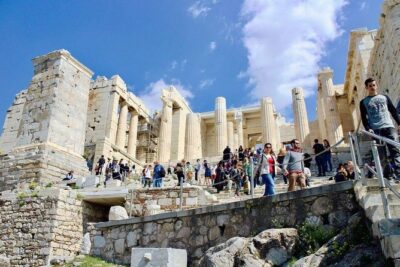
Athens All Included: Acropolis and Museum Guided Tour with Ticket
Read our verdict →Browse the lists this tour appears in