
Review · ACROPOLIS TOURS
Athens: Acropolis and Parthenon Guided Walking Tour
The best part of this Acropolis walking tour is the route itself. You enter from the south slope, begin with the Theater of Dionysus, and climb toward the monuments instead of simply arriving at the Parthenon with no context. Along the way, your guide connects the stones to Greek myths, civic life, theater, religion, and the city spread below.
I like the licensed local guides and the personal earsets. Guides such as Eva, Victor, Maria, Antonis, and Kalli have been praised for clear explanations, lively storytelling, and keeping groups together. I also like that the tour includes views toward the Ancient Agora, Filopappos Hill, Mars Hill, Pnyx, and the National Observatory, not just the famous temple.
The main consideration is the strict entry time. You must arrive 20 minutes early, and if you choose the option without tickets, your admission must match the tour time exactly. Summer heat, stone surfaces, security lines, and crowds can also make this a tiring walk.
Key points about the Acropolis tour
- A south-slope approach: Begin at the Sanctuary of Dionysus and Theater of Dionysus before reaching the hilltop monuments.
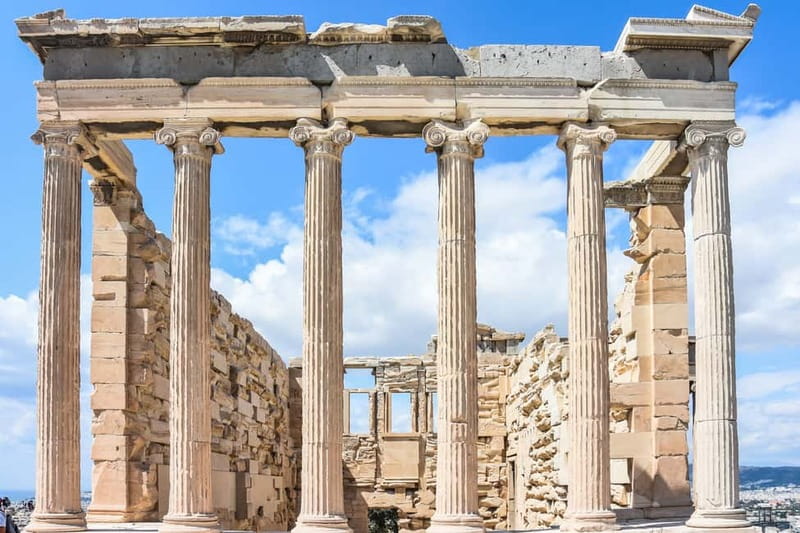
- The main Acropolis sights: See the Propylaea, Temple of Athena Nike, Erechtheion, and Parthenon with a guide.
- Clear commentary: Personal headphones help you hear the guide even when the site is crowded.
- Strong storytelling: Expect myths, historical background, and explanations of details that are easy to miss alone.
- Flexible ticket choices: Book with Acropolis admission included, or arrange your own ticket through the official website.
- A practical duration: Allow between two and three and a half hours, depending on the selected option and timing.
Starting on Dionysiou Areopagitou Street
The meeting point is at 3 Dionysiou Areopagitou Street, near the start of the pedestrian route toward the Acropolis from Hadrian’s Arch and Syngrou Avenue. Look for the orange Athens Walking Tours sign. You should arrive 20 minutes before departure, not just at the scheduled start.
This matters because the Acropolis uses timed entry. The group cannot wait for late arrivals, and a missed entrance does not bring a refund. Build in extra time for finding the meeting point, especially if you are coming from another part of central Athens.
The tour ends back at the meeting point according to the meeting details, while the guided sightseeing route itself finishes at the Acropolis. Clarify the end arrangements with the guide if you plan to remain on the hilltop for photographs after the formal commentary.
More Walking Tours in Athens
- Greek Food Walking Tour in Athens
★ 5.0 · 4,740 reviews - Acropolis: Acropolis and Parthenon Guided Walking Tour
★ 4.7 · 3,442 reviews - Acropolis monuments & Parthenon Walking Tour with Optional Acropolis Museum
★ 5.0 · 2,678 reviews
The Theater of Dionysus sets the scene
The first major stop is the Sanctuary of Dionysus, followed by the Theater of Dionysus. This is a smart beginning because the Acropolis was never only about one temple. The lower southern slope shows how religion, theater, public ceremony, and daily life all connected to the sacred hill.
Your guide explains the importance of Dionysus and the theater before you climb higher. The route includes roughly 10-minute walking sections between several stops, so this is not a single stationary lecture. You move, pause, listen, and then continue upward.
The theater is also a good place to understand scale. The Parthenon receives most of the attention, but the Theater of Dionysus helps you see the Acropolis as part of a larger Athenian setting. If you enjoy mythology and the origins of drama, this early portion may be one of the most rewarding parts of the walk.
Asklepieion and the Odeon of Herodes Atticus
Next comes the Asklepieion of Athens, a sanctuary connected with healing. It adds another layer to the site, showing that people came to the Acropolis area for more than political or religious ceremonies.
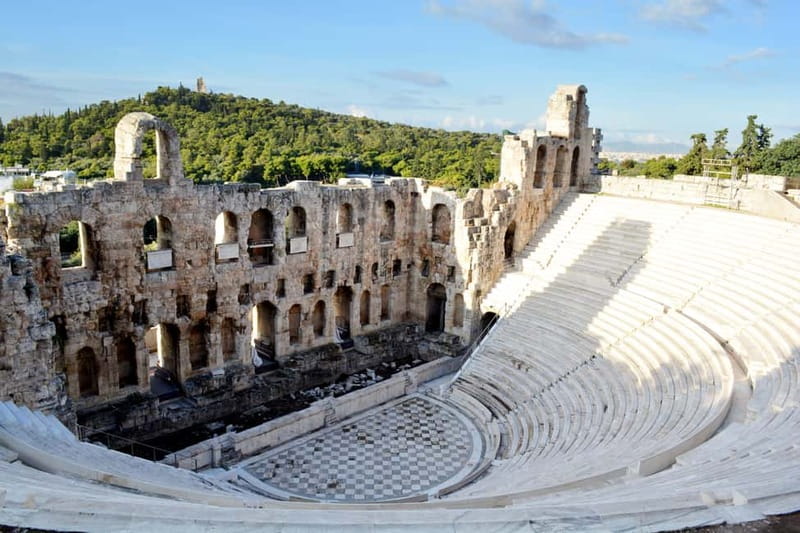
The route then reaches the Odeon of Herodes Atticus. This Roman-era theater sits against the Acropolis slope and remains one of the most striking structures you see before entering the upper site. Its curved stone seating and dramatic setting make it an excellent photography stop.
The guide’s role is especially useful here. Without context, you can easily treat the Odeon as just another old theater. A good explanation helps you separate the Greek and Roman periods and understand how the Acropolis area changed over time.
Passing through the Propylaea
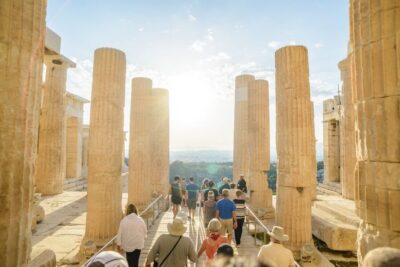
The Propylaea is the monumental gateway to the Acropolis. You approach it after walking uphill, so the entrance feels like a real threshold rather than a quick photo stop beside a road.
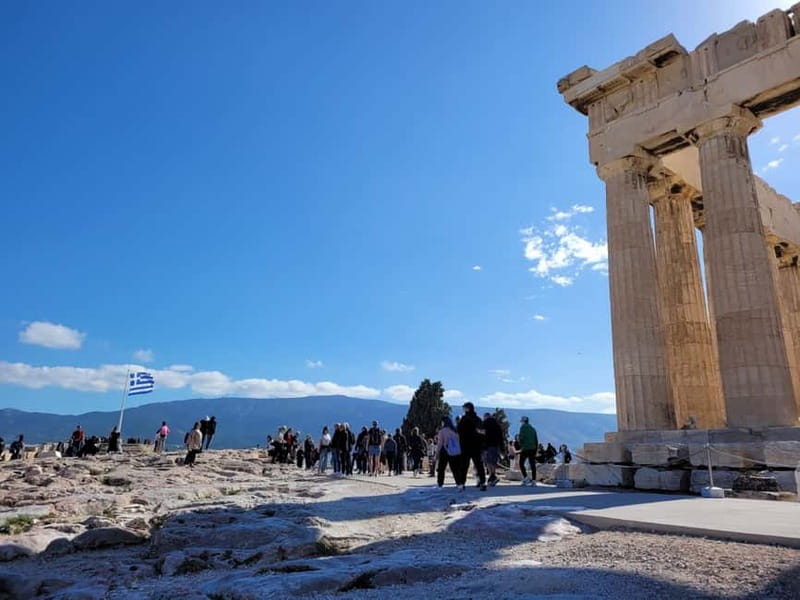
Expect uneven stone, exposed sun, and other groups moving through the same space. The earsets help here. You can stay close enough to follow the group while still looking at the architecture instead of staring at the guide.
This is also where the climb may begin to feel demanding. The tour is not suitable for wheelchair users or people with mobility impairments, and baby strollers and large bags are not allowed. Comfortable shoes are essential. Keep your hands free for balance and photography, and carry only what you need.
More Acropolis tickets and guided visits:
- Athens: Acropolis & up to 5 Archaeological Sites Combo Pass
★ 4.4 · 12,619 reviews - Athens: Acropolis Ticket with Optional Audio or Live Guide
★ 4.2 · 11,055 reviews - Athens: Acropolis, Parthenon & Acropolis Museum Guided Tour
★ 4.8 · 9,316 reviews - Athens: Acropolis, Parthenon & Acropolis Museum Guided Tour
★ 4.8 · 3,579 reviews
The Temple of Athena Nike and the Erechtheion
The Temple of Athena Nike comes next, with about five minutes of walking from the Propylaea. It is smaller than the Parthenon, but its position near the entrance makes it an important part of the Acropolis story.
The guide explains the temple’s connection with Athena Nike, the protective and victorious aspect of Athena. This is the sort of detail that can disappear when you are focused only on the larger ruins. The short stop gives you a useful reminder that the hilltop was filled with several sacred buildings, each with its own purpose.
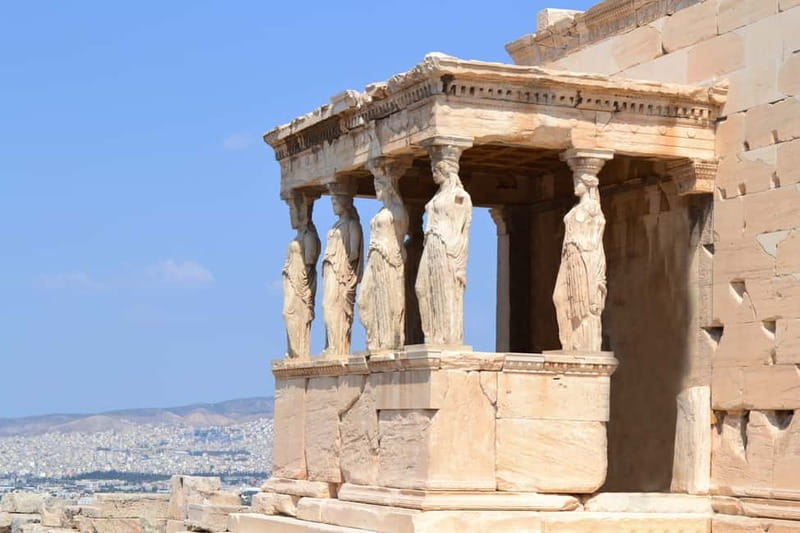
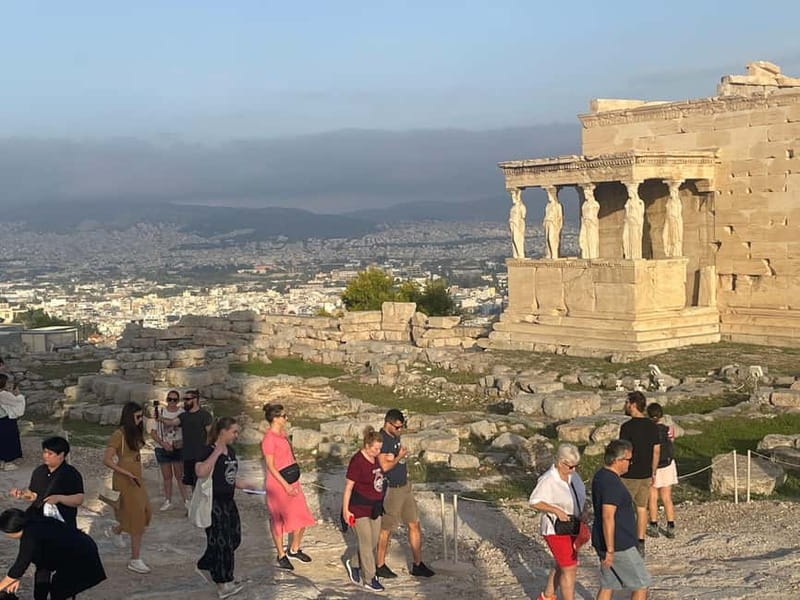
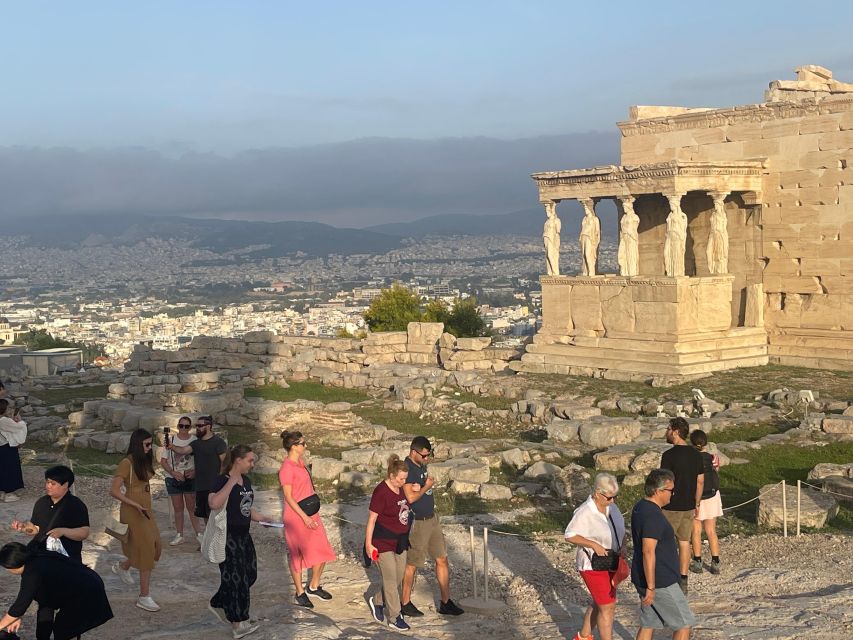
The route then continues to the Erechtheion. Its unusual design and famous Caryatid porch make it one of the most memorable stops on the hill. The Erechtheion is not as visually straightforward as the Parthenon, and that is exactly why a guide helps. You get explanations for the building’s different sacred associations and the myths tied to Athens.
The Caryatids are copies on the building, while the original sculptures are protected in the Acropolis Museum, a point your guide may address if the museum option is part of your booking. Do not rush this stop. It offers some of the best close-up architectural details on the entire visit.
The Parthenon and Athens below
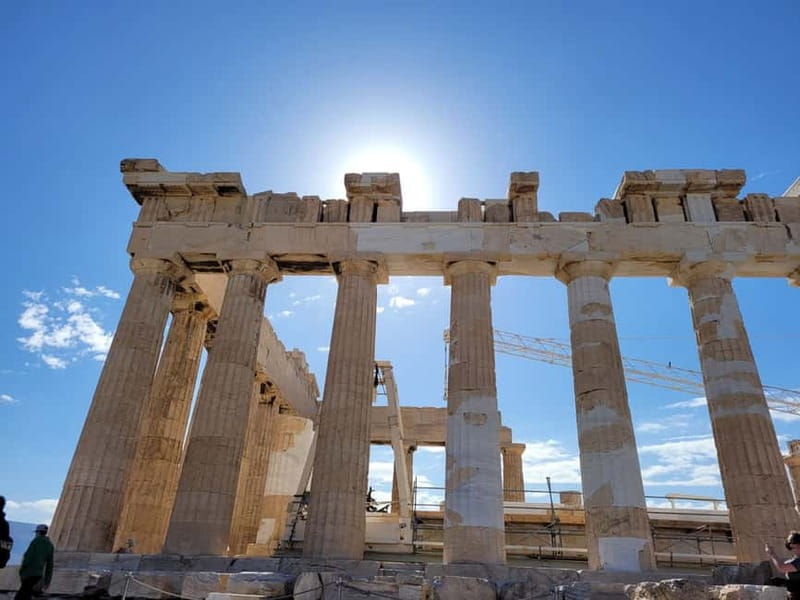
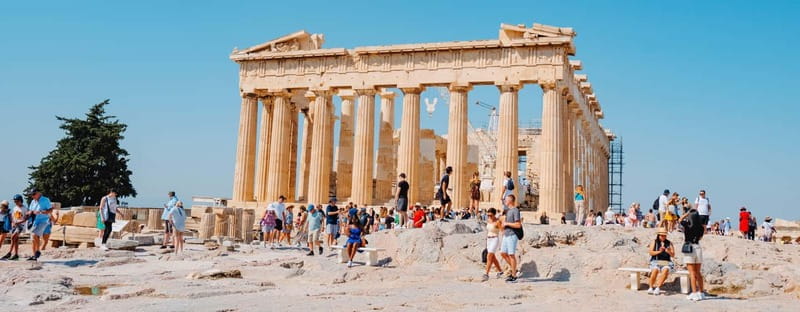
The tour’s final major stop is the Parthenon. You have already crossed the lower slope, theater area, gateway, and smaller temples, so the temple arrives with a sense of place and purpose.
Your guide discusses the monument’s role in ancient Athens, its connection with Athena, and the myths and historical events surrounding it. The tour does not simply point at columns and name dates. The strongest guides use stories to explain why this building mattered and how it fitted into the city’s religious and political life.
The hilltop also gives you wide views across Athens. You can look toward the Ancient Agora, the National Observatory, Filopappos Hill, Mars Hill, and Pnyx. These views help you read the city as a connected setting rather than a collection of separate sights.
Give yourself time for photographs, but remember that the formal guided portion ends at the Acropolis. Some people choose to remain for a while after the guide finishes, especially when the light is softer later in the day. An early morning tour can help with heat, while a late afternoon departure may offer warmer light for pictures. Exact crowd levels and conditions vary.
Why the audio equipment matters
The personal earsets are more important than they may sound. The Acropolis can be noisy, with wind, footsteps, tour groups, and visitors spread around the monuments. Without an audio device, you may hear only fragments of a guide’s explanation.
Here, you can look at the monument while listening from a short distance away. That makes it easier to take in the site without forming a tight circle around the guide.
The equipment does not remove every problem. You still need to stay with the group and watch your footing. But clear audio is a real advantage, especially at busy stops such as the Propylaea and Parthenon.
What the guides add
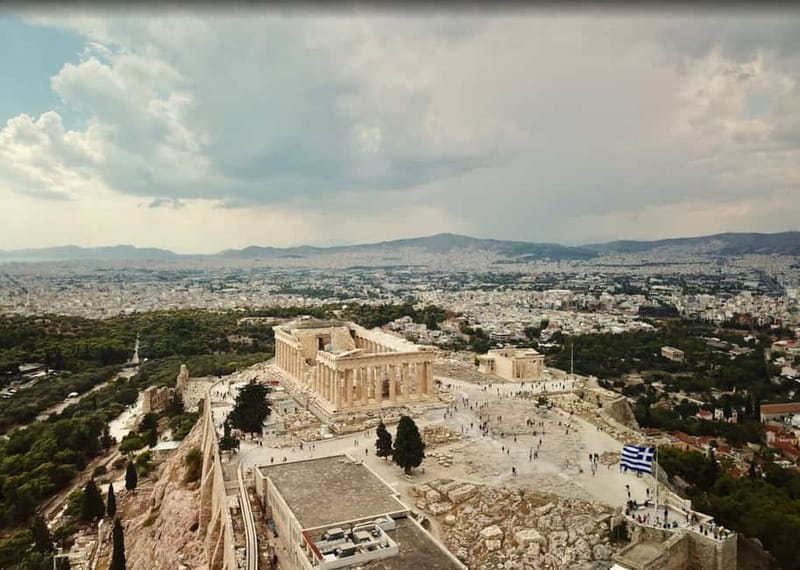
The tour has operated for 20 years and uses local licensed guides. The strongest part of the experience depends on the individual guide, but the feedback is consistently positive about clear English, pacing, and storytelling.
Eva has been praised for being warm, organized, and especially good with families. Maria kept children interested by using stories, while Victor used photographs and a personal style to make the monuments easier to understand. Antonis was noted for clear explanations and a comfortable pace, and Kalli brought Greek myths into the historical story.
You may also hear recommendations for places such as Filopappos Hill. That can be useful if you have only a short stay in Athens and want a good view after the tour.
A good guide also knows when to pause. One important practical issue is shade. Much of the Acropolis is open to the sun, and not every stopping point offers cover. Bring water, sunscreen, sunglasses, and a hat. The tour runs in rain or shine, so check the forecast and dress for the conditions.
Ticket choices and overall value
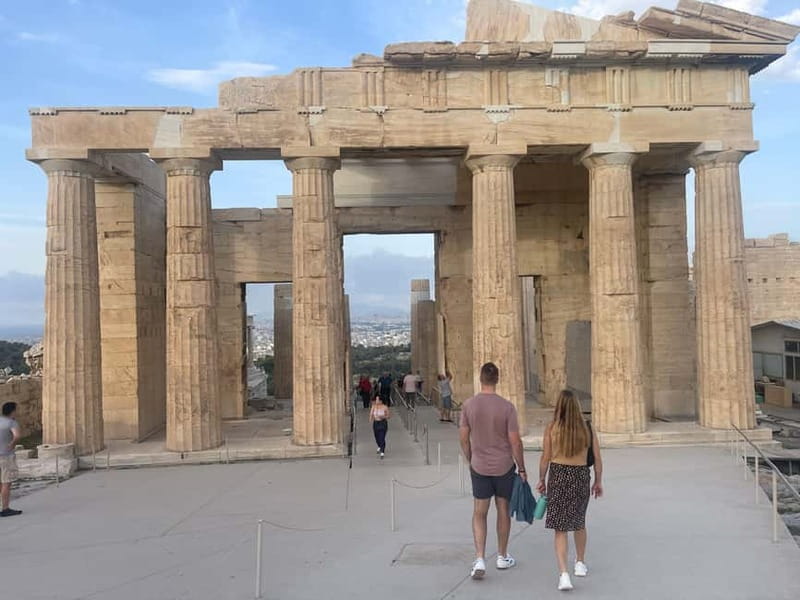
The advertised price is about $38.39 per person, but the final value depends on which ticket option you select. The basic guided experience includes the licensed guide, headphones, an Athens map, and an Athens Guide magazine. Acropolis admission is included only if you choose the option with tickets.
If you select the option without tickets, you must buy your own admission through the official website. Do this immediately after booking, and make sure the ticket date, time, and category match the tour. The tour enters the Acropolis soon after it begins, so buying the wrong ticket can prevent you from joining.
The ticket-included option costs more, but it removes a stressful task at one of Athens’ busiest sights. If you are comfortable handling official ticket sites and want to compare admission categories, the no-ticket option may suit you. If you have limited time or dislike coordinating timed entries, paying for the handled option is likely worth it.
On days with free Acropolis entry, the admission cost is deducted from the tour price. That is useful, but you still need to follow the scheduled entry time.
The optional Acropolis Museum package can also change the value. If you want the museum explained rather than visited on your own, adding the museum tour gives you a fuller day of ancient Athenian art and architecture. Check the exact booking option, since the museum entry and tour are not part of every version.
Who will enjoy this walk most
I would choose this tour if you are visiting Athens for the first time, have one day in the city, or want a clear introduction before exploring more on your own. The guide gives you a framework for noticing smaller temples, statues, myths, and views later.
Families can also do well with it, provided children are comfortable walking uphill in the heat. The stories help hold attention, and some guides use photos or visual comparisons to keep younger visitors involved. A two-year-old was managed successfully on one reported tour, but every family should consider the stone surfaces, sun, and strict timing.
This is less suitable if you want total freedom to linger at every ruin. You will follow a group schedule, and the guide must keep moving through a busy archaeological site. It is also not a good match for wheelchair users, people with mobility impairments, or anyone carrying large luggage.
For the best chance of a cooler experience, consider an early departure. A late afternoon tour may be appealing for light and photographs, but the Acropolis can still be crowded and hot.
Booking and practical preparation
Free cancellation is available up to 24 hours before the tour, and you can reserve now and pay later. That flexibility helps when your Athens plans may change, but it does not protect you from missing the timed entrance on the day itself.
Bring your passport or ID card, comfortable clothes, sturdy walking shoes, sunglasses, a hat, sunscreen, and water. Large bags and luggage are not allowed, and baby strollers are not permitted.
Security checks can take more than 30 minutes during peak season. Arriving early is not just polite to the group. It gives you a buffer for the meeting point, security, and the climb.
Should you book this Acropolis walking tour?
Yes, if you want the famous monuments to make sense rather than simply collect photographs. The south-slope route, local licensed guide, clear earsets, and broad city views give you more than a quick look at the Parthenon.
Choose the ticket-included version if you value ease and have a tight schedule. Choose the no-ticket version only if you are ready to buy the correct timed admission immediately. If you can handle the uphill walk, open sun, crowds, and firm start time, this is a well-priced way to get a thoughtful introduction to Athens’ most important ancient site.
FAQ
How long does the Acropolis walking tour last?
The tour lasts between two and three and a half hours. Check the available start times when booking because the exact duration can vary by option.
Where does the tour begin?
It begins at 3 Dionysiou Areopagitou Street. Look for the orange Athens Walking Tours sign near the pedestrian route from Hadrian’s Arch and Syngrou Avenue.
How early should I arrive?
Arrive 20 minutes before the scheduled departure. Timed Acropolis entry is strict, and the group cannot wait for late arrivals.
Is the Acropolis entry ticket included?
It depends on the option you choose. The with-tickets option includes Acropolis admission. If you select without tickets, you must buy your own ticket through the official website and match it to the tour date and time.
What sights are included on the route?
The route includes the Sanctuary and Theater of Dionysus, Asklepieion, Odeon of Herodes Atticus, Propylaea, Temple of Athena Nike, Erechtheion, and Parthenon. You also receive views toward several Athens landmarks and hills.
Is the Acropolis Museum included?
The museum entry and museum tour are included only if you select the option that specifically includes them.
Is the tour suitable for wheelchair users?
No. The activity is not suitable for wheelchair users or people with mobility impairments. Baby strollers and large bags are also not allowed.
New on the Athens shelf
- Small-Group Wine Tour in Athens with Tasting★ 5.0 · 33 reviews
- Acropolis of Athens, Parthenon and Acropolis Museum private tour with dinner★ 5.0 · 77 reviews
- Private Athens Transfer Airport/Port -Greek Tours-Hourly service★ 5.0 · 88 reviews
- VIP Private Guided Tour of Athens Acropolis & Plaka in a Sidecar★ 5.0 · 108 reviews
- Athens Moonlight Waling Tour with Drinks and Meze Dishes★ 5.0 · 259 reviews
- Private Athens Landmarks Layover Tour★ 4.5 · 41 reviews
- Departure Transfer from Athens City to Athens Airport★ 5.0 · 41 reviews
- Classic Athens Food Tour with Local Drink & Market Visit★ 5.0 · 34 reviews
Acropolis Tours, compared.
Acropolis & up to 5 Archaeological Sites Combo Pass
Read our verdict →

Acropolis, Parthenon & Acropolis Museum Guided Tour
Read our verdict →
Acropolis: Acropolis and Parthenon Guided Walking Tour
Read our verdict →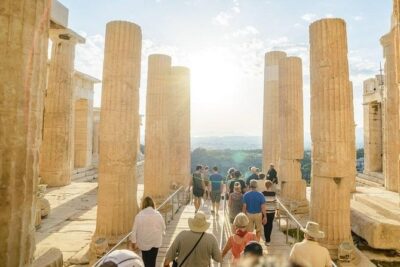
Acropolis monuments & Parthenon Walking Tour with Optional Acropolis Museum
Read our verdict →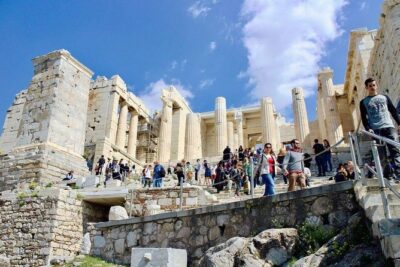
Athens All Included: Acropolis and Museum Guided Tour with Ticket
Read our verdict →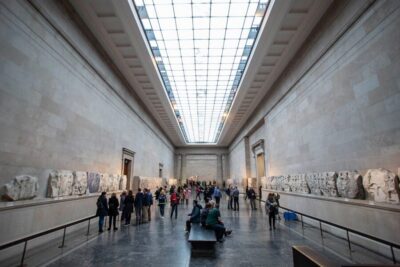
Acropolis Museum Ticket with optional Audio Guide
Read our verdict →Browse the lists this tour appears in