
Review · WALKING TOURS
Athens Highlights: Myths & Philosophers Walking Tour
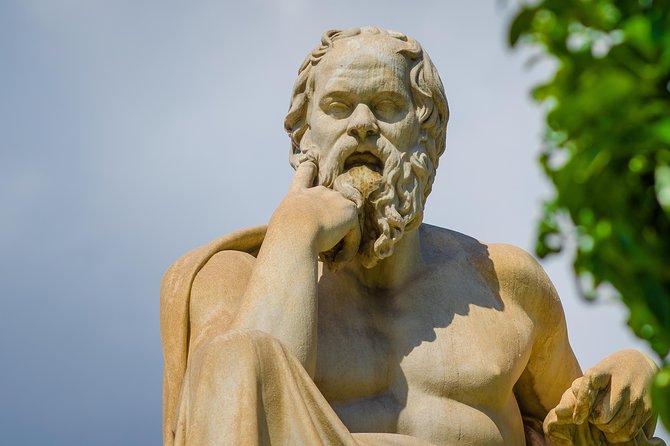
Athens becomes far more interesting when you stop treating philosophy as a school subject and start seeing it in the streets where these ideas took shape. This private four-hour walk connects Socrates, Plato, Aristotle, mythology, democracy, and everyday Athenian sights, ending on Areopagus Hill with a fine view of the Acropolis.
I like the private format, since you can ask questions without holding up a large group. I also like the way the route mixes famous landmarks with less formal conversation in gardens, squares, and old neighborhoods. The main drawback is the pace: four hours on foot, with several short stops, may feel long if your group wants a quick sightseeing circuit rather than sustained discussion.
Key points to know before booking
- Philosophy shapes the whole walk: Socrates, Plato, Aristotle, the pre-Socratics, Stoicism, Cynicism, ethics, physics, and astronomy all enter the conversation.
- Private guiding makes it flexible: Guides such as Bianca, John, Gianni, and Effrosyni have led this experience, with Bianca receiving especially strong praise for adapting to different ages and levels of interest.
- The route links modern and ancient Athens: You pass the Academy of Athens, Parliament, National Garden, Ermou Street, the Ancient Agora, Anafiotika, and Areopagus Hill.
- It is discussion-led, not just sight-led: You are encouraged to ask questions and exchange ideas rather than simply listen to a memorized speech.
- The final view is a fitting finish: Areopagus Hill gives you a clear look toward the Acropolis while the guide turns to myths of the Olympian gods.
- Plan for outdoor conditions: Admission is not included, the tour needs good weather, and comfortable walking shoes are a sensible choice.
Why this Athens walk feels different
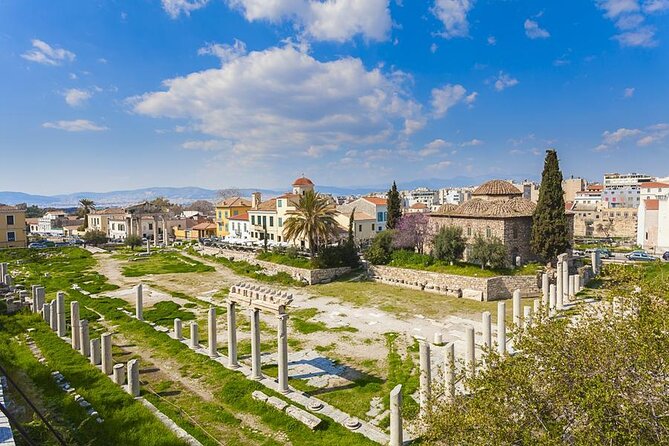
Many Athens tours organize the city around monuments. This one organizes it around ideas. The subject is not simply what a building looks like, but what people once argued about nearby: democracy, virtue, nature, the gods, the best form of government, and how a person should live.
That approach gives familiar places a second layer. The Hellenic Parliament becomes a chance to discuss Greek political traditions. The National Garden becomes a setting for physics, astronomy, and ethics. The Ancient Agora is linked to Stoicism, while the Tower of the Winds opens the door to Aiolos and the ancient effort to explain natural forces.
The strongest part of the experience is the conversation. The guide is not meant to talk at you for four straight hours. You can ask about Socrates, compare Plato with Aristotle, or pause over an idea that still applies to modern life. Past guide feedback describes Bianca as especially good at adjusting her explanations for mixed groups, including families with teenagers, couples, and people with little previous study of philosophy.
That flexibility matters. One person in your group may have taken a philosophy course, while another may know only that Socrates was an ancient Greek thinker. A private tour can meet both people at the right level. The guide may give a short explanation, then spend more time on a question that catches your interest.
More Mythology Tours in Athens
- Athens & Acropolis Highlights: Greek Mythology Small-Group Tour
★ 5.0 · 2,370 reviews - Athens: Acropolis and Mythology Highlights Small Group Tour
★ 4.8 · 2,275 reviews - Athens: Mythology Tour for Families
★ 4.8 · 173 reviews
Starting at the Academy of Athens
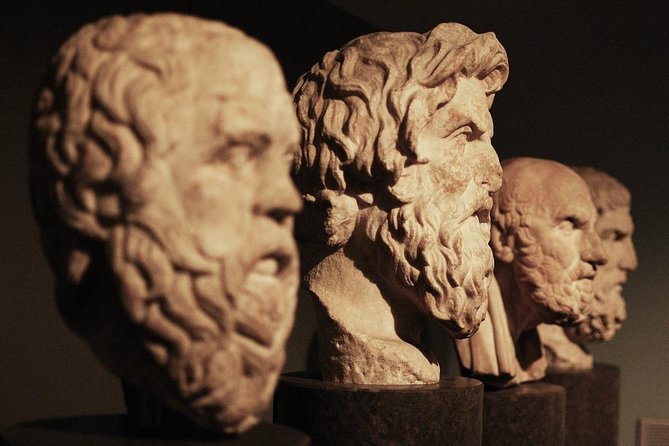
The meeting point is at Panepistimiou in central Athens, near the Academy of Athens. Your first stop lasts about 15 minutes and introduces the philosophical movements of ancient Greece while you view the Trilogy of Athens.
The Academy of Athens is a useful opening because it connects modern Athens with the intellectual tradition that made the city famous. You are not simply looking at a grand neoclassical building. You are starting a walk about how people tried to make sense of the world through reason, debate, observation, and moral thought.
The tour may also include a stop connected with one of the world’s great collections of coins, both ancient and modern. The supplied details do not give this stop a name or length, so treat it as an additional point along the route rather than a guaranteed museum visit with included entry.
No admission ticket is included at the Academy or other paid attractions. This tour is best understood as an outdoor walking experience with explanations from the guide, not as an admission package.
Parliament, guards, and the public life of Athens
At the Hellenic Parliament, you have about 15 minutes to see the Changing of the Presidential Guard. Admission is free, and the stop gives the walk a strong link to present-day Greece.
The guard ceremony is one of the country’s oldest public traditions. Here, the guide can place modern Greek civic life beside the ancient arguments about citizenship, government, and democracy. That connection is one of the tour’s clever features: you are not forced to separate ancient Greece from the city operating around you today.
The stop is short, so it is not designed as a full political history lesson. You will have time to watch the tradition and hear its historical setting, then continue toward the National Garden.
A shaded philosophy classroom in the National Garden
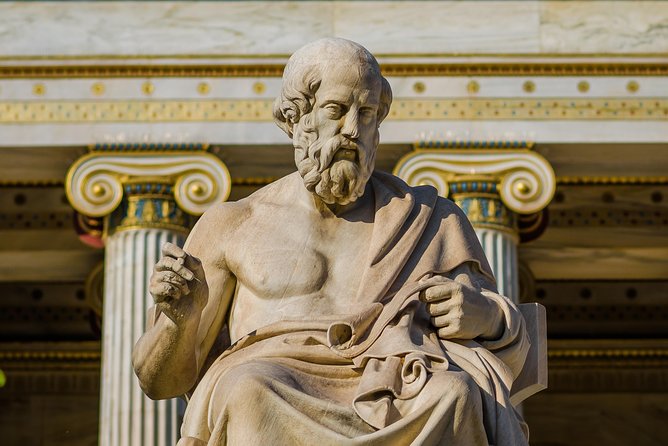
The National Garden is another 15-minute stop, focused on the Greek contributions to democracy, physics, astronomy, ethics, and other applied sciences. This is one of the places where the tour’s method works best. A garden offers a calmer setting for discussion than a crowded street.
The walk may pause in a shady spot, which is useful in Athens, especially during hot weather. The guide can use the surroundings as a place to discuss how early thinkers tried to understand the physical world and human behavior.
Do not expect a formal lecture with visual aids. The value here is the chance to stop, listen, and ask a question. If your group enjoys conversation, this can be more rewarding than rushing through a list of dates and names. If you prefer constant movement and major sights, the pauses may feel slow.
More Walking Tours in Athens
- Athens: Acropolis and Parthenon Guided Walking Tour
★ 4.6 · 5,882 reviews - Greek Food Walking Tour in Athens
★ 5.0 · 4,740 reviews - Acropolis: Acropolis and Parthenon Guided Walking Tour
★ 4.7 · 3,442 reviews - Acropolis monuments & Parthenon Walking Tour with Optional Acropolis Museum
★ 5.0 · 2,678 reviews
Hermes on Ermou Street
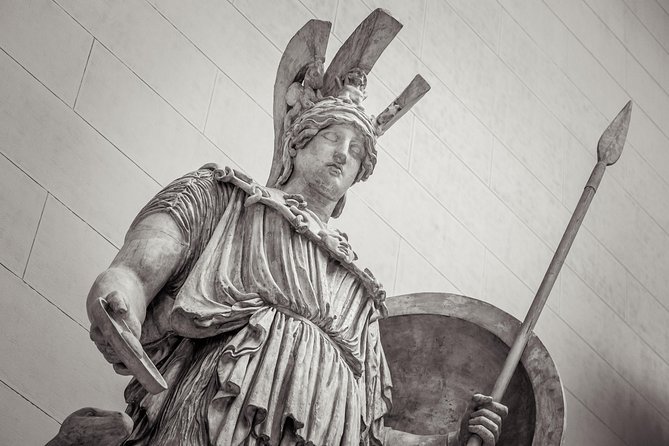
Ermou Street brings mythology into the modern city. The focus here is Hermes, the mischievous god associated with travel, messages, trade, and clever movement between worlds.
The stop lasts about 15 minutes and is free. It also breaks up the more academic parts of the tour. After discussing ethics or astronomy, you move into stories about a god with a livelier personality. That contrast helps keep the four-hour route varied.
Because this is a walking tour through an active central street, the experience here is about storytelling and atmosphere rather than entering a monument. You may find the modern setting makes the old myths feel less remote. Athens is not presented as a sealed archaeological site. Ancient names and stories appear in the middle of ordinary city life.
A square named for Pantanassa
The route includes a stop in an area named after the Church of the Pantanassa, located within the square. The supplied details do not list a duration or admission information for this point.
This is a useful reminder that the tour is not limited to the headline sights. Small urban details can explain how Athens has changed over time, with religious buildings, public squares, commerce, and ancient references layered close together. Ask your guide how this place fits the wider route, since the exact focus is not specified in the tour information.
The Ancient Agora and the birth of Stoicism
The Ancient Agora is one of the most important stops, even though the listed visit is only about 15 minutes. This was the civic center of ancient Athens, and the tour links it to the Poikile Stoa, where Stoic philosophy was born.
The word stoa refers to a covered walkway or portico. In the Poikile Stoa, Zeno of Citium taught ideas that became Stoicism. You do not need prior study to enjoy this section. The guide can explain how Stoic thought dealt with self-control, judgment, hardship, and the difference between what you can control and what you cannot.
Admission to the Ancient Agora is not included. That matters when you compare this experience with a ticketed archaeological tour. You may see the site from outside or enter at your own expense, depending on how the tour is conducted and what you choose to do. Confirm the plan when booking if entering the Agora is important to you.
The short listed stop also means the emphasis is on context rather than a long archaeological inspection. If you want detailed explanations of every ruin, inscription, and structure, you may need a separate Agora visit.
The Tower of the Winds and Aiolos
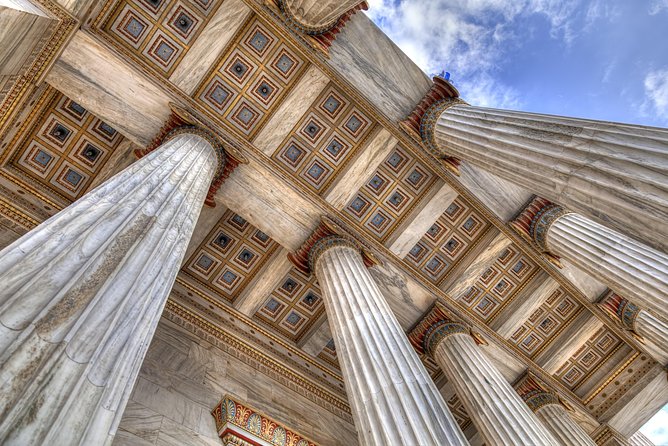
The Tower of the Winds is a compact but memorable stop. The tour allows about 15 minutes and does not include admission.
This ancient structure is used to introduce Aiolos, the keeper of the winds. Myth and observation meet here. The tower also suits the broader theme of the tour, since ancient Greek thinkers tried to explain the natural world through both stories and early scientific reasoning.
The stop is a good example of the tour’s range. You are not hearing only about famous philosophers. You are also being shown how mythology, astronomy, weather, and human curiosity overlapped in ancient thought.
As with the Agora, the price does not cover entry fees. If you are watching your budget, ask whether the stop is viewed from outside or whether the guide recommends paying to go in.
Anafiotika and the Cynic philosophers

In the Plaka area, the route climbs toward Anafiotika beneath the Acropolis. This section lasts about 20 minutes and is free.
Anafiotika is a striking part of the route because its small lanes and hillside setting feel removed from the broad avenues below. The subject here is the Cynic philosophers, whose ideas challenged social status, luxury, and artificial convention.
The spelling can be confusing: Cynic philosophy is linked to the Greek word for dog, not simply to modern cynicism. The guide can help separate the ancient school from the modern meaning of the word. This is exactly the sort of detail that makes a guided walk worthwhile.
The route toward Anafiotika may be uneven or uphill, so wear shoes you can comfortably use for several hours. The tour data says most people can participate, but the itinerary still includes a fair amount of walking and a climb toward the Acropolis.
Finishing on Areopagus Hill
The tour ends on Areopagus Hill, also called Mars Hill, at theorias in the Acropolis area. The final stop lasts about 15 minutes and is free.
This is an effective ending. You get a broad view of the Acropolis, then hear myths about the Olympian gods. After a walk through philosophy, politics, science, and urban history, the route returns to myth and the sacred world.
The hill is also a place to pause and reflect. The experience is designed to leave you thinking, not merely checking off one more monument. The view gives the guide a natural setting for tying together the city, its stories, and the ideas discussed along the way.
Because the tour ends here rather than returning to its starting point, plan your next move from the Acropolis and Plaka area. The route is one-way, from central Athens toward the historic center below the Acropolis.
The guides and the private format
Bianca is the guide named most often in the supplied feedback, and the descriptions of her teaching style are consistent: warm, energetic, able to tell a story, and comfortable turning the walk into a discussion. John is also praised for bringing myths and philosophy to life, while Gianni is described as carefully managing the timing of the route. Effrosyni is noted for her enthusiasm.
You should not assume you will receive a particular guide unless the operator confirms it. Still, these names give you a useful sense of the guiding style to expect: serious about the subject, but not stiff or classroom-like.
The private format is the real value here. Only your group participates, so the guide can adapt to your age range and interests. Families with teenagers have found the format useful because the conversation can shift as questions arise. Couples and solo visitors may appreciate the chance to talk without competing with a large group.
The four-hour length is both strength and limitation. It gives enough time for a real exchange, but it is not a quick orientation. One guide has extended the visit beyond the official duration when conversation continued, though you should not count on extra time. If your group has limited stamina, ask about pacing before you start.
Price, inclusions, and what you are really paying for
The price is $102.80 per person. Coffee or tea and bottled water are included, but personal expenses and entrance fees are not.
That is a substantial price for a walking tour, especially if you compare it with a large group city walk. The difference is that you are paying for a private guide and an experience built around discussion. The value rises if two or more people in your group are genuinely interested in philosophy, mythology, or ancient Greece.
Group discounts are available, which may improve the cost for a family or larger private party. The tour is offered in English and uses a mobile ticket. Confirmation arrives at booking.
I would not choose this walk mainly for the number of monuments. Several stops are only 15 minutes, and some sites may be viewed without included admission. I would choose it for the guide’s time, the ability to ask questions, and the unusual link between Athens sights and philosophical ideas.
Who should book this experience
This is a strong fit for:
- People who studied philosophy and want to connect ideas with Athens itself
- First-time visitors who want more than a standard monument checklist
- Families with older children, teenagers, or young adults
- Couples who enjoy discussion and a slower pace
- Visitors who already know the main sights and want a fresh way to see them
- Anyone curious about Socrates, Plato, Aristotle, Stoicism, Cynicism, or Greek myths
It is less suitable if you want a museum-heavy tour, a fast overview, or a route focused only on the Acropolis. The experience is also a poor match for very hot or wet weather, since it takes place outdoors and requires good weather to operate.
You receive free cancellation if you cancel at least 24 hours before the start time. Changes or cancellations within 24 hours are not accepted for a refund. If bad weather cancels the tour, you are offered another date or a full refund.
Should you book the Myths and Philosophers walk?
Book it if you want Athens to make you think as well as look impressive. The route covers famous landmarks, but its real purpose is to connect them with questions about how people live, govern, reason, and explain the world.
I would especially recommend it for a private family group or a couple who want a personal guide rather than a standard scripted walk. Bianca appears to be a particularly strong choice when available, though other named guides, including John, Gianni, and Effrosyni, are also associated with positive experiences.
Skip it if you mainly want entry to archaeological sites or a short introduction to Athens. At $102.80 per person, the price makes sense only when you plan to use the guide actively. Come ready to ask questions, and the four hours can become one of the most thoughtful parts of your stay.
FAQ
How long does the Athens Myths and Philosophers Walking Tour last?
The tour lasts approximately four hours.
Where does the tour start?
It starts at Panepistimiou, Athens 106 79, Greece.
Where does the tour end?
It ends at Areopagus Hill, Theorias 21, Athens 105 55, Greece.
Is this a private tour?
Yes. Only your group participates.
What language is the tour offered in?
The tour is offered in English.
Are entrance fees included?
No. Entrance fees to points of interest are not included, and personal expenses are also excluded.
Are drinks included?
Yes. Coffee or tea and bottled water are included.
Is the tour suitable for most people?
The tour information says most people can participate. Service animals are allowed, and the route is near public transportation.
What happens if the weather is bad?
The experience requires good weather. If it is canceled because of poor weather, you are offered a different date or a full refund.
New on the Athens shelf
- Acropolis of Athens, Parthenon and Acropolis Museum private tour with dinner★ 5.0 · 77 reviews
- Small-Group Wine Tour in Athens with Tasting★ 5.0 · 33 reviews
- Private Athens Transfer Airport/Port -Greek Tours-Hourly service★ 5.0 · 88 reviews
- VIP Private Guided Tour of Athens Acropolis & Plaka in a Sidecar★ 5.0 · 108 reviews
- Athens Moonlight Waling Tour with Drinks and Meze Dishes★ 5.0 · 259 reviews
- Private Athens Landmarks Layover Tour★ 4.5 · 41 reviews
- Departure Transfer from Athens City to Athens Airport★ 5.0 · 41 reviews
- Mercedes Transfer Athens Airport★ 5.0 · 26 reviews
Walking Tours, compared.

Acropolis: Acropolis and Parthenon Guided Walking Tour
Read our verdict →
Acropolis monuments & Parthenon Walking Tour with Optional Acropolis Museum
Read our verdict →
Knossos: Knossos Palace Skip-the-Line Guided Walking Tour
Read our verdict →

Athens Authentic Greek Food Walking Tour (Small Group)
Read our verdict →
Early Morning Acropolis & Old Athens Guided Walking Tour
Read our verdict →Browse the lists this tour appears in