
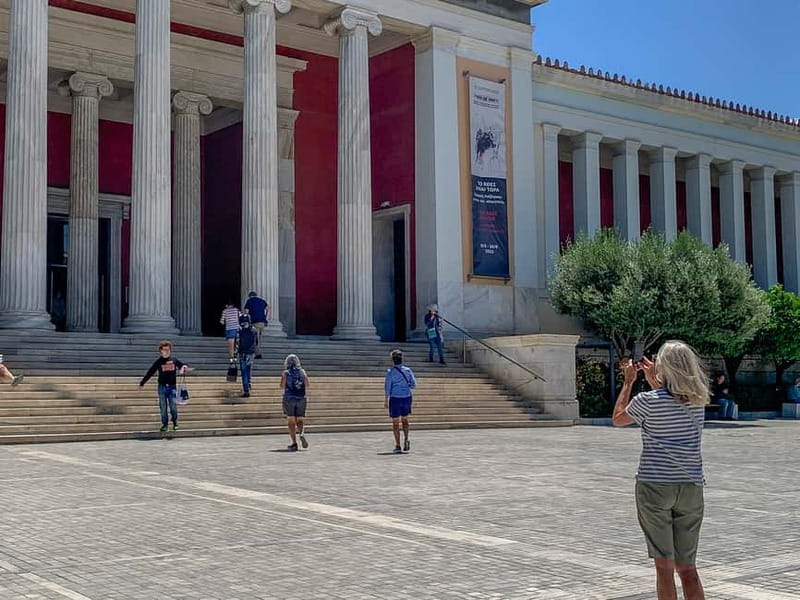
Review · MUSEUMS
National Archeological Museum Private Tour with Admission
The gold mask linked with Agamemnon, the Antikythera Mechanism, and the Cup of Nestor give this private visit plenty of famous sights, but the real strength is the guide’s explanation of why they matter. You meet at the museum’s main entrance, then spend two hours inside one of Athens’ great collections.
I like the private format, which lets your guide adjust the pace and subject matter for your group. I also like that admission is included and that the guide is a state-accredited archaeological expert, rather than someone simply reading labels aloud. The main drawback is price: at $199 per person, this makes the most sense for visitors who want close guidance, not those happy to browse alone.
Key points at a glance
- See major treasures in one focused visit: Agamemnon’s gold death mask, the Mycenaean gold hoard, the Antikythera Mechanism, and the Cup of Nestor are among the featured pieces.
- Shape the tour around your interests: Ask for mythology, ancient history, sculpture, one period, or simply the essential highlights.
- Meet at the museum’s main entrance: Your guide will carry a sign with your name and bring you back to the same spot.
- Enjoy a private two-hour tour: Your group receives the guide’s full attention instead of following a large shared party.
- Get skip-the-line admission: Museum tickets are included, which keeps the start simple.
- Expect a family-friendly approach: Commentary is adapted for all ages and is available in English, German, or Italian.
Why this museum deserves a guided visit
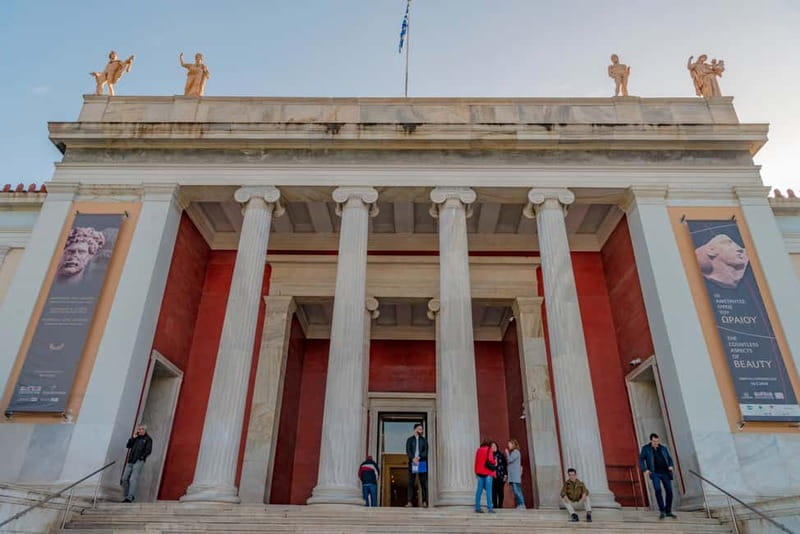
Athens has no shortage of ancient sites, but the National Archaeological Museum gives you something the ruins cannot: the actual objects. Here, you can look closely at gold, bronze, marble, pottery, jewelry, and scientific instruments created or used across many centuries of Greek history.
That range can also be a problem. A large museum filled with famous names is easy to approach without a plan and hard to understand without context. You may recognize Agamemnon’s mask or Poseidon’s statue, yet still miss the story of how the piece was found, what it tells us about its time, and where legend ends and evidence begins.
That is where this tour earns its place. Your guide can connect an object to ancient Greek mythology, political history, technology, or daily life. Instead of moving from case to case, you get a clear path through selected highlights.
The tour lasts two hours, a sensible length for a museum visit in Athens. It gives you enough time for the major rooms without asking you to spend half a day absorbing labels and marble figures. You can always stay longer afterward if a particular gallery catches your attention.
More Museum Tours in Athens
- Athens: Acropolis, Parthenon & Acropolis Museum Guided Tour
★ 4.8 · 9,316 reviews - Athens: Acropolis, Parthenon & Acropolis Museum Guided Tour
★ 4.8 · 3,579 reviews - Acropolis monuments & Parthenon Walking Tour with Optional Acropolis Museum
★ 5.0 · 2,678 reviews
Meeting your guide at the main entrance

The tour begins at the main entrance of the National Archaeological Museum. Your guide will hold a sign with your name, so the meeting point is straightforward. The activity ends back at this same location.
That simple arrangement matters in central Athens, where a busy sightseeing day can involve several meeting points and unclear directions. You do not need to find a separate office or arrange transport to the museum as part of this experience. You make your own way there, meet the guide, and begin inside.
Your guide is a state-accredited licensed archaeological expert. That qualification is useful here because the museum contains objects that need careful explanation. You are not just paying for someone to point out the famous pieces. You are paying for a person who can place them within ancient Greek history and mythology.
The tour is private, so the guide can speak to your group rather than to a crowd. If children are with you, the commentary can be adapted for younger listeners. If your group cares more about sculpture than mythology, you can say so at the start.
The first two hours: a focused route through ancient Greece
There is no promise of a fixed script, and that is one of the better features of the experience. The guide can build the visit around the main highlights or narrow it to a particular interest.
You might take a history-focused route, moving through major periods and showing how Greek art and society changed. You might concentrate on mythology, using gods, heroes, and legendary figures as a thread. You could also focus on sculpture, gold work, technology, or one specific part of the collection.
The flexibility helps different groups. A first-time visitor may want the essential sights and plain explanations. Someone who has already visited Athens may prefer a closer look at an area they missed. Families can ask for a lighter, more accessible presentation, while serious history fans can request more detail.
Two hours will not cover every gallery. That is not a flaw so much as a planning point. The museum is too large for a full treatment in a short private visit, so you should tell the guide what matters most to you. If you try to see everything, the tour may feel rushed.
Agamemnon’s mask and the Mycenaean gold

The gold death mask associated with Agamemnon is one of the museum’s headline objects. It has a powerful effect because it looks personal, not merely decorative. A human face appears through the gold, linking a famous name from Greek epic to the material remains of the Mycenaean world.
The guide can help you separate the object’s archaeological value from its place in later storytelling. Agamemnon is central to Greek mythology and Homeric tradition, but the exact identity of the person represented by the mask is a question that needs care. That mix of legend and archaeology makes the piece especially useful for a guided visit.
The Mycenaean gold hoard adds scale to the story. Instead of seeing one mask as an isolated treasure, you can view it alongside other gold objects and consider the wealth, craftsmanship, and burial customs of the period. The museum allows you to look at fine details that are easy to pass over when you are rushing toward the best-known display.
If ancient Greek legends are your main reason for visiting, this part of the tour should be near the top of your list. If you prefer firm historical evidence, the guide’s role becomes even more important, since the stories connected with these objects are not always the same as what archaeology can prove.
Close by, and nothing like it:
- Athens: Acropolis & up to 5 Archaeological Sites Combo Pass
★ 4.4 · 12,619 reviews - Athens: Acropolis Ticket with Optional Audio or Live Guide
★ 4.2 · 11,055 reviews - Athens: Acropolis and Parthenon Guided Walking Tour
★ 4.6 · 5,882 reviews - Athens, Piraeus, and Coastline: Blue Hop-On Hop-Off Bus
★ 3.9 · 4,849 reviews
The Antikythera Mechanism, ancient technology in a small object
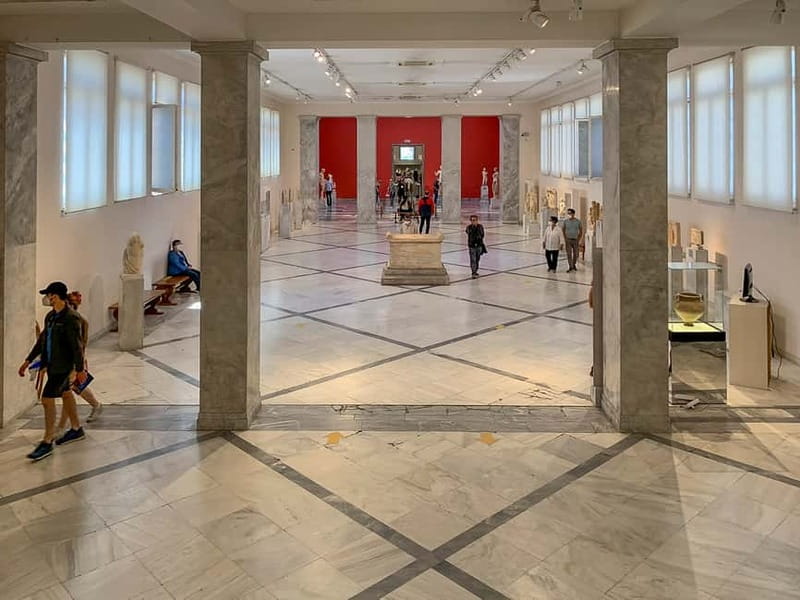
The Antikythera Mechanism is another major stop. This roughly 2,000-year-old device is often presented as one of the most remarkable objects in the museum because of its complex mechanical design.
You do not need to be a specialist to appreciate it. The basic question is enough to draw you in: how did an ancient maker produce such a sophisticated instrument? A guide can explain its importance in a way that connects technology with the wider ancient Greek interest in astronomy and measurement.
This is a good example of why a museum guide can add value beyond a label. A display case may identify the object and give a short description. Your guide can slow down, explain the key idea, and answer questions from your group. If this is the object you most want to understand, tell the guide before the tour begins so it receives proper attention.
The mechanism is also a useful break from gold and marble. It shows that ancient Greek achievement was not limited to temples, statues, and mythology. The collection includes evidence of engineering and scientific thought as well.
Cups, rings, and the human side of ancient Greece
The Cup of Nestor and the Ring of Theseus bring the tour back to smaller objects with strong links to ancient stories. A cup or ring can seem less impressive at first than a monumental statue, but these pieces often make the past feel more immediate.
A guide can explain how an object connects with a literary tradition, a hero, or a historical period. You get more than a name and a date. You begin to see how objects carried meaning, status, memory, or ritual importance.
These smaller works reward a slower look. In a large museum, it is easy to save all your attention for the largest sculpture. A private guide can point out the details that deserve a pause and explain why a small object has earned a place among the museum’s major treasures.
Aphrodite, Poseidon, and the power of Greek sculpture
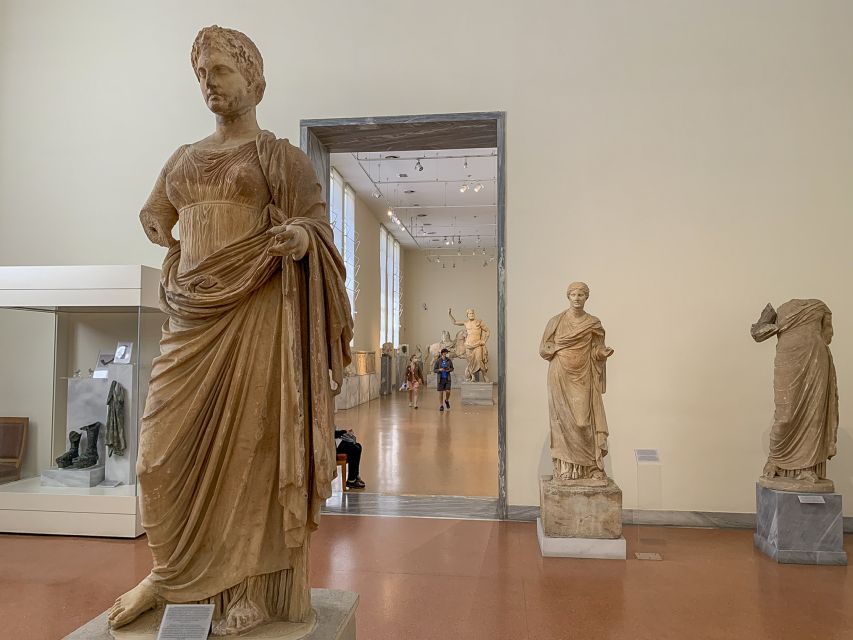
The museum’s sculpture collection supplies the visual high points of the visit. The statues of Aphrodite and Poseidon show the range of Greek artistic interests, from idealized human beauty to divine power and movement.
A guide can help you look at more than the subject. Notice the pose, the balance, the treatment of the body, and the way the sculptor suggests motion or presence in stone. Without some context, you may simply label one figure as beautiful and move on. With explanation, the sculpture becomes a record of changing ideas about gods, people, and the human form.
The sculpture section can suit a wide range of interests. First-time museum visitors get recognizable figures and clear stories. Art lovers can ask for more attention to style and technique. Children may respond well to the gods and heroes, especially when the guide connects the statue to a familiar myth.
The experience does not promise a specialist sculpture tour, so you should state your priorities clearly. If you mainly want the major statues, the guide can keep the route focused. If you want an equal balance of sculpture, gold, history, and technology, two hours will require some choices.
A neoclassical building with a calm garden
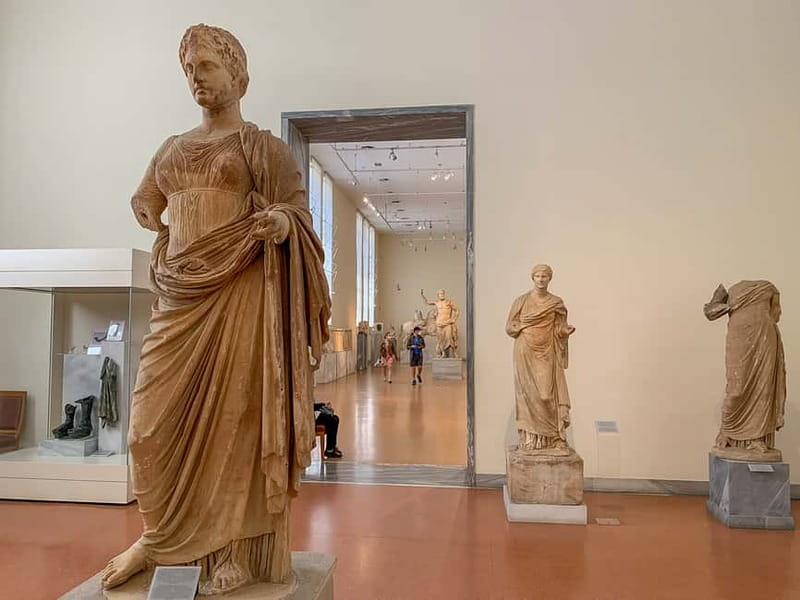
The museum is housed in a neoclassical building that has been recently renovated. The setting adds to the visit without competing with the collection.
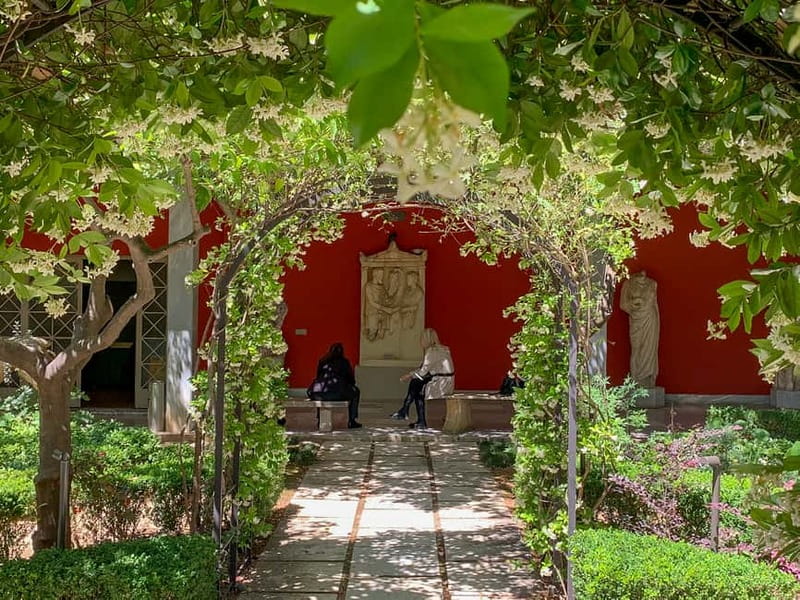
Exhibition rooms open toward a leafy inner garden, where mosaics and other artifacts are displayed around a café. This gives you a useful place to pause before or after the guided portion. It also softens the intensity of a museum visit, particularly if you are touring with children or combining the museum with a full day in Athens.
The garden and café are not separate tour stops with a scheduled activity, so do not treat them as part of the two-hour guided route. They are simply useful features of the museum itself. If you want time to sit or look around at your own pace, allow extra time beyond the tour.
How the private format changes the experience
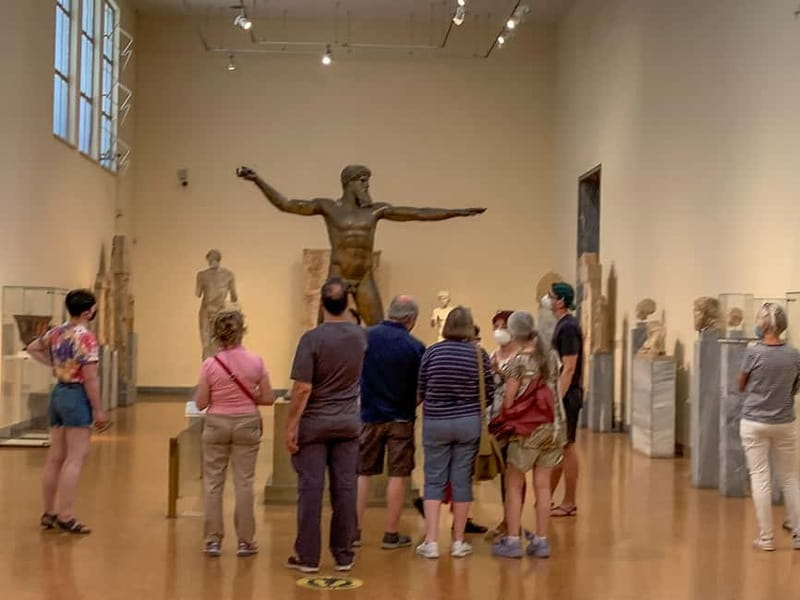
A private tour is most valuable when you use its flexibility. Tell the guide at the beginning if you want the main highlights, mythology, ancient history, sculpture, or one particular period. A private group also lets you ask questions without worrying about holding up a large party.
The commentary is designed for all ages. That does not mean every explanation will suit every person automatically, so be direct about your group. A family may need shorter explanations and more story. Adults with a strong interest in archaeology may want the guide to spend longer on dates, discoveries, and interpretation.
For groups of six or more, a whisper communication system is included. This helps your group hear the guide inside the galleries without requiring the guide to speak loudly. It is a small feature, but it matters in an active museum where sound can carry and nearby displays deserve quiet.
The private format also means you are not locked into someone else’s pace. The tradeoff is cost. At $199 per person, the tour is a serious expense for a solo visitor or couple. For a family or group that can share the benefit of one guide, the price may feel more reasonable, especially since admission is included and the visit is built around your interests.
Languages, access, and practical details
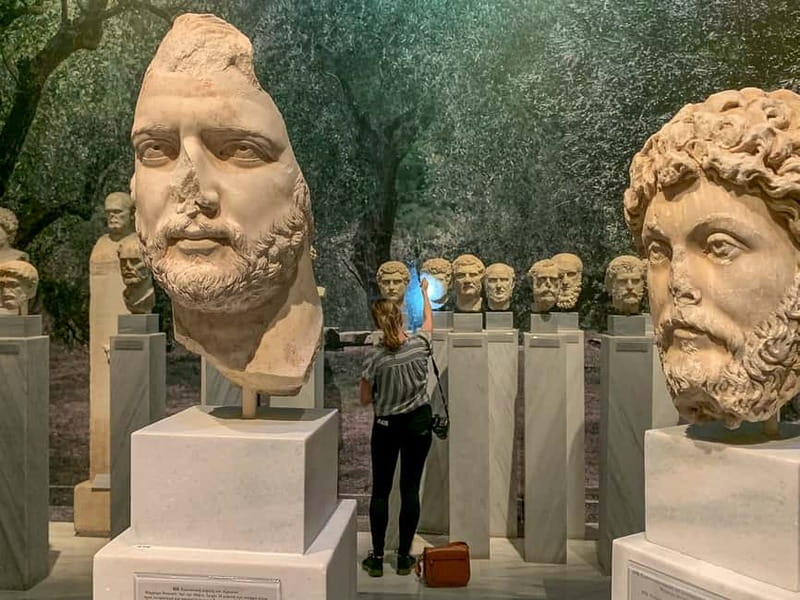
Guiding is available in English, German, or Italian. Choose the language that will let your group follow complex stories and ask questions comfortably.
The museum tour is wheelchair accessible. Pets are not allowed, so plan accordingly. Admission tickets are included, and skip-the-line entry is part of the arrangement, which removes one common delay at the start of a museum visit.
The activity lasts two hours, with starting times dependent on availability. Cancellation is allowed up to 24 hours in advance for a full refund, and you can reserve now and pay later. These terms are useful if your Athens schedule is still shifting, but you should still check the selected time before committing to other plans.
Who should book this museum tour?
I would recommend it most strongly to a first-time Athens visitor who wants the National Archaeological Museum to make sense, not just to see a few famous objects. It also suits families, museum newcomers, and small private groups with mixed interests.
The tour is a good fit if you want:
- A clear introduction to major ancient Greek objects
- Help connecting mythology with archaeology
- A private guide who can adjust the route
- A focused two-hour visit instead of an unplanned museum wander
- English, German, or Italian commentary
- Admission handled as part of the experience
I would think twice if you already know the museum well, prefer reading labels alone, or want to spend several hours examining every gallery at your own pace. You may get better value from a standard admission visit and your own route.
Should you book it?
Book this private tour if the National Archaeological Museum is important to your Athens plans and you want context for the objects you see. The strongest reason to choose it is not simply skip-the-line entry. It is the chance to shape two hours around Agamemnon’s mask, the Antikythera Mechanism, sculpture, mythology, or whatever your group finds most compelling.
At $199 per person, it is not the budget choice. But for a family or private group that wants a well-planned introduction, the guide’s archaeological training, included admission, flexible focus, and personal commentary can justify the cost. If you want an easy, focused way to understand the museum’s biggest treasures, this is a sound addition to an Athens visit.
FAQ
Where does the tour begin?
You meet your guide at the main entrance of the National Archaeological Museum. The guide will hold a sign with your name.
Where does the tour end?
The activity ends back at the museum’s meeting point.
How long does the tour last?
The guided tour lasts two hours. Starting times depend on availability.
Is admission included?
Yes. Admission tickets are included, and skip-the-line entry is provided.
Is this a private tour?
Yes. The experience is arranged for a private group.
Which languages are available?
The live guide can lead the tour in English, German, or Italian.
Can the tour accommodate wheelchair users?
Yes. The activity is wheelchair accessible. Pets are not allowed.
New on the Athens shelf
- Acropolis of Athens, Parthenon and Acropolis Museum private tour with dinner★ 5.0 · 77 reviews
- Small-Group Wine Tour in Athens with Tasting★ 5.0 · 33 reviews
- Private Athens Transfer Airport/Port -Greek Tours-Hourly service★ 5.0 · 88 reviews
- VIP Private Guided Tour of Athens Acropolis & Plaka in a Sidecar★ 5.0 · 108 reviews
- Athens Moonlight Waling Tour with Drinks and Meze Dishes★ 5.0 · 259 reviews
- Private Athens Landmarks Layover Tour★ 4.5 · 41 reviews
- Departure Transfer from Athens City to Athens Airport★ 5.0 · 41 reviews
- Classic Athens Food Tour with Local Drink & Market Visit★ 5.0 · 34 reviews
Museums, compared.
Mythology of Delphi, Museum and Arachova Guided Tour
Read our verdict →
Acropolis, Parthenon & Acropolis Museum Guided Tour
Read our verdict →
Acropolis monuments & Parthenon Walking Tour with Optional Acropolis Museum
Read our verdict →
Athens All Included: Acropolis and Museum Guided Tour with Ticket
Read our verdict →
Acropolis Museum Ticket with optional Audio Guide
Read our verdict →
Small-Group Delphi, Museum & Arachova Day Trip
Read our verdict →
Parthenon & Acropolis Museum with Audio or Live Tour Option
Read our verdict →
Acropolis, Parthenon and Acropolis Museum Guided Tour
Read our verdict →Browse the lists this tour appears in