
Review · MYTHOLOGY TOURS IN ATHENS
Mythology, Philosophy and Democracy Tour
Athens’ ancient stones make more sense when you connect them to the ideas born here. This walking tour follows that thread from mythology and blind faith to philosophy, early science, and democracy, using old streets and hills as its classroom.
I like two things right away. First, Panos gives the tour a clear purpose instead of simply pointing at ruins. Second, the route reaches places many first-time visitors skip, including Kerameikos and the Pnyx, then finishes with broad Acropolis views from Philopappos Hill.
The main consideration is pace and weather. You walk uphill in places, and summer heat can make three hours feel long. The tour is also discussion-heavy, so it suits curious minds better than anyone seeking a quick photo stop.
Key points to know before booking
- Pericles’ democracy speech: Visit the area linked to his famous funeral speech for Athenian soldiers.
- Panos leads the walk: Expect history, philosophy, humor, and questions rather than a simple monument tour.
- Small group format: The group is limited to 12 people, which gives the conversation a personal feel.
- Free-access sights: The advertised stops carry no separate admission charge.
- Two excellent viewpoints: The Pnyx and Philopappos Hill bring the Acropolis into view from different angles.
- Good first-day tour: The historical framework can help you understand Athens before visiting the Acropolis itself.
A walking tour built around ideas, not just ruins
Many Athens tours move from monument to monument. This one takes a different route. Its subject is the chain of ideas that shaped the city: gods and myths, questions about nature, political debate, written history, and the early development of democracy.
Panos is the key to the experience. His delivery combines serious historical detail with wit, and he encourages you to think about how ancient questions still touch modern life. You should expect a lively talk as you walk, with room for discussion rather than a memorized speech delivered at fixed points.
The group limit of 12 matters here. A small group makes it easier to ask about Socrates, Pericles, mathematics, religion, or the limits of Athenian democracy. It also helps the guide adjust the conversation to the interests of the people in front of him.
This is not a full archaeological tour of Athens. You will not spend long inside each site, and the stops are connected by city streets. The reward is the larger picture. By the end, you should have a better sense of how Athens moved from sacred stories toward questioning, observation, public debate, and political experiment.
More Mythology Tours in Athens
- Athens & Acropolis Highlights: Greek Mythology Small-Group Tour
★ 5.0 · 2,370 reviews - Athens: Acropolis and Mythology Highlights Small Group Tour
★ 4.8 · 2,275 reviews - Athens: Mythology Tour for Families
★ 4.8 · 173 reviews
Kerameikos and the place where democracy was praised
The tour begins near the Statue of Theseus and heads toward Kerameikos, one of Athens’ less obvious historic areas. The name refers to pottery, since ceramic workshops once occupied this part of the city. Kerameikos also served as Athens’ cemetery for centuries.
That mix gives the stop unusual weight. It was a working district, a burial ground, and a place tied to the public life of the city. Important Athenians were buried here, and the remains help show that ancient Athens was more than temples and marble columns. It was also a city of craftsmen, families, soldiers, and mourners.
The major story here concerns Pericles’ famous Epitaphios, or funeral speech, delivered for the first Athenian dead of the Peloponnesian War. The speech praised the city’s political system and the habits of its citizens. At this point, democracy becomes something more tangible than a modern textbook term. You are standing in a place connected with how Athens explained itself to its people.
The stop is scheduled for about 25 minutes. That gives Panos time to set up the central themes of the tour. Kerameikos is especially useful early in your Athens visit because it introduces the city as a community with competing values, not only as an ancient showpiece.
The Ancient Agora, where public life happened
From Kerameikos, the route continues to the Ancient Agora, the heart of Athens in the classical period. This was where citizens walked, met, argued, conducted business, and discussed public matters.
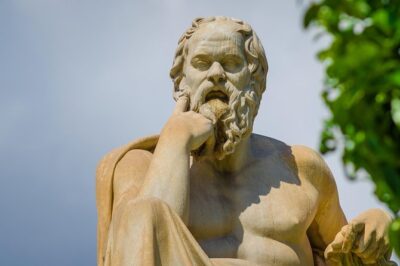
The Agora brings the tour’s philosophy theme into everyday life. Socrates, Plato, Solon, Themistocles, Pericles, Thucydides, Sophocles, and Aristophanes are all tied to the intellectual and political world that developed around Athens. The area was not a quiet study hall. It was a public place where ideas could be tested in conversation.
The planned stop is short, around 10 minutes, so do not expect a full archaeological-site visit. Instead, Panos uses the setting to explain how political thought and philosophy grew from public exchange. That approach is useful if you are visiting the Agora separately with more time, since you will know what questions to bring with you.
The route’s outdoor format also means your experience depends on the day. You may hear more than you see at some points, especially when ruins are viewed from outside or from a public path. The value lies in the interpretation and the connections between places.
Monastiraki, the Roman Agora, and the Tower of the Winds
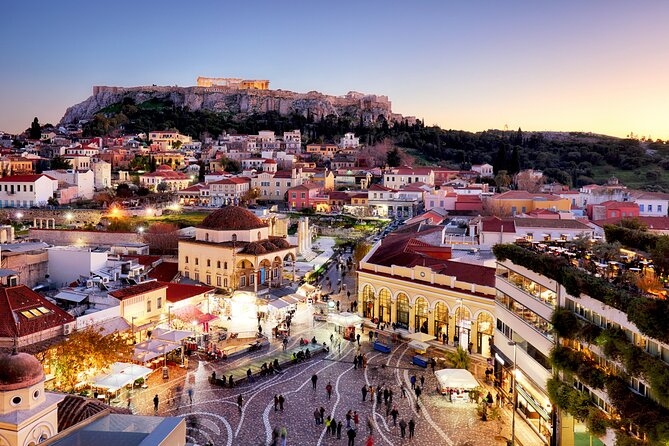
The walk then enters the more familiar center of Athens. At Monastiraki Square, you pass through the flea market area, with antique shops and tourist stores along the way. This is a brief stop, about 10 minutes, and it gives the route a change of mood.
I like this contrast. Ancient political thought is not separated from modern city life by a museum wall. You move through a working neighborhood and a shopping district before reaching more old monuments. The route shows Athens as a living city, not a preserved set of ruins.
The Roman Agora sits north of the Acropolis and east of the Ancient Agora. It reflects the later Roman period of Athens, when the city remained important but operated within a different political world. The stop is again short, around 10 minutes, so listen for the historical shift rather than expecting a long site inspection.
Nearby, the Tower of the Winds is one of the most memorable details on the route. This octagonal building was made in the first century BC by the astronomer Andronicus of Kyrristos. It served as a wind indicator, a solar clock, and a weather station.
On cloudy days, a hydraulic mechanism could mark the hour with sound. That detail gives the tower a practical edge. Ancient Athens was not only concerned with gods, heroes, and political ideals. People also measured time, watched the weather, and built machines to solve ordinary problems.
The Tower of the Winds is a strong stop for anyone interested in early science. It helps explain the shift described by the tour, from accepting traditional explanations to observing and questioning the natural world.
Close by, and nothing like it:
- Athens: Acropolis & up to 5 Archaeological Sites Combo Pass
★ 4.4 · 12,619 reviews - Athens: Acropolis Ticket with Optional Audio or Live Guide
★ 4.2 · 11,055 reviews - Athens: Acropolis, Parthenon & Acropolis Museum Guided Tour
★ 4.8 · 9,316 reviews - Athens: Acropolis and Parthenon Guided Walking Tour
★ 4.6 · 5,882 reviews
Hadrian’s Library and Plaka’s narrow streets

Hadrian’s Library was built by Roman Emperor Hadrian in AD 132, on the north side of the Acropolis. It was once one of the largest libraries in the world.
The stop lasts about 10 minutes. That is enough to place the building in the Roman story of Athens, though not enough for a long architectural study. You will also see how Roman Athens added new layers to a city already shaped by the classical age.
After the monuments, the route passes through Plaka. This scenic neighborhood is known for small houses and narrow, picturesque streets. Plaka is an easy place to appreciate the contrast between the formal ruins and the softer scale of later Athens.
The area can feel more relaxed than the archaeological stops, though the walking surface and narrow lanes call for comfortable shoes. The route is not described as difficult, but it is a walking tour with several stops, a later hill climb, and no guarantee that every part will feel effortless in hot weather.
The Pnyx, where citizens gathered to debate
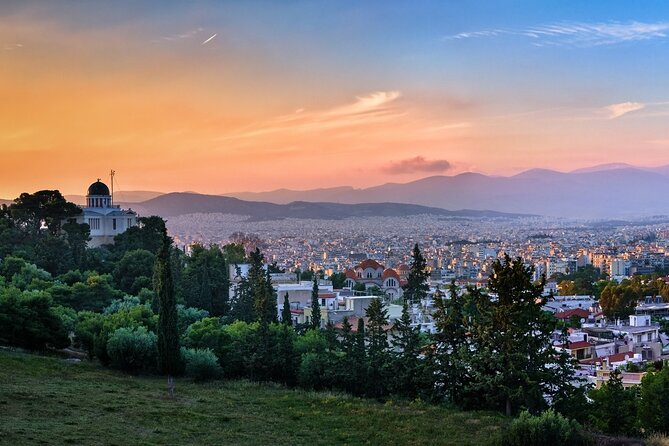
The tour’s political center comes at the Pnyx. This hill is associated with the world’s first parliament, and it offers a powerful setting for discussing Athenian democracy.
The Pnyx was where citizens gathered and took part in public decision-making. The site helps you picture democracy as a physical act: people walking to a hill, listening to speeches, judging arguments, and deciding what their city should do.
That does not mean ancient Athenian democracy matched modern democracy. The system excluded large parts of the population, including women, enslaved people, and others without citizenship. A good discussion here should leave you thinking about both the achievement and the limits of the system.
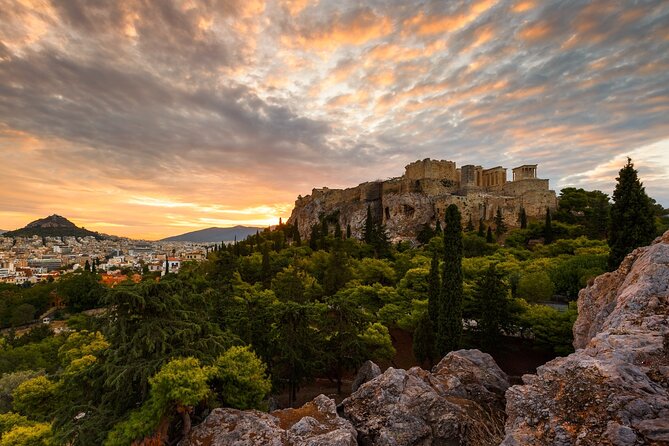
The Pnyx is also a fine place for late-day light and views. The tour notes its sunset appeal, though the exact light depends on the season and start time. If your walk takes place in strong summer heat, an evening departure can make a major difference. One family found an evening in June cooler and more pleasant than a daytime outing.
Philopappos Hill and the final view of Athens
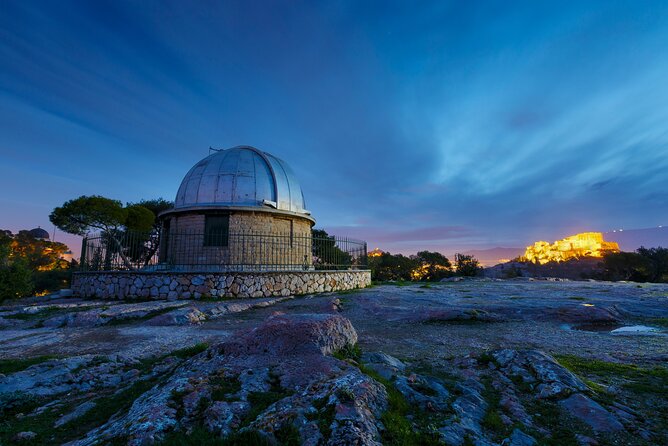
The final stop is Philopappos Hill, also called the Hill of the Muses. The scheduled time here is about 45 minutes, making it the longest stop of the tour.
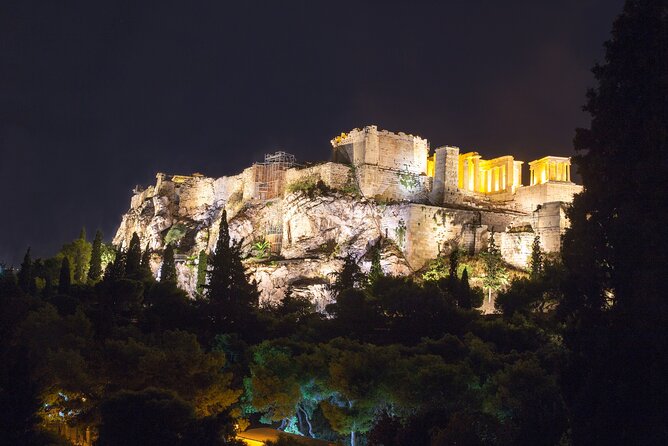
This is where the route pays off visually. From the hill, you get wide views toward the Acropolis and Athens, with especially attractive conditions after dark or near sunset. The final setting gives you time to absorb the city rather than rushing straight to another monument.
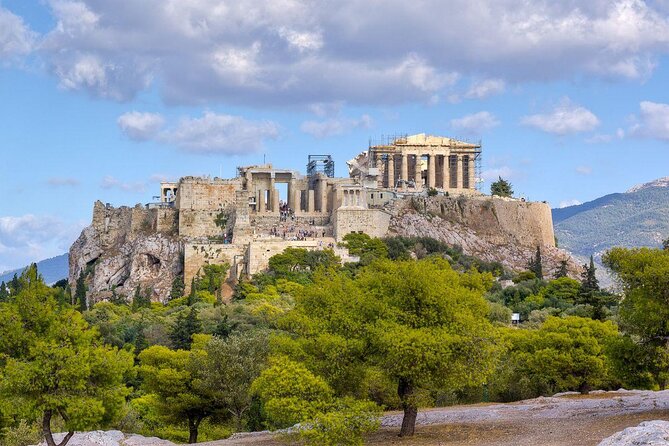
The hill is also a fitting place to end a tour about ideas. From above, the Acropolis, ancient neighborhoods, modern streets, and distant parts of Athens come together. You can see why this city became such a powerful symbol, while also remembering that its ancient life was made up of ordinary people, arguments, ambitions, wars, and practical work.
The route ends at Philopappos Hill rather than returning to the starting point. Plan your next move before setting out. The stated meeting point is the Statue of Theseus, and the end point is Philopappos Hill. Both are near public transportation, but the tour does not include a return transfer.
What the $50.69 price gets you

At $50.69 per person, the tour is not the cheapest way to walk around central Athens. You can visit many of these areas independently, and the listed stops have no separate admission charge.
The value comes from the guide’s framework. Without interpretation, Kerameikos can seem like a cemetery, the Pnyx like a rough hillside, and the Tower of the Winds like a small old building. Panos connects these places into a story about how people explained the world, organized power, and argued about what makes a good society.
For three hours, that is a fair price if you want context and conversation. It is less compelling if you mainly want entry to major archaeological sites or long stops for photographs. The tour is best understood as an intellectual walking experience with scenery, not as an admissions package.
The advertised duration is about three hours, though the route includes many stops and discussion. Some descriptions of the experience run closer to four hours, so keep your schedule flexible. The tour is offered in English and is usually booked well ahead, with an average booking time of 37 days before the date.
Who will enjoy this Athens experience most
I would choose this tour for you if you enjoy history that asks questions. It suits adults, older teenagers, university students, teachers, and families who want more than a list of dates. One family found it educational for children, while other participants appreciated the connections to mathematics, philosophy, and modern political problems.
It is also a smart choice before visiting the Acropolis. The tour gives you a working background in Athenian society, public life, religion, and philosophy. When you later see the Acropolis, you may look at it less as an isolated monument and more as part of a city with competing ideas.
You should think twice if you dislike walking, heat, hills, or extended discussion. The route is not a quick circuit. The guide may encourage you to reflect and respond, which some people find energizing and others may find slower than expected.
The tour welcomes service animals, is near public transportation, and allows most people to participate. Wear practical shoes, bring water, and consider an evening departure in hot weather. The experience depends on good weather, and if conditions cancel it, you are offered another date or a full refund. Cancellation at least 24 hours before the start time also allows a full refund.
Should you book the Mythology, Philosophy and Democracy Tour?
Book it if you want Athens explained through its ideas as well as its stones. Panos brings together mythology, early science, literature, political life, and philosophy in a way that gives the route a clear shape. The strongest moments are Kerameikos, the Pnyx, the Tower of the Winds, and the final view from Philopappos Hill.
I would place it early in an Athens visit, ideally before your Acropolis visit. You will pay mainly for interpretation, not entry tickets, so choose it for the guide-led conversation and small group setting.
Skip it if your priority is a fast sightseeing loop or a long interior visit at each archaeological site. For curious visitors willing to walk and think, this is one of the more useful ways to understand why Athens still matters.
FAQ
How long does the Mythology, Philosophy and Democracy Tour last?
The tour lasts approximately three hours. Because the route includes several stops and discussion, you should keep some flexibility in your schedule.
What is the price of the tour?
The listed price is $50.69 per person.
Where does the tour start?
The meeting point is the Statue of Theseus in Athens, Greece.
Where does the tour finish?
The tour ends at Philopappos Hill, also known as the Hill of the Muses.
Is the tour offered in English?
Yes. The tour is offered in English.
How large is the group?
The tour has a maximum of 12 participants.
Can I cancel for a full refund?
Yes. You can cancel at least 24 hours before the experience start time for a full refund. Poor weather or failure to meet the minimum number of participants can also lead to a different date or a full refund.
New on the Athens shelf
- Acropolis of Athens, Parthenon and Acropolis Museum private tour with dinner★ 5.0 · 77 reviews
- Small-Group Wine Tour in Athens with Tasting★ 5.0 · 33 reviews
- Private Athens Transfer Airport/Port -Greek Tours-Hourly service★ 5.0 · 88 reviews
- VIP Private Guided Tour of Athens Acropolis & Plaka in a Sidecar★ 5.0 · 108 reviews
- Athens Moonlight Waling Tour with Drinks and Meze Dishes★ 5.0 · 259 reviews
- Private Athens Landmarks Layover Tour★ 4.5 · 41 reviews
- Departure Transfer from Athens City to Athens Airport★ 5.0 · 41 reviews
- Classic Athens Food Tour with Local Drink & Market Visit★ 5.0 · 34 reviews
Mythology Tours in Athens, compared.
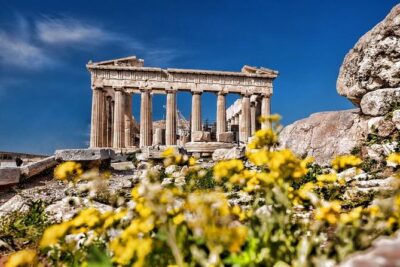
Athens & Acropolis Highlights: Greek Mythology Small-Group Tour
Read our verdict →
Acropolis and Mythology Highlights Small Group Tour
Read our verdict →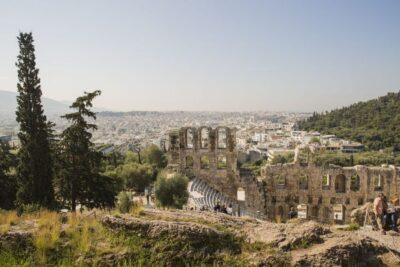
The History of Athens: Greek Mythology Private Tour
Read our verdict →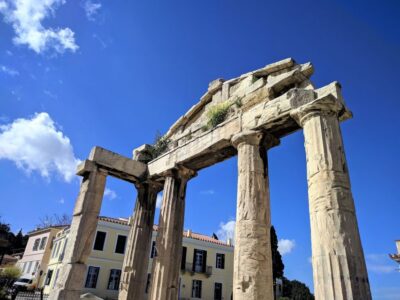
Athens Highlights: Myths & Philosophers Walking Tour
Read our verdict →
Greek Mythology Treasure Hunt for Kids – Athens Private Tour
Read our verdict →
Browse the lists this tour appears in