

Review · ACROPOLIS TOURS
Beat the Heat Acropolis Tour – Small group
The best reason to take this tour is its timing. An afternoon visit, often around 5 PM, can soften the fierce Athenian heat and bring golden light to the Parthenon and the city below. Small groups of up to 15 also make it easier to stay near your guide among the crowds.
I like the wireless headset, which lets you study the ruins without pressing close to the guide, and I like the way the route covers the Acropolis’s major monuments in only two hours. Guides such as Maria, Michalis, Athina, Calliope, Vicky, and Eleni have made this tour lively with myths, construction details, and stories tied to modern Athens.
The main catch is important: the Acropolis entry ticket is not included in the $54.44 tour price. You need a separate €30 ticket, and a long ticket line can make you miss the group if you arrive unprepared.
Key points to know before you book
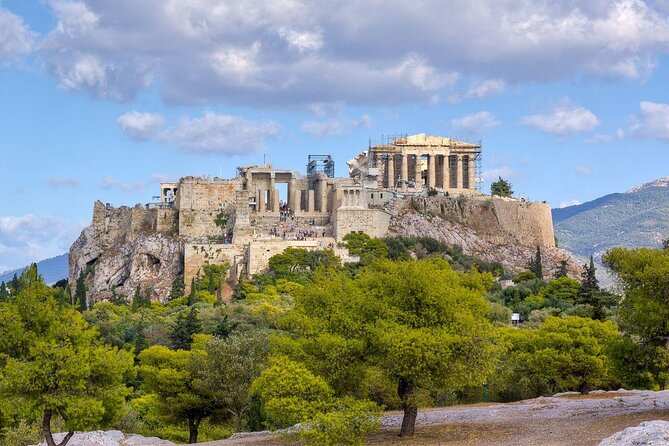
- The 5 PM timing can be a smart choice: You may get cooler air, softer light, and somewhat thinner crowds, though the Acropolis can still be busy.
- The group is capped at 15 people: That is small enough for personal attention without the price of a private tour.
- The route covers the essential monuments: You see the Theatre of Dionysus, Temple of Athena Nike, Erechtheion, Propylaea, and Parthenon.
- A wireless headset is provided: You can follow the guide while looking around, though crowd noise and guide volume can still matter.
- Tickets cost extra: The separate Acropolis admission fee is €30 per person, and entry fees cannot be refunded or exchanged.
- Good shoes are essential: Marble can be slippery, and the walk uphill includes steep sections.
Why an afternoon Acropolis tour makes sense
Athens can be punishing in summer. The Acropolis is an exposed rocky hill with little shade, and the pale stone reflects the sun from every direction. A later start will not magically empty the site, but it can make the climb easier and the views more pleasant.
The tour lasts about two hours, although one visit ran closer to two hours and 15 minutes. That is enough time for the main monuments without turning the experience into an all-day march. You will spend much of the time listening to explanations, stopping at key points, and walking over uneven stone.
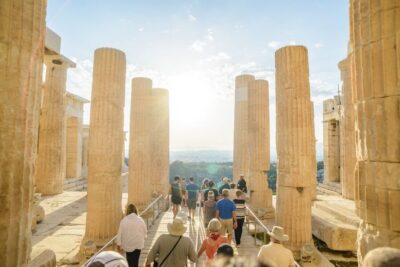
The afternoon timing also changes the mood. Instead of harsh midday light, you may see the Parthenon glowing at sunset, with Athens and the port of Piraeus spread below. The exact light depends on the season and the scheduled closing time, so do not book this tour solely for sunset. Still, the late slot is a strong choice if you want photos and cooler temperatures.
The Acropolis remains crowded even at 5 PM. One afternoon group found it less crowded than during the day, but still busy enough that hearing the guide required attention. The tour includes wireless headsets, a useful feature in theory and a major help when the site is noisy.
More Acropolis tickets and guided visits:
- Athens: Acropolis & up to 5 Archaeological Sites Combo Pass
★ 4.4 · 12,619 reviews - Athens: Acropolis Ticket with Optional Audio or Live Guide
★ 4.2 · 11,055 reviews - Athens: Acropolis, Parthenon & Acropolis Museum Guided Tour
★ 4.8 · 9,316 reviews
Meeting at Hadrian’s Arch

The tour begins at the Arch of Hadrian on Leoforos Vasilisis Amalias 50. This is a sensible meeting point because it places you near the Acropolis and gives you a clear landmark rather than an obscure office or hotel lobby.
There is no hotel transfer, so you need to reach the arch on your own. The meeting point is near public transportation. Plan to arrive early, especially if you need to collect or buy an entry ticket before the tour begins.
The organizer can pre-purchase Acropolis tickets for you for €30 per person. Use that option if available and suitable for your plans. The ticket issue is the single most important practical detail here. The admission fee is separate, and the tour cannot simply carry on without your entry ticket.
Bring an ID card or passport if anyone in your party is under 25. It may be needed for a possible discount. Entry fees are non-refundable and non-exchangeable, so check the details carefully before paying.
Theatre of Dionysus: where Greek drama began
The first stop is the Theatre of Dionysus Eleuthereus, usually given about 15 minutes. This is more than a pile of worn stone at the foot of the Acropolis. It was Athens’ oldest theatre and the place where works by Aeschylus, Sophocles, Euripides, and Aristophanes were first performed.
Your guide can help you picture the theatre as a working civic space rather than a quiet ruin. Dionysus was associated with wine and the grape harvest, and theatre grew from religious celebrations connected with him. The stop gives useful context before you climb higher, since it shows how performance, religion, and public life were linked in ancient Athens.
Do not expect a full theatre performance or a long stop here. Fifteen minutes is enough for an explanation and a look around, but not for a detailed archaeological study. The value comes from understanding that the Acropolis was not only about temples. It was part of a larger religious and cultural center.
Temple of Athena Nike: a small temple with a sharp idea
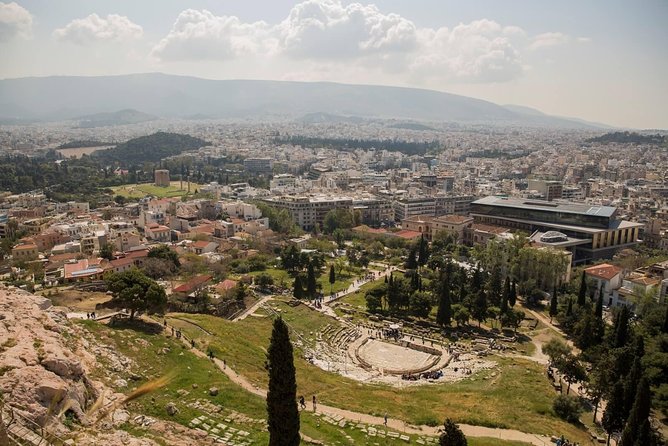
The Temple of Athena Nike receives another 15 minutes. This compact temple honored Athena in her form as a goddess of victory. Nike was the Greek goddess of victory, while Athena was also worshipped as a victorious war goddess.
The guide may explain the famous detail behind the temple’s cult statue. Athena Nike was said to have no wings, so she could never leave Athens. It is a memorable bit of ancient religious thinking, and it helps you see how closely the city connected its safety and success with Athena.
This is a small stop, but do not judge its importance by its size. The Acropolis is filled with grand structures, and a smaller temple can be easy to overlook without an explanation. Your guide gives it a proper place in the story.
A few more Athens options worth putting side by side
- Athens: Acropolis and Parthenon Guided Walking Tour
★ 4.6 · 5,882 reviews - Athens, Piraeus, and Coastline: Blue Hop-On Hop-Off Bus
★ 3.9 · 4,849 reviews - Greek Food Walking Tour in Athens
★ 5.0 · 4,740 reviews - Athens: City Sightseeing Hop-On Hop-Off Bus Tour
★ 4.3 · 4,520 reviews
Erechtheion and its unusual sacred spaces
The Erechtheion is one of the most interesting buildings on the hill. It was built to house the ancient wooden cult statue of Athena and to honor the city at the height of its power.
Its shape is less orderly than the Parthenon, and that difference makes it worth slowing down. The building had to accommodate several sacred traditions and uneven ground, so it does not present the same simple symmetry as the great temple nearby.
This is a good place to listen closely to the guide’s explanation of myths, worship, and the way ancient Athenians treated their most important religious objects. Guides such as Maria and the archaeologist who led one group have been especially good at explaining how the monuments may have looked and functioned in their own time.
The stop is scheduled for about 15 minutes. That is enough for the key points, but you will not receive a long, specialized lecture on every architectural detail. If you have a strong interest in archaeology, treat this as an introduction rather than a complete study.
Propylaea: the dramatic gateway
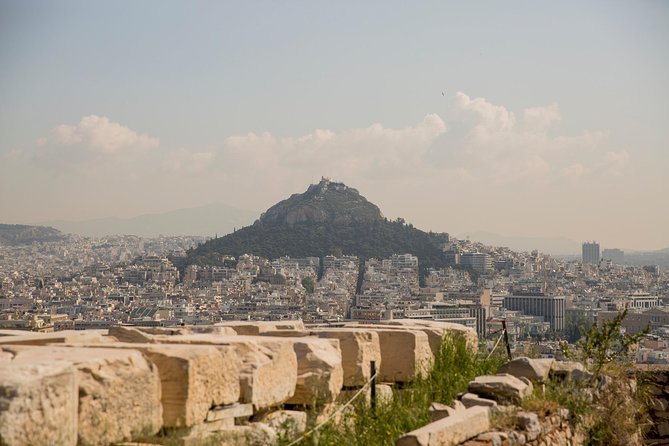
The Propylaea is the monumental entrance to the Acropolis. It is less famous than the Parthenon, but it gives you one of the clearest sensations of entering a special precinct.
The approach matters. You walk uphill toward a gateway built to make the arrival feel important, then pass through it into the central sanctuary. Your guide will usually explain how the entrance framed the experience and how the Acropolis was designed to impress people before they even reached the temples.
The route is not flat or effortless. The climb to the top is a real walk, and the stone underfoot can be uneven. Several people found the hike manageable when paced well, but you should wear shoes with a firm grip. Marble surfaces can be slippery, particularly around the upper terrace.
Large backpacks, big bags, and strollers are not allowed at the Acropolis and should not be brought on the tour. Pack lightly from the start. Service animals are allowed, and most people can take part, but the steep walk and slippery stone still deserve attention.
The Parthenon: the tour’s main event
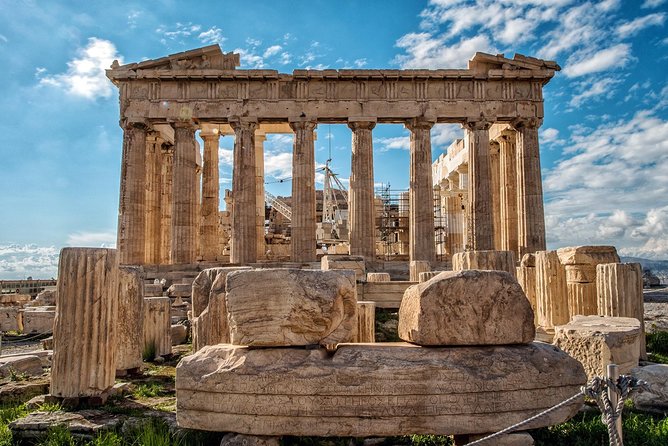
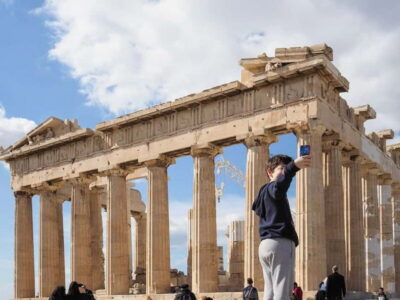
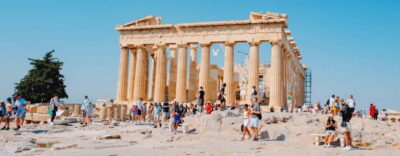
The Parthenon receives about an hour, making it the center of the experience. Built in the mid-5th century BCE, it was dedicated to Athena Parthenos, Athena the Virgin, and is widely regarded as the high point of the Doric architectural order.
The familiar image does not prepare you for the scale of the setting. Even in a damaged state, the temple dominates the hill and commands wide views over Athens. Your guide can point out the structure’s purpose, its connection to the city’s power during the Age of Pericles, and the design choices that make it so important.
The best guides turn the Parthenon from a famous photograph into a place with human decisions behind it. Maria has connected ancient stories with modern events. Michalis has used humor and energy to make the history easier to follow. Calliope has been praised for being organized and clear, while Vicky has brought patience and warmth to the explanations. Guide quality can vary from one departure to another, but the tour depends heavily on this personal storytelling.
The wireless headset should help you hear while looking at the columns, but do not assume it will remove every sound problem. One group found a soft-spoken guide difficult to hear in a packed area, and another found that crowd noise and extreme heat made it hard to concentrate. Stay within range of the guide and speak up if the audio is not working.
The group may pause often for explanations. That is useful if you want context, but it leaves less time for wandering alone. One person felt rushed near closing and had no free time at the top. If independent exploration matters more to you than guided interpretation, a self-guided visit may suit you better.
What the small group changes
The maximum group size is 15, though some departures have been smaller, including one with eight people and another with 11. This is not a private tour, but it is far more manageable than a large coach group.
A small group helps in three ways. You can stay close enough to hear, the guide can answer more questions, and the pace can adjust slightly to the people in front. It also makes movement through crowded paths less awkward.
The small format is particularly useful for families with older children and teenagers. One guide kept younger people engaged while explaining the main monuments, and another tour was described as a good short option for children in hot weather. At the same time, one person found the many information stops better suited to adults. I would choose this for children who enjoy stories and questions, not for very young children who need room to run.
You should also understand what small group does not mean. It does not guarantee an empty Acropolis, silence, or a private view of the Parthenon. At popular times, the hill remains full of people. The advantage is that you have a better chance of following one guide through the crowd.
Guide style and the value of the commentary
A two-hour Acropolis visit can easily become a blur of columns and names. A good guide gives the monuments a sequence and explains why they matter.
This tour has been led by guides including Maria, Michalis, Athina, Calliope, Christia, Michael, Stelios, Nikki, Vicky, and Eleni. Some have been archaeologists, while others have focused on myths, construction, and interactive explanations. That range matters because the same ruins can feel dry or memorable depending on how they are presented.
I especially like the mix of stories and physical details. You may hear why Athena Nike was portrayed without wings, how the theatre relates to Dionysus, and how the temples reflected Athens’ power. You can also expect help with photographs, answers to questions, and explanations of what the buildings may have looked like before centuries of damage.
The headset is a valuable inclusion because the Acropolis is open, windy, and noisy. Still, keep your expectations sensible. If the guide speaks softly or the crowd presses in, you may need to move closer. The equipment improves the odds of hearing clearly, but it cannot create quiet.
Price, ticket cost, and overall value
The tour costs $54.44 per person. The Acropolis admission ticket costs an additional €30 per person, unless your own ticket arrangement is different. That puts the total well above the advertised tour price, so calculate the full cost before you book.
Is it good value? I think it can be, especially if you want the main sites explained by a licensed English-speaking guide and prefer a small group. The fee pays for structure, interpretation, and a less stressful way to move through a complicated archaeological site. You also receive a fun map of ancient Athens.
The value is weaker if you mainly want free time, a quick photo stop, or the lowest possible cost. You are paying for the guide and the organized route, not for extra access or a private area. The separate ticket fee also means you need to compare the total with a self-guided visit.
The tour has been recommended by 95 percent of people who rated it, with an overall rating of 4.8 from 160 reviews. Those numbers suggest a strong record, but the practical details still matter more than the score. Buy or arrange the ticket early, arrive at Hadrian’s Arch with time to spare, and wear shoes that grip stone.
Who should book this Acropolis tour?
Book it if you want the major monuments explained in a compact two-hour visit, prefer an English-speaking guide, and like the idea of a small group rather than a large crowd. It is especially suitable for first-time visitors, couples, families with older children, and people who want the sunset-hour atmosphere without paying for a private guide.
The tour is also a good match for anyone who finds ancient sites hard to interpret alone. The Theatre of Dionysus, Erechtheion, and Propylaea can be overshadowed by the Parthenon, but a guide gives each a place in the story.
Think twice if you need a fully relaxed pace, extensive time for photography, or freedom to explore after the explanations. The climb is steep in places, the stone can be slippery, and the site may close before you have much time alone. Most important, do not book without planning for the separate entry ticket.
You can cancel for a full refund up to 24 hours before the start time. Within 24 hours, changes and cancellations are not accepted, and no refund is offered. Poor weather or failure to meet the minimum group size can lead to a different date or a full refund.
Final verdict: a smart guided introduction with one crucial warning
I would book this tour for a first Acropolis visit, especially in the late afternoon. The route is efficient, the group size is sensible, and the best guides make the gods, theatres, temples, and ancient building work feel connected rather than random.
The one rule is simple: handle the admission ticket before tour time. If you do that, wear sturdy shoes, bring only a small bag, and arrive ready for a climb, this is a practical way to see Athens’ greatest ancient site with useful context and a chance of cooler air and beautiful evening light.
FAQ
How long does the Beat the Heat Acropolis Tour last?
The tour lasts approximately two hours. One departure ran for about two hours and 15 minutes.
What monuments are included in the route?
The route includes the Theatre of Dionysus Eleuthereus, Temple of Athena Nike, Erechtheion, Propylaea, and Parthenon.
Is the Acropolis entry ticket included?
No. The Acropolis entry ticket is not included in the tour price. The operator can pre-purchase a ticket for €30 per person if you request it.
Where does the tour begin?
The meeting point is the Arch of Hadrian at Leoforos Vasilisis Amalias 50, Athens 105 58, Greece.
Where does the tour end?
The tour ends at the Acropolis of Athens.
What language is the tour offered in?
The tour is offered in English and includes an English-speaking licensed guide.
How large is the group?
The group can include a maximum of 15 people.
What should I bring or avoid bringing?
Wear shoes with good grip because the route includes steep sections and slippery marble. Do not bring strollers, backpacks, or large bags, as these are not allowed at the Acropolis. People under 25 should carry an ID card or passport for possible discounts.
New on the Athens shelf
- Acropolis of Athens, Parthenon and Acropolis Museum private tour with dinner★ 5.0 · 77 reviews
- Small-Group Wine Tour in Athens with Tasting★ 5.0 · 33 reviews
- Private Athens Transfer Airport/Port -Greek Tours-Hourly service★ 5.0 · 88 reviews
- VIP Private Guided Tour of Athens Acropolis & Plaka in a Sidecar★ 5.0 · 108 reviews
- Private Athens Landmarks Layover Tour★ 4.5 · 41 reviews
- Athens Moonlight Waling Tour with Drinks and Meze Dishes★ 5.0 · 259 reviews
- Departure Transfer from Athens City to Athens Airport★ 5.0 · 41 reviews
- Classic Athens Food Tour with Local Drink & Market Visit★ 5.0 · 34 reviews
Acropolis Tours, compared.
Acropolis & up to 5 Archaeological Sites Combo Pass
Read our verdict →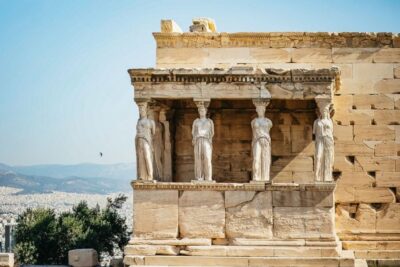
Acropolis, Parthenon & Acropolis Museum Guided Tour
Read our verdict →
Acropolis: Acropolis and Parthenon Guided Walking Tour
Read our verdict →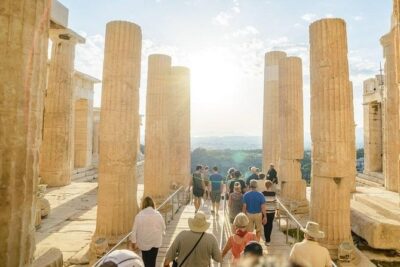
Acropolis monuments & Parthenon Walking Tour with Optional Acropolis Museum
Read our verdict →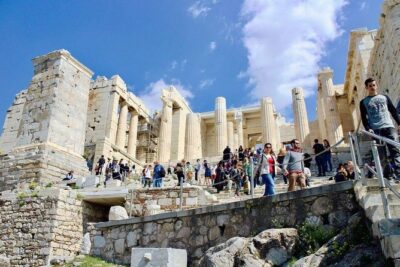
Athens All Included: Acropolis and Museum Guided Tour with Ticket
Read our verdict →Browse the lists this tour appears in