
Review · WALKING TOURS
Athens: History of Rebellion Walking Tour
Athens has an ancient face, but this walking tour asks you to look at its more recent one: a city shaped by rebellion, occupation, dictatorship, protest, and daily fights for social justice. You begin in Monastiraki, follow the route toward Syntagma, and finish in Exarchia, where politics is written on walls and argued in cafés, squares, and collective spaces.
I like the way the tour connects familiar places, such as the Hellenic Parliament and the Tomb of the Unknown Soldier, to the people and movements behind them. I also like the attention given to Exarchia, a neighborhood often reduced to a stereotype but presented here through its anarchist, refugee, LGBT+, artistic, and community life.
The main consideration is the subject matter. This is not a neutral highlights tour, and it may not suit you if you want to avoid politics or prefer ancient history. You will also walk and stand for about 2.5 hours, with no stated suitability for people with mobility impairments.
Key points to know before booking

- Follow Athens from Ottoman rule to present-day activism: The route links the Greek Revolution, fascism, occupation, protest, and modern social struggles.
- See Syntagma as more than a grand square: The Parliament, memorials, and surrounding streets become places tied to mass movements and political change.
- Spend the final section in Exarchia: Learn why this neighborhood matters to anarchists, refugees, artists, LGBT+ residents, and anti-gentrification activists.
- Expect a discussion-led tour: Maelle encourages questions, critical thinking, and conversation rather than simply listing dates.
- Get useful Athens advice afterward: Maelle has offered personal suggestions for food, shopping, sights, and places to visit elsewhere in Greece.
- Plan for a real city walk: Wear comfortable shoes, bring water, and use sun protection.
Why this Athens tour feels different
Many first visits to Athens focus on temples, marble, and classical mythology. Those are essential, but they tell only part of the city’s story. This tour shifts the focus to the last two centuries, when Athens became the capital of a modern state and faced occupation, dictatorship, economic strain, police violence, migration, and political protest.
I find that useful because modern Greece can otherwise feel like a collection of disconnected facts. You may hear about the Ottoman period, the Greek Revolution, the Second World War, the military junta, or the 2008 unrest without seeing how those events relate to the city around you. Here, streets and public squares provide the setting for that larger story.
The tone is serious at times, but it is not presented as a dry lecture. Maelle’s style, based on the information available about the experience, combines historical explanation with humor, personal insight, and questions for the group. The aim is to help you think about what you are seeing rather than simply memorize names and dates.
That approach suits curious visitors who want social and political context. It is especially useful if you have already visited the Acropolis and now want to understand the city beyond antiquity.
More Historical Tours in Athens
- Historic Athens: Small Group Electric Bike Tour
★ 4.9 · 740 reviews - The History of Athens: Greek Mythology Private Tour
★ 5.0 · 138 reviews - Athens Highlights by E-Bike: Small-Group Historic Tour
★ 5.0 · 131 reviews
Starting beneath Pantanassa Church in Monastiraki
The meeting point is in Monastiraki Square, in front of Pantanassa Church. Look for a guide holding a sign marked Athens City of Rebellion. The area is easy to recognize, but it is also busy, so give yourself enough time to find the church and guide without rushing.
Monastiraki is a fitting starting point. It is one of Athens’ best-known visitor areas, yet the tour uses it to take you back to a period when the city was under Ottoman rule. The opening section introduces resistance to Ottoman authority and the events that helped ignite the Greek Revolution roughly 200 years ago.
You get only a short formal stop in Monastiraki, listed at about five minutes, but the value is not in standing there for a long speech. It is in learning to read a familiar square through political history. The market streets and monuments become part of a story about power, freedom, and the creation of the Greek state.
If this is your first activity in Athens, the location is practical. You begin near a major central square and finish in one of the city’s most politically distinctive neighborhoods. If you have already spent time in Monastiraki, the historical framing gives the area a new angle.
From the Metropolitan Church to Syntagma
The route then passes the Metropolitan Church of Athens before moving toward Syntagma Square. This section appears to include a short passage by the church rather than a full interior visit, so do not book it expecting a church tour.
A brief stop at an unspecified location adds another layer to the walk. The exact place is not named in the supplied details, which is part of the tour’s character: some of its interest comes from sites that are less obvious to a casual passerby. You are not simply moving from one famous monument to another.
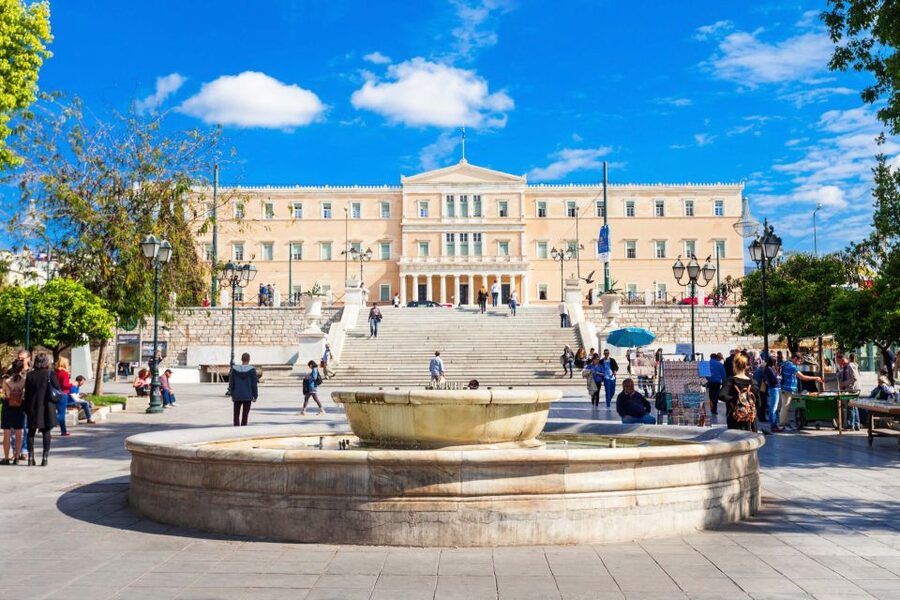
Syntagma Square receives a longer stop of about ten minutes. This is the political heart of present-day Athens, and the tour explains why. The square has been a setting for public protest and collective action, making it a useful place to discuss how ordinary people have challenged authority.
The stories include individuals who became symbols of resistance, as well as large popular movements formed in response to fascism, violence, and oppression. The focus is not only on famous leaders. The broader question is how a city’s residents respond when public life is under pressure.
That makes Syntagma more than a photo stop. You may already know it for the Parliament, buses, hotels, and ceremonial activity. This tour asks you to picture it as a place where political demands have been made in public, sometimes by enormous crowds.
Parliament and the Tomb of the Unknown Soldier
The Hellenic Parliament is another ten-minute guided stop. You will not be taking a parliamentary tour, but you will use the building and its setting to discuss modern Greek political history.
The nearby Tomb of the Unknown Soldier gets a shorter stop, around five minutes. Its importance lies in the way national memory, military symbolism, and public ceremony meet in one small area. The tour links this formal memorial space to wider questions about sacrifice, state power, and the people remembered by official history.
I like this contrast between grand institutions and less formal acts of resistance. The Parliament and tomb represent the state in a very direct way. The stories of protest and popular movements bring in the people who challenged, resisted, or reshaped that state.
The walk continues through Kolonaki, which is passed rather than explored in detail. That distinction matters. You should expect a route through the district, not a full neighborhood tour of its shops, architecture, or cafés.
More Walking Tours in Athens
- Athens: Acropolis and Parthenon Guided Walking Tour
★ 4.6 · 5,882 reviews - Greek Food Walking Tour in Athens
★ 5.0 · 4,740 reviews - Acropolis: Acropolis and Parthenon Guided Walking Tour
★ 4.7 · 3,442 reviews - Acropolis monuments & Parthenon Walking Tour with Optional Acropolis Museum
★ 5.0 · 2,678 reviews
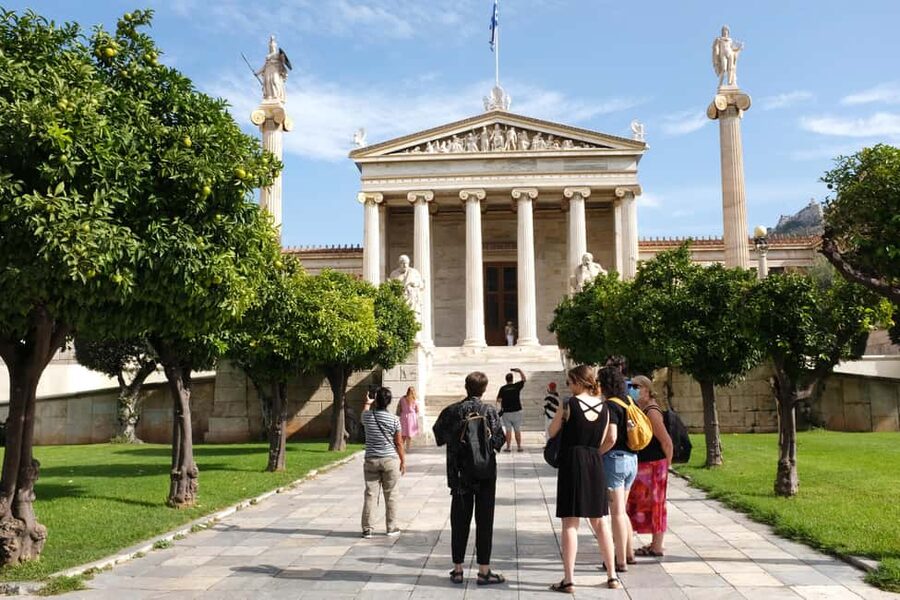
The Academy of Athens and the official story

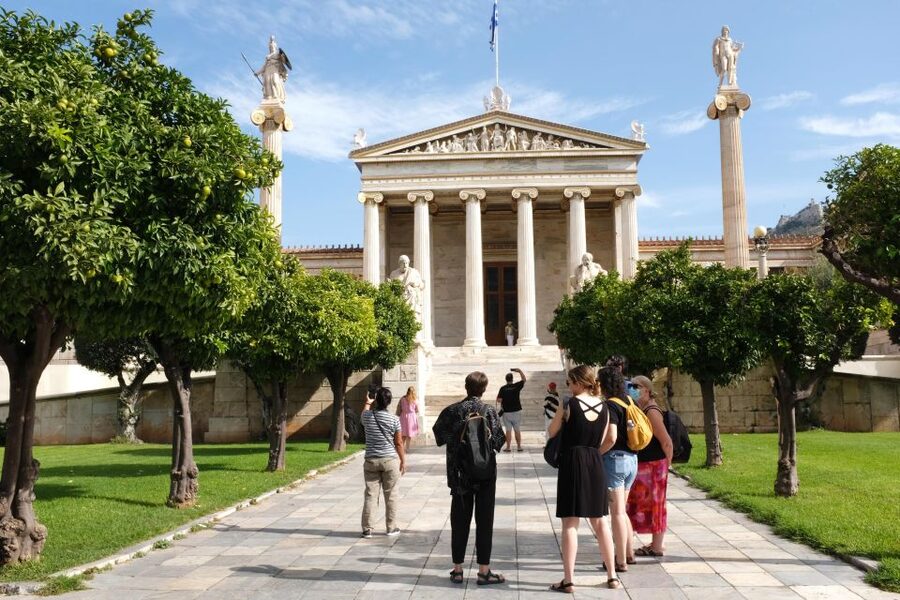
The Academy of Athens receives another guided sightseeing stop of about ten minutes. Its classical design and institutional role provide a strong setting for discussing how Greece presents its national identity.
The tour is especially useful here because public buildings often tell an official version of a country’s past. This walk adds voices that are less likely to appear on a standard architectural tour. You are encouraged to consider who gets remembered, who is left out, and how national stories change over time.
That does not mean the tour ignores famous places. It uses them as entry points. The Academy, Parliament, and Syntagma are familiar landmarks, but the discussion moves beyond what you can see in a guidebook photograph.
If you prefer architecture, archaeology, or art history without political discussion, this section may feel less satisfying. If you want to understand how monuments connect to power and memory, it should add useful context.
Entering Exarchia, Athens’ political neighborhood
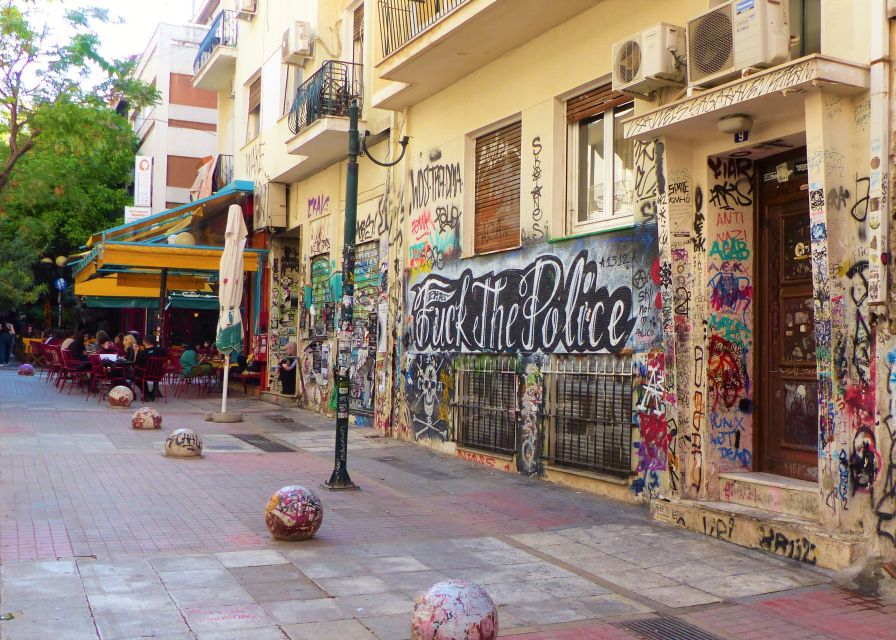
The final part of the walk takes you into Exarchia. This is the section many people will find most distinctive, because the neighborhood is presented as a living community rather than a curiosity for outsiders.
Exarchia is described through its role as a center for resistance and activism. The tour addresses anarchist groups, refugees, the LGBT+ community, artists, and residents involved in struggles over social justice. It also covers police repression, gentrification, and efforts to preserve a collectivist and activist way of life.
You will pass through several stops in the neighborhood, including two unnamed locations and Exarchion Square. The stops range from about five to ten minutes, but the guide’s explanations and group conversation are likely to shape the experience more than the clock.
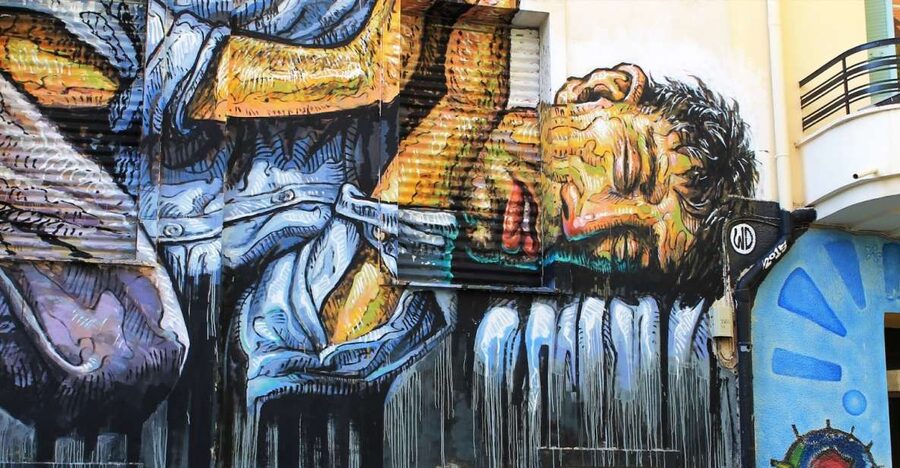
Street art is part of the discussion. One review of the experience specifically describes looking at work by the artist WD and using it to think critically about politics and society. That is a good example of how the tour works: graffiti is not treated as decoration alone, but as a public statement that can reveal conflict, identity, and local concerns.
You should also be prepared for a respectful approach to lived experience. The tour information stresses that Exarchia is a real community, not a display arranged for visitors. That matters in a neighborhood where outside attention can easily turn complex social issues into spectacle.
The district has a reputation for protest and tension, but the tour does not reduce it to that. It also presents creative energy, mutual support, and a mix of people and ideas. You may leave with a more complete sense of why Exarchia remains important to modern Athens.
A small-group format that encourages questions
Private and small-group options are available. That is a meaningful advantage for a subject that depends on discussion. In a large group, sensitive political questions can be difficult to ask, and the guide has less time to respond.
Maelle is the guide named in the experience details, and the strongest praise centers on her warm, personal delivery. She is described as clear, funny, patient, and willing to answer questions about history, politics, culture, everyday life, and street art.
The tour is not simply a speech delivered while you walk. The format encourages you to connect the places with larger ideas. You may find yourself discussing how resistance is remembered, why some movements are ignored, or how a neighborhood protects its identity.
That open style also means the experience may vary with the group. A small group that asks questions can get more out of the 2.5 hours than one that remains silent. If you want a tightly scripted tour with exact timing at every stop, this may feel more relaxed than expected.
What the $44.04 price gets you
At $44.04 per person, this is not the cheapest way to see central Athens. You are paying for a 2.5-hour guided walk rather than entry to a major monument, a meal, or transportation.
The value depends on what you want from Athens. If you are mainly looking for famous sights and photographs, you can see many of the route’s major landmarks independently. If you want a guide who can connect those places to modern Greek history and current political life, the price is more reasonable.
The personal recommendations add practical value. Maelle has provided suggestions for restaurants, shopping, sights, and places to visit in Athens and on the Greek islands. Those tips can help you use the rest of your trip better, especially if you are new to the city.
I would see this as a context-building tour. It works best alongside archaeological visits, not as a replacement for them. You get more from the Acropolis, the Agora, and central Athens when you understand that the modern city is not just a backdrop for ancient monuments.
Walking conditions and practical planning
Bring comfortable shoes, water, a sun hat, and sunscreen. The route includes outdoor walking and standing, and Athens can feel hot even when the distance seems manageable.
The experience is listed as unsuitable for people with mobility impairments. No detailed information is provided about step-free access, seating, or the exact walking distance, so ask the provider before booking if those points matter to you.
The tour is offered in English and French. It lasts 2.5 hours, with starting times that depend on availability. The listed finish is Plateia Exarcheion, although the meeting information also says the activity ends back at the meeting point in Monastiraki. Because those locations are not the same, confirm the final drop-off point before you go.
You can cancel up to 24 hours before the start for a full refund, and the reserve-now, pay-later option keeps your plans flexible. Those terms are useful if your Athens schedule is still changing.
Who should book this tour
I would book it early in an Athens visit if you care about modern Greece, social movements, or the way political history shapes daily life. The route can give you a stronger frame for the rest of your time in the city.
It is also a good fit if you have already seen the main ancient sites and want something less conventional. Couples, solo visitors, and small groups who enjoy conversation should get the most from it.
I would hesitate if you want a purely sightseeing-focused walk, dislike political topics, or need frequent sitting breaks. The content includes serious subjects, and the route is designed around walking and discussion rather than quick stops for photographs.
Should you book the History of Rebellion Walking Tour?
Yes, if you want to understand Athens as a modern city shaped by conflict, protest, memory, and community action. The strongest reason to book is the connection between familiar landmarks and lesser-told stories, especially in Exarchia.
The tour’s value rests heavily on the guide. Maelle’s style is personal, thoughtful, and open to questions, which helps difficult material feel approachable without turning it into a simple sightseeing script. Book it early if you want recommendations that can shape the rest of your stay.
Skip it if ancient Athens is your only interest or if you want to avoid political discussion. For curious visitors ready to look beyond the Acropolis, this is a focused and worthwhile way to meet the city’s modern side.
FAQ
How long is the History of Rebellion Walking Tour?
The tour lasts 2.5 hours. Starting times vary, so check availability when booking.
Where does the tour start?
The meeting point is in Monastiraki Square, in front of Pantanassa Church. The guide will hold a sign that says Athens City of Rebellion.
Where does the tour finish?
The route information gives Plateia Exarcheion as the finish. The meeting information also says the activity ends back at the meeting point in Monastiraki, so confirm the final location before the tour.
Which languages are available?
The tour is offered in English and French.
Is this a private tour or a group tour?
Private or small-group options are available.
What should I bring?
Wear comfortable shoes and bring water, a sun hat, and sunscreen. The activity involves walking and standing and is not suitable for people with mobility impairments.
New on the Athens shelf
- Acropolis of Athens, Parthenon and Acropolis Museum private tour with dinner★ 5.0 · 77 reviews
- Small-Group Wine Tour in Athens with Tasting★ 5.0 · 33 reviews
- Private Athens Transfer Airport/Port -Greek Tours-Hourly service★ 5.0 · 88 reviews
- VIP Private Guided Tour of Athens Acropolis & Plaka in a Sidecar★ 5.0 · 108 reviews
- Athens Moonlight Waling Tour with Drinks and Meze Dishes★ 5.0 · 259 reviews
- Private Athens Landmarks Layover Tour★ 4.5 · 41 reviews
- Departure Transfer from Athens City to Athens Airport★ 5.0 · 41 reviews
- Classic Athens Food Tour with Local Drink & Market Visit★ 5.0 · 34 reviews
Walking Tours, compared.

Acropolis: Acropolis and Parthenon Guided Walking Tour
Read our verdict →
Acropolis monuments & Parthenon Walking Tour with Optional Acropolis Museum
Read our verdict →
Knossos: Knossos Palace Skip-the-Line Guided Walking Tour
Read our verdict →

Athens Authentic Greek Food Walking Tour (Small Group)
Read our verdict →
Early Morning Acropolis & Old Athens Guided Walking Tour
Read our verdict →Browse the lists this tour appears in