
Review · WALKING TOURS
Athens: City Highlights Nighttime Walking Tour in Spanish
Athens is at its most atmospheric after sunset, when the Acropolis and ancient monuments glow above the city and the busy daytime streets cool down. This two-hour Spanish walking tour connects major sights with stories about Greek history, mythology, architecture, and the modern Olympic Games.
I like the easy-to-follow route from the National Library to Monastiraki, and I like having a Spanish-speaking guide such as Sara or Saraita explain the buildings along the way. The main consideration is that this is a sightseeing walk, not an interior visit, so attraction tickets are not included and some stops are viewed from outside.
Key points
- A strong first-night orientation: The route links central Athens landmarks from the National Library to Monastiraki, helping you understand the city’s layout quickly.
- Spanish-speaking guidance: Guides including Sara and Saraita have been singled out for clear explanations, useful recommendations, and lively anecdotes.
- Nighttime views: Illuminated sights, especially the Acropolis area, give the walk a different mood from a daytime tour.
- Modern Olympic connections: See Zappeion and the Panathenaic Stadium, two important places tied to the revival of the Olympic Games.
- Ancient and modern Athens together: The route moves from neoclassical institutions to the Parliament, Roman monuments, churches, and the Ancient Agora.
- Good value at $28: For two hours with a live guide, the price is fair, though admission fees are extra.
Why an evening walk works well in Athens
This tour uses Athens after dark to good effect. The city’s monuments take on a cleaner, more dramatic look when lit, and a walking route lets you connect places that can feel scattered when you see them one at a time.
You begin in the central area around the National Library and finish near Monastiraki Square, with the Acropolis in view from the Greek Agora. That direction matters. You are not simply taken to one famous monument and sent away. Instead, the walk gives you a broad introduction to Athens through government buildings, churches, Roman remains, Olympic landmarks, and ancient sites.
The tour lasts two hours, so expect a brisk overview rather than a slow archaeological visit. I would use it early in your stay, especially if you want to get your bearings before exploring Athens on your own. A Spanish-speaking guide can also help you understand the names, myths, and political history that can otherwise blur together.
A 4.8 rating from 101 bookings suggests a consistently strong experience, and the praise centers on the guide’s explanations. Sara is mentioned several times, with specific appreciation for her professionalism, anecdotes, historical knowledge, and practical recommendations. One participant also noted that the tour worked well for a Spanish-speaking couple traveling together.
More City Tours in Athens
- Athens: City Sightseeing Hop-On Hop-Off Bus Tour
★ 4.3 · 4,520 reviews - City Sightseeing Athens, Piraeus & Beach Riviera Hop-On Hop-Off Bus Tours
★ 4.0 · 1,887 reviews - Athens: City Highlights Bike tour
★ 4.9 · 453 reviews
Starting beneath the National Library sculpture
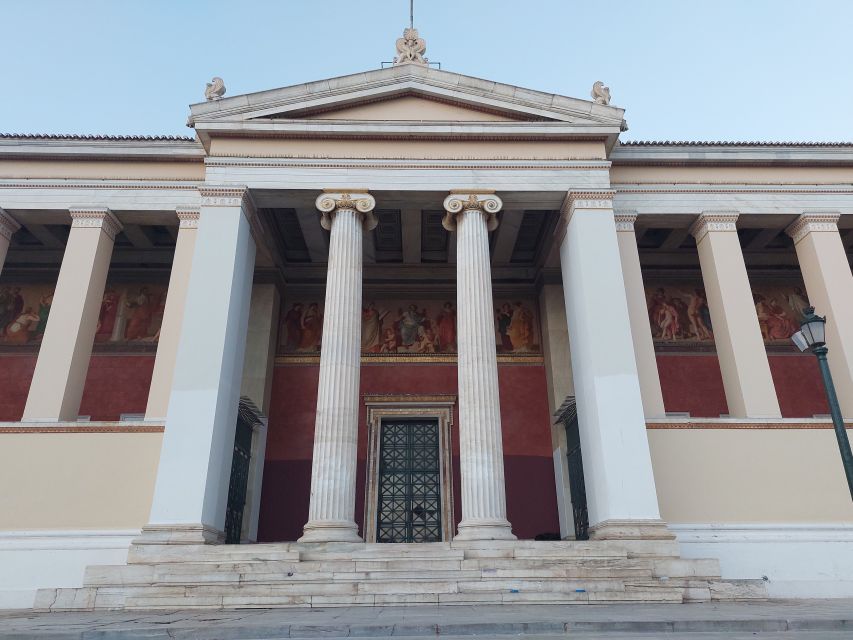
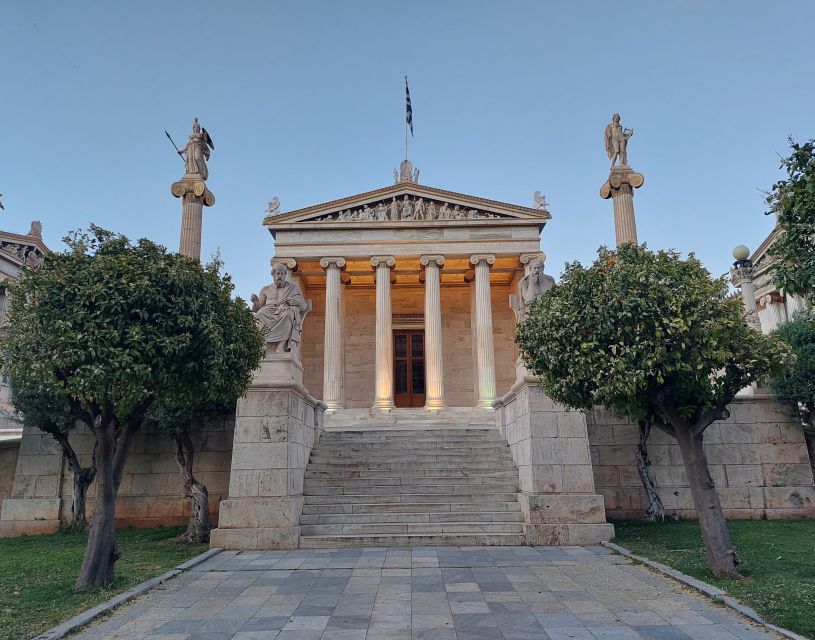
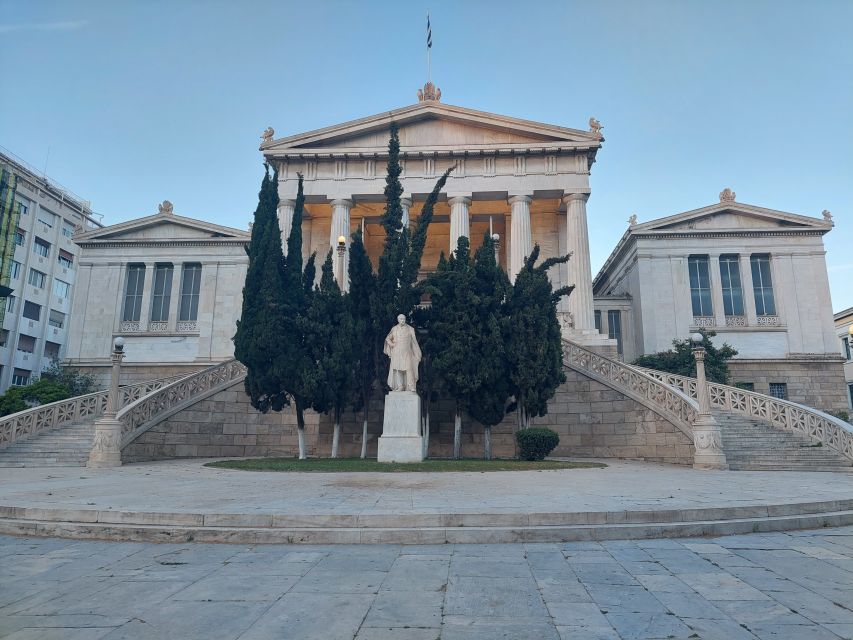
The meeting point is just below the sculpture of Panagiotis Vallianos, under the stairs of the National Library of Greece. This is a precise place to look for your guide, but give yourself enough time to find the correct side of the building.
The National Library forms part of Athens’s famous neoclassical trilogy, along with the University and the Academy of Athens. These buildings introduce an important side of the city that is easy to miss if you focus only on ancient ruins.
The opening section is especially useful because it shows how modern Greece presented itself through architecture. The grand facades reflect the country’s effort to connect its new national identity with the ideals of classical Greece. Your guide can help you read the columns, statues, and formal design instead of treating them as impressive backdrops only.
This is also a good place to settle into the tour. The route begins with public institutions and broad historical themes, then moves toward squares, royal-era monuments, Roman ruins, churches, and the old market district.
The University and Academy of Athens
The University and Academy continue the neoclassical story. From the outside, you will see how Athens used classical forms to give its capital a serious, European character.
This part of the walk is best for travelers who enjoy architecture and urban history. The buildings are not just decorative. Their design tells you how nineteenth-century Greece wanted to be seen, and why ancient Athens remained central to the country’s public image.
The guide’s role matters here. Without explanation, the trilogy can look like three grand facades on a broad avenue. With context, the buildings become part of the story of modern Greece, its institutions, and its connection to the ancient world.
The tour does not list interior visits, so plan to admire the buildings from outside. If you want to see collections or enter specific monuments, you will need separate plans and tickets.
Syntagma Square and the Evzones
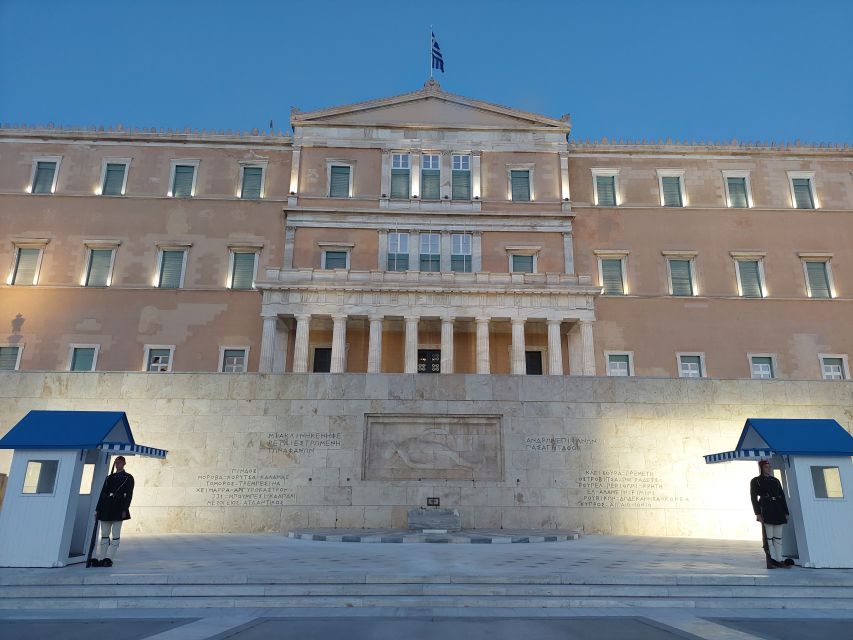
The next major stop is Syntagma Square, the political heart of Athens. Here you will see the Greek Parliament and the presidential guard, known as the Evzones.
The Evzones are one of the city’s most recognizable sights. Their formal uniforms and ceremonial role add a strong national character to the stop, while the Parliament connects the square to present-day Greek government.
Syntagma is a useful point of contrast with the neoclassical trilogy. The earlier buildings express education and culture. Here, the subject shifts to politics, national identity, and public life.
The guide will explain what you are seeing, but this is still a public square rather than a scheduled ceremony or interior tour. The supplied details do not promise a specific guard-change time, so do not book this walk solely for that event. Think of Syntagma as one stop within a larger route.
More Walking Tours in Athens
- Athens: Acropolis and Parthenon Guided Walking Tour
★ 4.6 · 5,882 reviews - Greek Food Walking Tour in Athens
★ 5.0 · 4,740 reviews - Acropolis: Acropolis and Parthenon Guided Walking Tour
★ 4.7 · 3,442 reviews - Acropolis monuments & Parthenon Walking Tour with Optional Acropolis Museum
★ 5.0 · 2,678 reviews
Zappeion and the Olympic story

From Syntagma, the route continues through the National Gardens toward Zappeion. The building is tied to the original Olympic Village and adds a less obvious chapter to Athens’s Olympic story.
Zappeion is valuable because it broadens the usual Olympic picture. Many people know the Panathenaic Stadium, but Zappeion shows how the revived Olympic movement was connected to civic buildings and public spaces as well as athletic competition.
The walk then reaches the Panathenaic Stadium, also called the Panathinaiko Stadium. It is identified as the first stadium of the modern Olympic Games, and its white marble form is one of Athens’s most memorable sights.
The evening setting should make the stadium feel different from a bright midday visit. You can appreciate its shape and scale without turning the stop into a full stadium tour. Attraction tickets are not included, so the focus here is an exterior view and the guide’s explanation.
If you are choosing between a general city walk and a tour focused only on ancient ruins, the Olympic section is a real advantage. It gives the route variety and shows that Athens is not only a city of temples.
Hadrian’s Arch and the Temple of Zeus
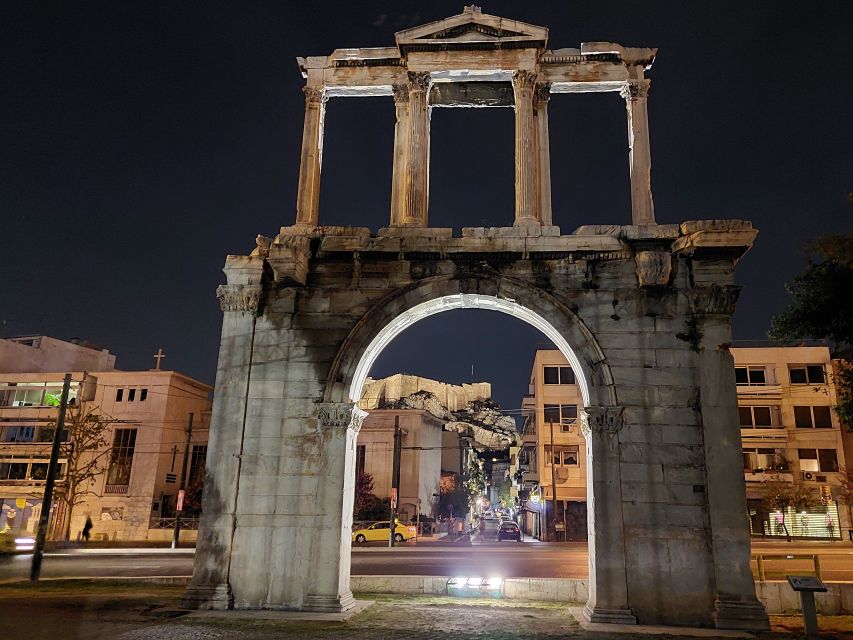
The route next turns toward two major Roman-era sights: Hadrian’s Arch and the Temple of Zeus. These monuments help explain how Athens changed long after its classical peak.
Hadrian’s Arch is a visual marker between different parts of the city. It is also a reminder of Emperor Hadrian’s connection to Athens and the city’s place within the Roman world. The Temple of Zeus, or Olympieion, gives you a sense of the scale ancient builders attempted.
At night, the lighting can make the columns and arch easier to appreciate as silhouettes and shapes. Still, darkness may limit the small details you can see. If you care deeply about inscriptions, carved decoration, or archaeological layers, you may want to return in daylight.
This is one of the tour’s strongest historical transitions. You move from modern Greece and the Olympic revival to Roman Athens, then continue toward Christian and Ottoman-era layers in the city center. A good guide makes those changes easier to follow.
The Metropolitan Cathedral and Little Mitropolis
The walk then reaches the Metropolitan Cathedral and the Little Mitropolis. These churches add a religious and medieval dimension to a route that has so far focused heavily on civic and ancient monuments.
The Little Mitropolis is especially interesting because it is a smaller church set beside the larger cathedral. The contrast in scale gives you a quick lesson in how Athens contains different periods side by side.
You should expect an exterior stop unless your guide says otherwise. The tour description does not include entry tickets or an interior visit, and the focus remains on walking, explanation, and city views.
This section also helps prevent the tour from becoming a simple march between famous archaeological sites. Athens is a layered city. Classical temples, Roman projects, modern institutions, and Orthodox churches all occupy the same central area.
Monastiraki Square and the Ancient Agora
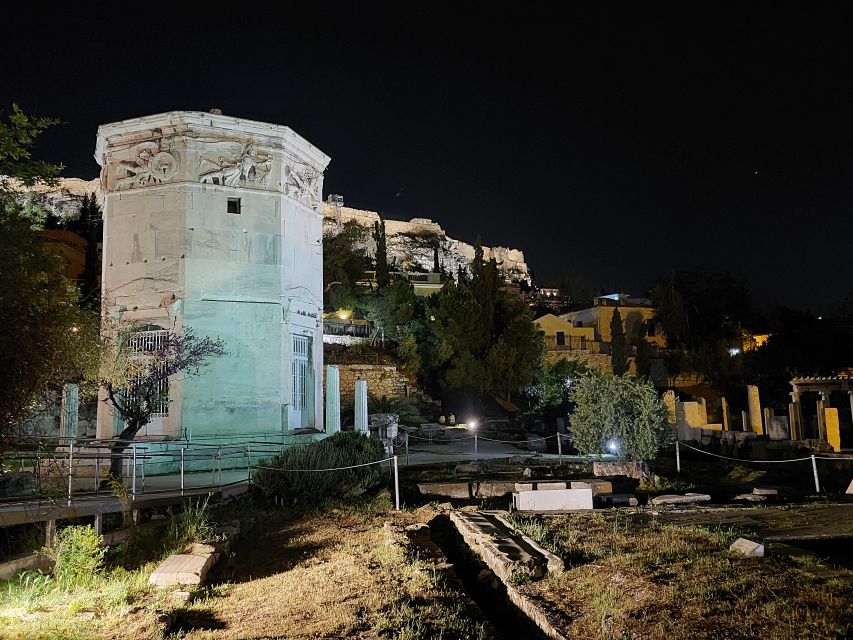
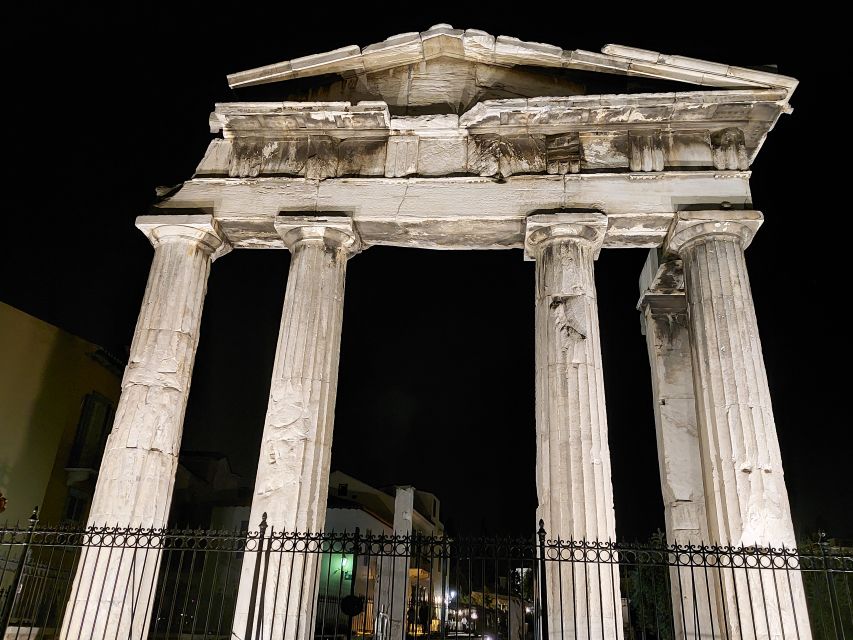
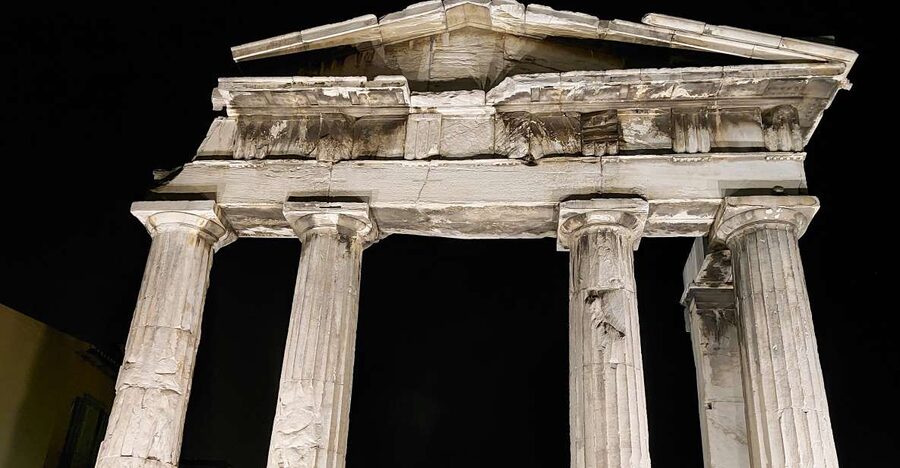
The route ends at Monastiraki Square, one of the best-known meeting places in central Athens. From here, you continue into the Greek Agora, with impressive views toward the Acropolis.
Monastiraki gives the final part of the walk a livelier urban feel. The square is a useful place to continue your evening after the tour, although the activity itself ends with the Acropolis view in the Ancient Agora area.
The Agora was the center of public life in ancient Athens. It was a place for politics, commerce, social activity, and civic discussion, so it fits the tour’s wider theme very well. You have already seen modern government at Parliament. The Agora brings that idea back to the ancient city.
The Acropolis view is a fitting finish. You do not climb the Acropolis as part of this activity, and the attraction ticket is not included. Instead, you see the landmark from below, illuminated against the night sky.
That distinction is important when comparing this walk with an Acropolis entry tour. This experience gives you orientation and context. It does not replace time inside the Acropolis, Ancient Agora, Temple of Zeus, or Panathenaic Stadium.
What the $28 price really covers
At $28 per person, the tour offers fair value for a two-hour guided introduction to central Athens. You are paying for a live Spanish-speaking guide, a carefully connected route, and explanations that turn a series of sights into a readable story.
The value is strongest if you are new to Athens or prefer to learn through conversation rather than a recorded audio guide. It is also useful if Spanish is your preferred language. Clear explanation can make a big difference when a route covers Greek mythology, classical architecture, Roman monuments, Orthodox churches, and modern politics in a short time.
The price does not include attraction tickets. That keeps the base cost reasonable, but you should budget separately if you want to enter any of the sites along the way.
I would not choose this tour if your main goal is extended archaeological study. Two hours is enough for an overview, not detailed examination. I would choose it if you want a guided city walk that covers many major sights without spending the whole evening inside one museum or monument.
Pace, footwear, and practical comfort
Wear comfortable shoes. The tour covers central Athens on foot, and even a two-hour walk can feel tiring if your footwear is poor.
Bring water, as specifically advised for the activity. The tour takes place at night, but that does not remove the need for basic comfort. You will be outside for the full route unless your guide changes the plan.
The experience is not suitable for wheelchair users. The information provided does not give details about exact surfaces, stairs, or the size of the group, so anyone with mobility concerns should ask the operator before booking.
The meeting point is not at Syntagma or Monastiraki. It is at the National Library, under the stairs and below the Panagiotis Vallianos sculpture. This matters because arriving at the wrong end of central Athens could make you late.
Free cancellation is available up to 24 hours before the start time, and you can reserve now while paying later. Those terms are useful if your Athens schedule is still changing.
The Spanish guide makes the difference
The strongest part of this experience is the live Spanish guidance. The tour covers many subjects quickly, and a good guide keeps the story moving without turning the walk into a list of dates.
Sara receives particularly strong praise for her anecdotes, professionalism, explanations, and recommendations. Saraita is also named as a brilliant Spanish-speaking guide. The comments indicate that the guide can help you understand both the buildings and the city around them, which is valuable on a first day.
The Spanish format is also a practical choice for mixed-language couples or families. One English-speaking participant explained that the arrangement worked well because her Spanish-speaking husband could follow everything.
Guide assignments can change, so do not assume a specific person is guaranteed unless the booking confirms it. Still, the repeated mention of Sara and the high overall rating make the guide element a major reason to consider this walk.
Who should book this Athens night tour?
I would recommend it to first-time visitors who want a clear introduction to central Athens. It works especially well on your first evening, when you can learn where Syntagma, Monastiraki, the National Gardens, the Temple of Zeus, and the Acropolis area fit together.
It also suits Spanish-speaking visitors who want more than basic sightseeing. The route has enough variety to interest people who like architecture, mythology, political history, religion, and the Olympic Games.
Families with older children may appreciate the short duration and the changing subjects. The experience is less suitable for anyone who wants a relaxed pace, a fully accessible route, or lengthy interior visits.
I would pair it with a separate daytime visit to the Acropolis and other archaeological sites. This night walk gives you the map and the story. The daytime visits give you the close-up details.
Should you book it?
Book this tour if you want a well-priced Spanish introduction to Athens, especially early in your stay. The route is broad, the nighttime views are appealing, and the guides named in the feedback, particularly Sara, have been praised for turning the walk into an engaging history lesson.
Skip it if you want guaranteed entry to monuments, a detailed Acropolis tour, or a wheelchair-friendly experience. For most able-bodied visitors who want to connect Athens’s ancient, Roman, religious, Olympic, and modern landmarks in two hours, $28 is a sensible price for a useful first look.
FAQ
How long is the Athens nighttime walking tour?
The tour lasts two hours.
What language is the tour conducted in?
The live tour guide speaks Spanish.
How much does the tour cost?
The listed price is $28 per person.
Where does the tour meet?
Meet the guide just below the sculpture of Panagiotis Vallianos, under the stairs of the National Library of Greece.
Where does the tour end?
The walk ends in the Greek Agora area near Monastiraki Square, with views of the Acropolis.
Are attraction tickets included?
No. Attraction tickets are not included in the tour price.
Which Athens sights are included in the route?
The route includes the National Library, the University, the Academy of Athens, Syntagma Square, the Greek Parliament, the Evzones, Zappeion, the Panathenaic Stadium, Hadrian’s Arch, the Temple of Zeus, the Metropolitan Cathedral, the Little Mitropolis, Monastiraki Square, the Greek Agora, and views of the Acropolis.
What should I bring?
Bring comfortable shoes and water.
Can I cancel the booking?
Yes. You can cancel up to 24 hours in advance for a full refund. You can also reserve now and pay later.
New on the Athens shelf
- Small-Group Wine Tour in Athens with Tasting★ 5.0 · 33 reviews
- Acropolis of Athens, Parthenon and Acropolis Museum private tour with dinner★ 5.0 · 77 reviews
- Private Athens Transfer Airport/Port -Greek Tours-Hourly service★ 5.0 · 88 reviews
- VIP Private Guided Tour of Athens Acropolis & Plaka in a Sidecar★ 5.0 · 108 reviews
- Athens Moonlight Waling Tour with Drinks and Meze Dishes★ 5.0 · 259 reviews
- Private Athens Landmarks Layover Tour★ 4.5 · 41 reviews
- Departure Transfer from Athens City to Athens Airport★ 5.0 · 41 reviews
- Classic Athens Food Tour with Local Drink & Market Visit★ 5.0 · 34 reviews
Walking Tours, compared.

Acropolis: Acropolis and Parthenon Guided Walking Tour
Read our verdict →
Acropolis monuments & Parthenon Walking Tour with Optional Acropolis Museum
Read our verdict →
Knossos: Knossos Palace Skip-the-Line Guided Walking Tour
Read our verdict →

Athens Authentic Greek Food Walking Tour (Small Group)
Read our verdict →
Early Morning Acropolis & Old Athens Guided Walking Tour
Read our verdict →Browse the lists this tour appears in