
Review · WALKING TOURS
Athens Social and Political Walk
Athens is often sold through ancient temples, but this walk asks a sharper question: how did the birthplace of democracy become a country reshaped by dictatorship, austerity, protest, migration, and political distrust? Political scientist Isaac leads you through central Athens while connecting government buildings, memorials, universities, and public spaces to modern Greek life.
I like two things especially. First, the tour reaches beyond the usual ancient sights and explains Greece from independence in 1821 to the present. Second, Isaac uses humor, comparisons with other countries, and plain language to make difficult subjects such as religion, party politics, the financial crisis, and neoliberalism easier to follow. The main drawback is that this is an idea-heavy walk, not a classic sightseeing tour, so you should choose it for context rather than monuments.
Key points to know before you book
- Modern Greece takes center stage: The story runs from the independence struggle and the Ottoman period through war, dictatorship, European integration, and the financial crisis.
- Political scientist Isaac leads the walk: His role gives the tour a clear analytical focus, while the conversation remains open to questions.
- Central Athens becomes the classroom: Government buildings, memorials, streets, and the Polytechnic help place political events in real locations.
- The tone is serious but accessible: Humor and everyday examples keep the discussion from becoming a lecture.
- A slideshow adds extra context: Photos and additional information support the topics covered on the walk.
- The practical format is flexible: The experience lasts 2.5 hours, costs $47 per person, and allows cancellation up to 24 hours ahead for a full refund.
Why this Athens walk feels different
Many Athens walking tours explain what happened in ancient Greece. This one spends its time on the country that exists now. You examine how modern Greece was formed, how institutions developed, and why old disputes still affect daily life and public debate.
That makes the experience useful early in an Athens visit. You can look at the Parliament, the Presidential Palace, or a university building with more than a passing sense of place. You begin to see them as parts of a continuing argument about national identity, authority, Europe, class, language, and social change.
The central question about Greece’s rise and crisis is deliberately blunt. It points toward the way international reporting often reduced a complicated country to a financial problem after 2008. This walk gives you a chance to replace that simple picture with a longer account.
Isaac’s approach is described as unbiased, but the useful meaning here is not that every issue becomes bland or neutral. Instead, you get competing pressures placed side by side. Religion, language, European politics, party systems, economics, immigration, and gentrification are treated as connected forces rather than isolated subjects.
The strongest praise centers on Isaac’s ability to explain difficult material without making you feel lost. He is also willing to answer questions, and his humor gives the walk some air when the subject turns toward war, repression, or economic hardship.
More Walking Tours in Athens
- Athens: Acropolis and Parthenon Guided Walking Tour
★ 4.6 · 5,882 reviews - Greek Food Walking Tour in Athens
★ 5.0 · 4,740 reviews - Acropolis: Acropolis and Parthenon Guided Walking Tour
★ 4.7 · 3,442 reviews
From the Maximos Mansion to the Presidential Palace
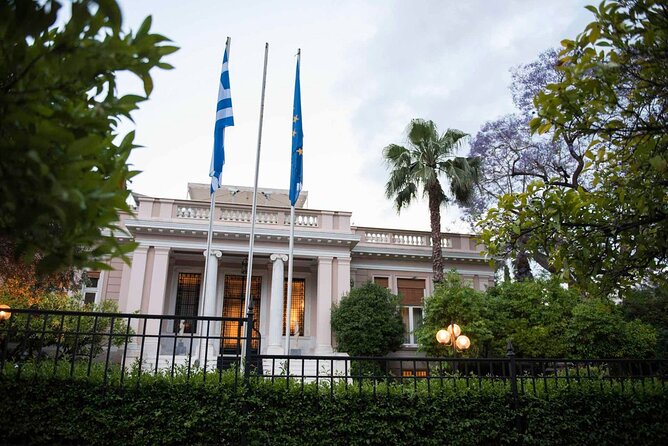
The walk begins at Planetwonk Experiences and moves toward two of Greece’s most important political buildings: the Maximos Mansion and the Presidential Palace. These stops give the discussion a practical starting point. You are not simply hearing about government in the abstract. You are looking at places tied to executive power and the modern state.
The Maximos Mansion is associated with the office of the prime minister. From there, the conversation can frame how Greece is governed and how political authority has changed since the country became independent. The Presidential Palace provides a second point of reference, helping distinguish the roles and symbols connected with Greece’s political institutions.
You should not expect a formal interior visit or an official ceremony. The value is in the setting and the explanation outside the buildings. Because the walk focuses on analysis, Isaac can use these locations to introduce political structures, national identity, and the relationship between public symbols and real power.
The National Garden and the meaning of public space
The route continues through the National Garden. This is a welcome change of pace after the first political stops, but it still fits the theme. Public gardens and central open spaces can tell you something about how a capital presents itself and how residents use the city.
The itinerary does not promise a botanical tour, so do not book this expecting detailed plant information. Instead, treat the garden as a breathing space within a walk that asks you to think. It also breaks up the concentration of government buildings and keeps the outing from feeling like a string of lectures on pavements.
A stop here may be especially useful if you are new to Athens. It gives you a feel for the central city while the guide continues to explain how public life, institutions, and social habits connect.
Parliament, protest, and the modern Greek state
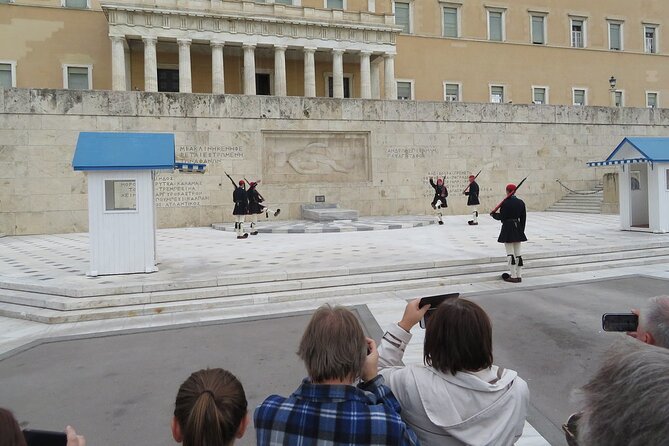
The Hellenic Parliament is one of the walk’s most important settings. It offers a direct route into party politics, democracy, economic decisions, and the public response to government policy.
The tour places modern political developments in a long time frame. You may hear about the independence war of 1821, the making of the modern state, the postwar years, European integration, and the financial crisis. The point is not to memorize a list of dates. It is to understand how one period creates pressure for the next.
The financial crisis is a major part of the story, but the experience does not present it as the beginning of Greece’s troubles. The discussion reaches back to older questions about the state, society, religion, national identity, and Europe. That wider view matters because it prevents the familiar stereotype of Greece as simply irresponsible or poorly managed.
For a first-time visitor, the Parliament stop can also make later news reports easier to understand. The tour helps you connect economic policy and political conflict with the streets where those arguments have been publicly acted out.
Close by, and nothing like it:
- Athens: Acropolis & up to 5 Archaeological Sites Combo Pass
★ 4.4 · 12,619 reviews - Athens: Acropolis Ticket with Optional Audio or Live Guide
★ 4.2 · 11,055 reviews - Athens: Acropolis, Parthenon & Acropolis Museum Guided Tour
★ 4.8 · 9,316 reviews - Athens, Piraeus, and Coastline: Blue Hop-On Hop-Off Bus
★ 3.9 · 4,849 reviews
The National Historical Museum and the making of Greece
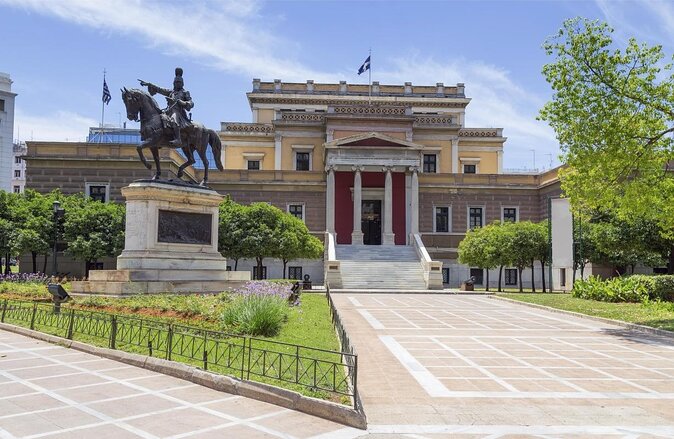
The National Historical Museum introduces another layer: how Greece tells the story of its own formation. The museum is located in a former Parliament building, and its setting links national history with political institutions.
The walk uses modern history rather than ancient mythology as its main subject. Topics can include the Byzantine and Ottoman periods, independence, the Second World War, the postwar period, religion, language, and political parties. These subjects matter because Greece’s identity is not a single, fixed idea. Different groups have argued over what it means to be Greek, how the country should face Europe, and how much influence religion should have in public life.
You may not spend time touring the museum’s full collection. The stop is part of the outdoor route, and the guide’s explanation remains the focus. If you want a detailed museum visit, plan that separately. If you want a short, useful frame for understanding the building and the modern state, this stop earns its place.
Memorials, hidden stops, and the cost of political memory
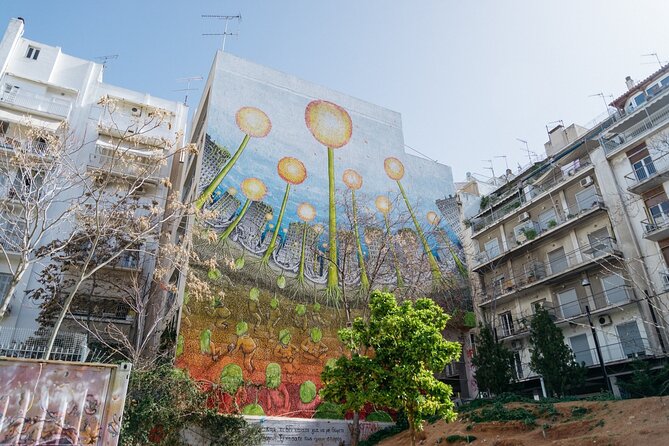
Several points on the route are described simply as hidden stops. Their exact names are not provided in advance, but they add a useful quality to the experience. You are not only moving between famous landmarks. You are also being taken to places that help explain less visible parts of Athens’ political and social past.
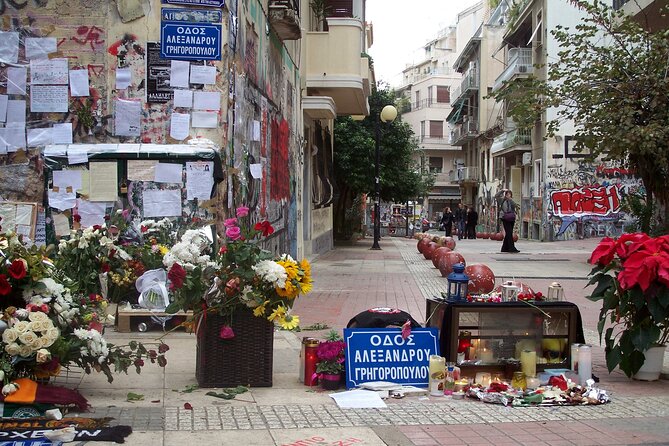
One clearly identified stop is Korai 4, a memorial site connected with the years 1941 to 1944. This gives the walk a direct connection to wartime memory and occupation. It also reminds you that modern Greece was shaped by conflict within living memory, not just by events from the distant past.
A memorial can be easy to pass without context. With Isaac’s explanation, it becomes a place to consider how a society remembers loss, resistance, and political violence. The subject may be sobering, but it is essential if you want to understand postwar Greece and the disputes that followed.
Because some stops are not fully named, you should not expect a fixed checklist of famous sights. The route’s strength is its meaning rather than its photo opportunities.
Panepistimiou and the story of urban Athens
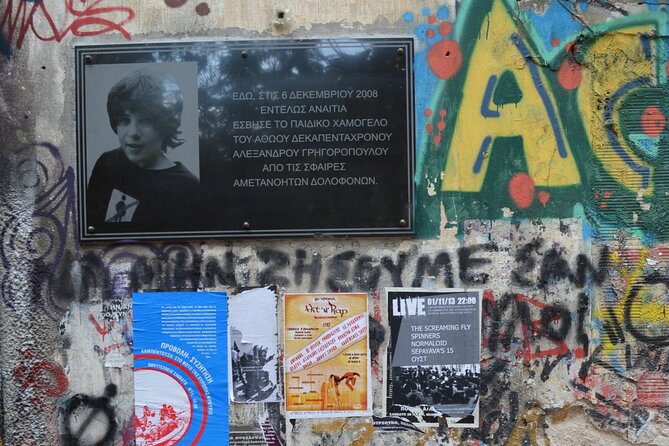
Panepistimiou brings the walk back into one of central Athens’ major avenues. Here, the city itself becomes evidence of change. Streets, institutions, and commercial areas show how the capital has been shaped by politics, economics, and shifting ideas about modernity.
The discussion can move from formal government to everyday life. One of the most useful parts of the experience is its attention to ordinary Athenians, not only presidents, prime ministers, and political parties. You hear how wider decisions affect social relations, public space, economic opportunity, and the way people view their country.
The tour also addresses gentrification and immigration. These issues can be reduced to slogans, but a walking format helps you notice that they are connected to real streets and neighborhoods. The guide’s job is not to tell you what opinion to adopt. It is to give you enough background to form one carefully.
The Polytechnic and the memory of protest
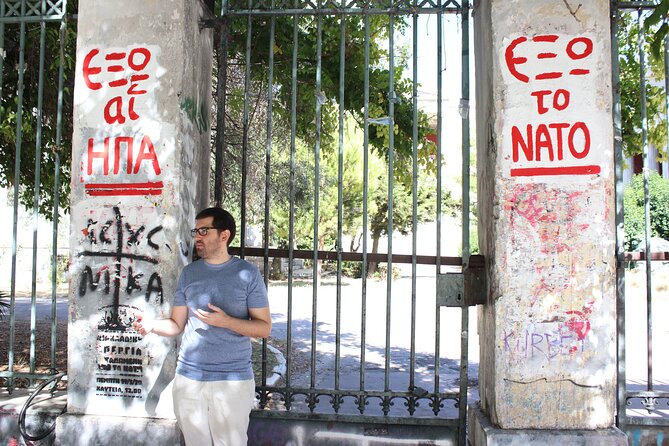
The National Technical University of Athens, commonly known as the Polytechnic, is one of the most important final stops. Its connection to student protest and the student massacre gives the walk a powerful ending.
This is a place where education, military rule, protest, and public memory meet. The stop helps explain why the Polytechnic remains so important in Greek political life and why student movements carry such weight in the country’s modern story.
You should expect serious material here. The tour does not turn political violence into a quick anecdote. At the same time, the guide’s conversational manner and willingness to answer questions keep the discussion open rather than solemn for its own sake.
The walk ends at 28is Oktovriou 42, near the Polytechnic area. Ending here gives the route a clear arc, from the institutions of government to a site linked with resistance and public protest.
What you get for $47
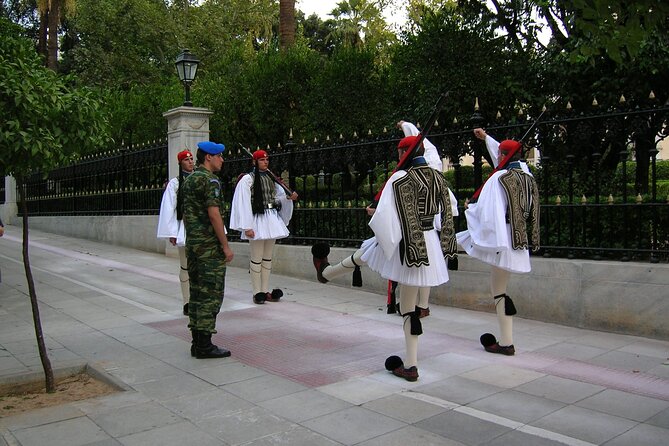
At $47 per person, the price is reasonable if you want an informed introduction to modern Greece rather than another general city walk. The tour lasts 2.5 hours, which is enough time to build a coherent story without taking up an entire day.
The value depends on your interests. If you want major ancient monuments, food stops, or panoramic views, this is not the best use of your money. If you want to understand the country behind the headlines, the price pays for a specialist guide, a carefully connected route, conversation, and a slideshow with photos and extra information.
The slideshow is a useful addition. It can bring in images or background that are difficult to explain from the pavement alone. You also gain the ability to ask questions as you go, something a book or self-guided route cannot provide in the same way.
The booking terms are friendly for uncertain plans. You can cancel up to 24 hours before the walk for a full refund, and you can reserve now and pay later. Tours are offered in English and Spanish. The experience is listed as wheelchair accessible, though you should still confirm any route concerns with Planetwonk Experiences before booking.
Who will get the most from this walk
I would choose this tour for anyone who has already seen the Acropolis and wants to understand present-day Greece. It also suits politics students, history readers, long-stay visitors, and people curious about how economic and social changes affect ordinary life.
It works particularly well for travelers who enjoy asking questions. The strongest accounts of the experience describe Isaac as open, funny, and able to explain complex subjects in simple terms. That matters because the route covers a lot: independence, Byzantine and Ottoman periods, religion, language, Europe, World War II, party politics, neoliberalism, immigration, gentrification, and the financial crisis.
You do not need a specialist background. The walk is designed to make complicated issues approachable. Still, it helps if you are willing to listen for most of 2.5 hours and think about political questions without demanding quick answers.
It may be less suitable for young children or anyone who wants a relaxed sightseeing stroll. The subject matter includes war, repression, economic hardship, and political violence. The guide uses humor, but the walk remains an adult discussion about a country’s difficult recent past.
Should you book the Athens Social and Political Walk?
Book it if you want Athens to make more sense beyond its ancient ruins. The route gives you a useful framework for understanding Greek politics, society, national identity, and the financial crisis, all while moving through places tied to those subjects.
Skip it if your priority is archaeology, shopping, or a broad introduction to every famous Athens sight. You will get more from this experience after visiting the main ancient sites, or at least alongside them.
For $47 and 2.5 hours, I see it as a strong choice for a curious visitor who wants context, honest discussion, and a guide who can make hard topics clear. Isaac’s mix of political training, humor, comparisons with other countries, and patience with questions is the main reason to choose this particular walk.
FAQ
How long does the Athens Social and Political Walk last?
The walk lasts 2.5 hours.
How much does the experience cost?
The price is $47 per person.
What languages are available?
The tour is available in English and Spanish.
Who leads the walk?
The walk is led by Isaac, a political scientist associated with Planetwonk Experiences.
What subjects does the tour cover?
It covers Greece’s social and political development from the independence war in 1821 to the present, including religion, language, Europe, economics, party politics, World War II, immigration, gentrification, and the financial crisis.
Is anything included besides the walking tour?
A slideshow with photos and extra information about the subjects discussed is included.
Can I cancel or pay later?
You can cancel up to 24 hours in advance for a full refund. You can also reserve your place and pay later.
New on the Athens shelf
- Acropolis of Athens, Parthenon and Acropolis Museum private tour with dinner★ 5.0 · 77 reviews
- Small-Group Wine Tour in Athens with Tasting★ 5.0 · 33 reviews
- Private Athens Transfer Airport/Port -Greek Tours-Hourly service★ 5.0 · 88 reviews
- VIP Private Guided Tour of Athens Acropolis & Plaka in a Sidecar★ 5.0 · 108 reviews
- Athens Moonlight Waling Tour with Drinks and Meze Dishes★ 5.0 · 259 reviews
- Private Athens Landmarks Layover Tour★ 4.5 · 41 reviews
- Departure Transfer from Athens City to Athens Airport★ 5.0 · 41 reviews
- Classic Athens Food Tour with Local Drink & Market Visit★ 5.0 · 34 reviews
Walking Tours, compared.

Acropolis: Acropolis and Parthenon Guided Walking Tour
Read our verdict →
Acropolis monuments & Parthenon Walking Tour with Optional Acropolis Museum
Read our verdict →
Knossos: Knossos Palace Skip-the-Line Guided Walking Tour
Read our verdict →

Athens Authentic Greek Food Walking Tour (Small Group)
Read our verdict →
Early Morning Acropolis & Old Athens Guided Walking Tour
Read our verdict →Browse the lists this tour appears in