

Review · ACROPOLIS TOURS
Acropolis monuments, Parthenon and Plaka, Monastiraki walking tour
The Parthenon is only the beginning here. This three-and-a-half-hour walk connects the Acropolis with the old lanes of Plaka and the lively square at Monastiraki, giving you both ancient Athens and the city people live in today.
I like the included Acropolis entry and the Greek pastry stop. I also like the guides’ relaxed teaching style, with names such as Anna, Demos, Sofia, and Artemis praised for making the ruins easy to understand. The main drawback is the uphill walking, uneven ground, heat, and a group that can reach 20 people.
Key points to know before booking
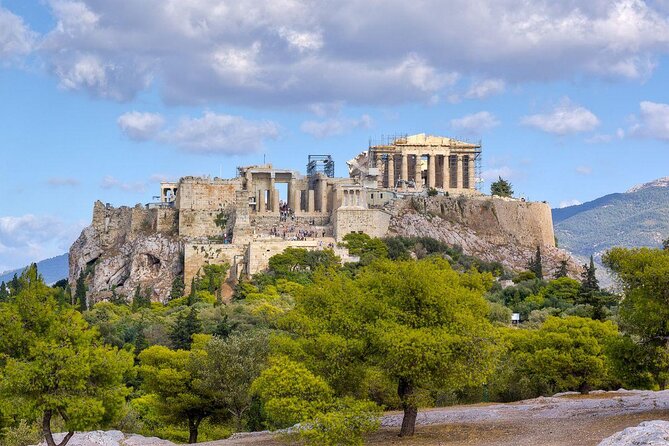
- Begin at 9 a.m. near the Acropolis: An early start helps you reach the main monument before the day grows hotter and busier.
- See more than the Parthenon: The route includes the Temple of Athena Nike, Roman Agora, Tower of the Winds, Plaka, and Monastiraki.
- Listen without crowding around the guide: Headsets may be used, making it easier to hear while taking photos or walking a short distance away.
- Taste two Greek favorites: The snack stop includes spanakopita and sweet semolina custard pastry.
- Plan for real walking: Comfortable shoes, water, and moderate fitness matter, especially on the Acropolis slopes.
- Finish in Monastiraki: You end near shops, cafés, restaurants, and public transportation, rather than returning to the starting point.
Why this route works for a first morning in Athens
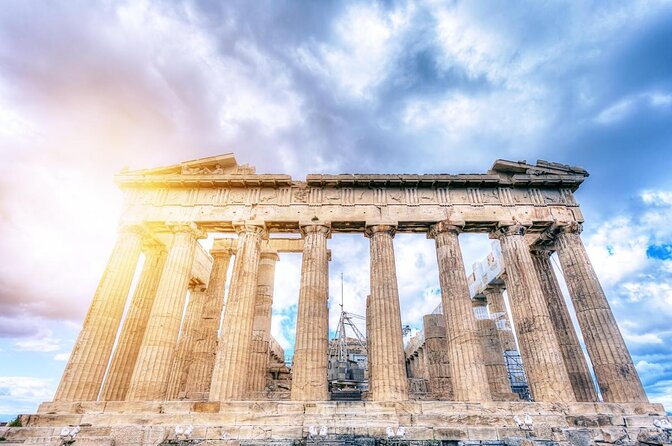
This tour gives you a useful first look at Athens without trying to cover the whole city. You begin with the monuments that most people come to see, then move into neighborhoods where the ancient and modern city overlap.
That order makes sense. The Acropolis needs your best attention, and the morning start places it first, when you are still fresh. Afterward, the walk becomes less formal. You pass Roman ruins, narrow streets, small shops, tavernas, and squares where daily Athens unfolds around you.
I especially like the way the route links the sights instead of treating each one as a separate photo stop. Your guide can explain how the Acropolis relates to the neighborhoods below it, then point out details you could easily miss on your own.
The group may include as many as 20 people. That is not a private tour, but it is still small enough to move through central Athens without the feel of a large bus outing. Headsets have helped some groups hear the guide clearly, even when people spread out to take pictures.
More Walking Tours in Athens
- Athens: Acropolis and Parthenon Guided Walking Tour
★ 4.6 · 5,882 reviews - Greek Food Walking Tour in Athens
★ 5.0 · 4,740 reviews - Acropolis: Acropolis and Parthenon Guided Walking Tour
★ 4.7 · 3,442 reviews
Starting at the Acropolis and meeting the guide
The meeting point is at Porinou 5, near the Acropolis, with a scheduled start at 9 a.m. You will need to make your own way there because hotel pickup and drop-off are not included.
Bring an electronic or paper voucher. The experience is offered in English, and the minimum age is 10. Since the tour is on foot, wear shoes with a good grip rather than smooth sandals or dress shoes.
The Acropolis rises above Athens on a rocky hill, so the first part is not a gentle stroll through a flat city park. You will walk uphill and across ancient surfaces that can be uneven or slippery. One useful point from the tour experience is that anyone needing elevator access must arrange it when booking. Last-minute access may not be possible.
Start with water in your bag. Shade can be limited around the monuments, and Athens can feel hot even in the morning. A hat or small umbrella is also sensible, though you will want to keep your hands free for steps and uneven ground.
Entering the Acropolis and seeing the Parthenon
The included Acropolis ticket is the main practical benefit of this tour. It is described as skip-the-line access, which can save valuable time at one of Athens’ most sought-after sights. Entry procedures can still involve some waiting, but joining a guide with tickets already arranged is easier than trying to work out the visit alone.
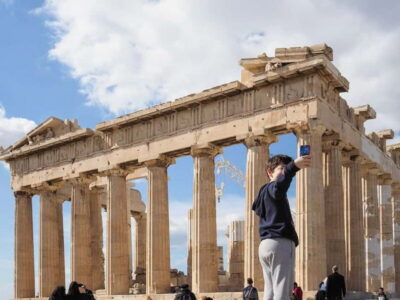
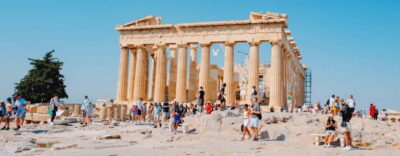
Inside the Acropolis, your first major sight is the Parthenon. Built beginning in 447 BC and dedicated to Athena, it is more than a famous backdrop. Its scale, position, and surviving details make it the natural center of any first visit to Athens.
Expect about 30 minutes focused on the Parthenon. That is enough time for a clear explanation of its purpose, construction, damage, and place in Athenian life, while leaving room for the other monuments. It is not a long archaeological seminar, and that is a good fit if you want the main ideas without spending your entire day on one building.
The guide’s value is clearest here. A strong guide can point out what your eye should notice, explain why some parts are missing, and connect the site to the wider story of Athens. Demos, Anna, Sofia, Annie, Eleni, Lisa, Sapfo, and Artemis have each been praised for clear explanations, humor, patience, and good pacing on different departures.
Do not expect complete solitude. The Acropolis is one of Europe’s most famous archaeological sites, and other groups will be present. The advantage is that you have someone helping you make sense of the crowd, the stonework, and the views instead of simply walking around and reading a few signs.
The Temple of Athena Nike and the smaller Acropolis details
The Temple of Athena Nike receives a shorter stop of about five minutes, but it deserves attention. Built around 420 BC, it is an early fully Ionic temple on the Acropolis and is dedicated to Athena Nike, associated with victory.
Because it is smaller than the Parthenon, it is easy to overlook. That is precisely why a guide helps. You get a brief explanation of its role and architecture rather than rushing past it as part of the main approach.
The itinerary focuses on the major Acropolis highlights rather than every structure on the hill. If your priority is an exhaustive archaeological study, you may want more time afterward to explore independently. If you want a well-paced introduction, the selection is sensible.
More Acropolis tickets and guided visits:
- Athens: Acropolis & up to 5 Archaeological Sites Combo Pass
★ 4.4 · 12,619 reviews - Athens: Acropolis Ticket with Optional Audio or Live Guide
★ 4.2 · 11,055 reviews - Athens: Acropolis, Parthenon & Acropolis Museum Guided Tour
★ 4.8 · 9,316 reviews - Athens: Acropolis, Parthenon & Acropolis Museum Guided Tour
★ 4.8 · 3,579 reviews
Walking down to the Roman Agora and Tower of the Winds
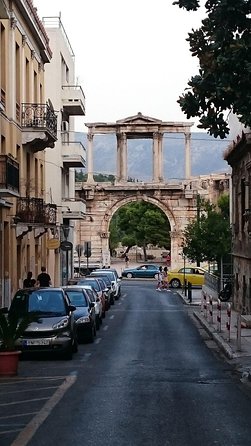
After the Acropolis, the route moves into central Athens and the Roman Agora. The Roman Agora was built between 27 and 17 BC, using funds connected with Augustus and a promise associated with Julius Caesar.
The site once had an open central space, shops, entrances, a fountain, and public facilities. The remains are less immediately grand than the Parthenon, but they help show how Athens kept functioning long after its classical peak.
The Tower of the Winds is the star here. This octagonal marble structure served as a timepiece and combined sundials, a water clock, and a wind vane. It is often described as the world’s first meteorological station, which gives you a memorable way to understand what you are seeing.
The stop lasts about 10 minutes. Admission to the Tower of the Winds is not included, so you should not assume you will enter every monument along the route. The guide can still explain the exterior and its role within the Roman Agora.
A restoration project from 2014 to 2016 cleaned and conserved the structure. Even from outside, its unusual shape and carved wind figures make it one of the more rewarding smaller stops in central Athens.
Plaka: pretty lanes, old churches, and useful food advice
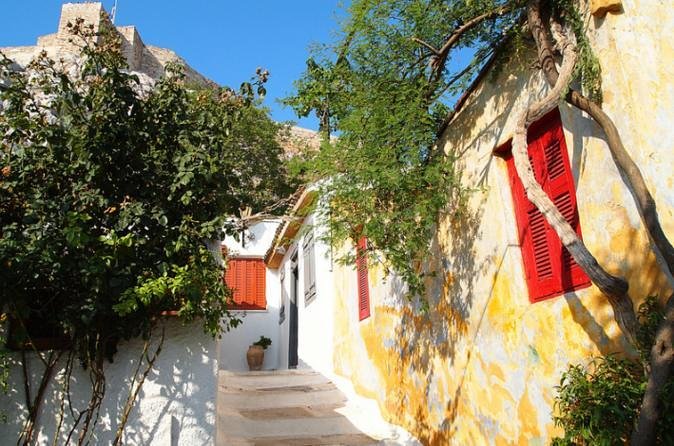
Plaka spreads across the lower slopes of the Acropolis. Its narrow cobbled lanes, neoclassical houses, Byzantine churches, cafés, tavernas, and independent shops make it feel very different from the open archaeological site above.
The planned time here is about 30 minutes, though the exact flow can depend on the group and the guide. This is a walking introduction rather than a dedicated shopping tour. You might see jewelry, clothing, ceramics, souvenir shops, and restaurant terraces.
I like this part because it gives the Acropolis a human setting. You are no longer looking only at temples and columns. You are seeing how the city grew around the ancient hill and how old buildings, modern businesses, and religious sites share the same streets.
Plaka can also feel commercial, especially on the busiest lanes. If you are hoping for a quiet village, keep your expectations in check. The appeal is the mix of history and everyday Athens, not total seclusion.
Guides can also point you toward restaurants and shops. Anna, for example, was praised for offering practical suggestions during the neighborhood walk. That advice can be useful if this is your first day in Athens and you still need to decide where to eat later.
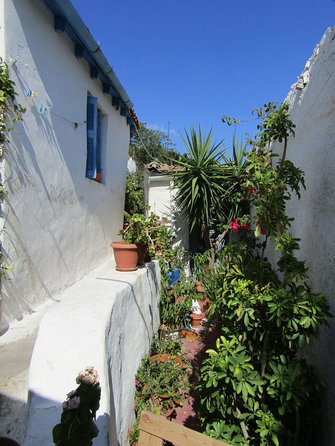
Anafiotika, the small whitewashed area within Plaka, has a Greek-island feel. The route description places emphasis on Plaka generally, so do not assume every departure will spend equal time in every side lane. Ask your guide if you want to know which sections you will see that morning.
Greek pastries that make the walk more memorable
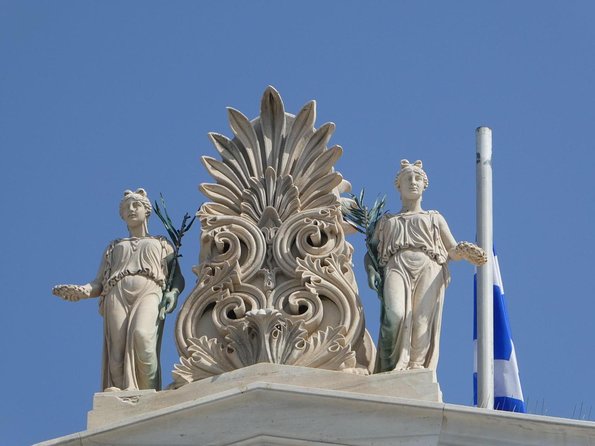
The included snack stop is small but well chosen. You taste traditional spanakopita, a savory spinach pie, along with a sweet semolina custard pastry.
This is not a full meal. Think of it as a chance to try two familiar Greek flavors during the walk. If you are booking this around lunchtime, plan to eat afterward, since the tour ends in Monastiraki and the snack will not replace breakfast or lunch.
The food also adds something a monument-only tour cannot. You get a simple connection to local eating habits, and the break gives your feet a rest after the Acropolis. Several departures have been praised for especially good pies, so this part is more than a token refreshment.
If you have allergies or dietary restrictions, the supplied information does not promise substitutions. Ask the operator before booking rather than assuming the pastries can be changed.
Ending at Monastiraki Square
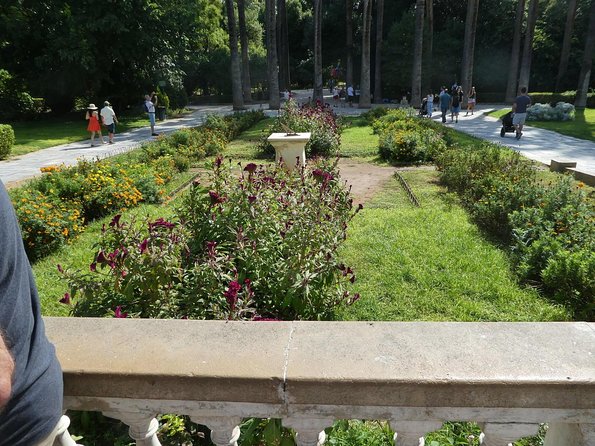
The tour ends in Monastiraki, one of the most useful places to finish a first Athens walk. The square is central, easy to recognize, and close to public transportation. From here, you can continue shopping, find a café, or explore nearby streets on your own.
Monastiraki also gives the tour a lively final scene. The atmosphere is more urban and energetic than the Acropolis, with shops, food spots, and people moving through the square. It is a good place to keep exploring after your guide leaves.
Because the tour ends here rather than returning to Porinou Street, think about your plans for the rest of the day. That is convenient if you want to stay downtown. It is less convenient only if you need to collect belongings or return to a hotel near the starting point.
Price, group size, and what you receive
At $105.26 per person, this is not the cheapest way to see the Acropolis. The value depends on how much you want from the morning.
You are paying for the licensed guide, the Acropolis admission ticket, the route planning, and the pastry tasting. You are also paying to connect several places that would otherwise require your own research and navigation. For a first visit, that can be worthwhile, especially if you want context rather than a quick walk around the ruins.
The ticket and guide are the strongest parts of the price. The Tower of the Winds admission is not included, and hotel transportation is not included. Gratuities are optional, so budget for those only if you feel the guide added real value.
The maximum group size is 20. That keeps the price below a private tour, but it means you will sometimes wait for the group to gather. The headset system is helpful here, particularly when you want to take photos without losing the explanation.
The tour is booked, on average, 76 days ahead. That suggests you should reserve early if your Athens dates are fixed, especially during high season.
Who should book this Athens walk?
I would choose this tour for a first morning in Athens, especially if you want the major monuments explained by a local guide and prefer a planned route to independent research.
It suits adults, families with children aged 10 or older, and anyone who likes history presented in a friendly, practical way. The guides have been praised for humor, patience, clear English, and the ability to connect ancient facts with modern life.
It is also a good choice if you want neighborhood time built into your archaeological visit. The Plaka and Monastiraki sections stop the experience from becoming only a tour of stones and temples.
You should think twice if you dislike groups, struggle with uphill walking, or want to spend a long time inside each archaeological site. The pace is relaxed, but three and a half hours still covers a lot of ground.
Good weather is required. If poor weather cancels the tour, you can choose another date or receive a full refund. Free cancellation is available up to 24 hours before the start time, while changes or cancellations inside that window are not accepted.
My take: a strong introduction with sensible limits
I like this experience because it gives Athens a clear shape. You see the Acropolis first, then follow the city downhill through Roman remains, Plaka streets, Greek pastries, and Monastiraki Square.
The strongest reason to book is the guide. Names such as Demos, Anna, Sofia, Artemis, Eleni, and Lisa have been associated with lively explanations, steady pacing, and useful local suggestions. The second strong reason is efficiency: the included Acropolis ticket and planned route save you from handling the main logistics yourself.
The main caution is physical. Wear proper shoes, bring water, and be ready for steps, slopes, uneven surfaces, and sun. If you meet those conditions, this is a well-balanced way to get your Athens bearings early in a trip, with enough free time afterward to keep exploring on your own.
FAQ
How long does the Acropolis, Plaka, and Monastiraki tour last?
The tour lasts approximately 3 hours and 30 minutes.
What time and where does the tour begin?
It begins at 9 a.m. at Porinou 5 in Athens, near the Acropolis.
Is Acropolis admission included?
Yes. Skip-the-line Acropolis entrance tickets are included. Admission to the Tower of the Winds is not included.
What food is included?
The tour includes a snack stop with sweet semolina custard pastry and traditional spanakopita.
Is the tour suitable for people with mobility concerns?
A moderate level of physical fitness is advised because the route includes uphill walking and uneven surfaces. Travelers who need Acropolis elevator access must request permission when booking, since last-minute access may not be available.
What happens if the weather is poor?
The experience requires good weather. If the operator cancels because of poor weather, you will be offered another date or a full refund.
New on the Athens shelf
- Acropolis of Athens, Parthenon and Acropolis Museum private tour with dinner★ 5.0 · 77 reviews
- Small-Group Wine Tour in Athens with Tasting★ 5.0 · 33 reviews
- Private Athens Transfer Airport/Port -Greek Tours-Hourly service★ 5.0 · 88 reviews
- VIP Private Guided Tour of Athens Acropolis & Plaka in a Sidecar★ 5.0 · 108 reviews
- Athens Moonlight Waling Tour with Drinks and Meze Dishes★ 5.0 · 259 reviews
- Private Athens Landmarks Layover Tour★ 4.5 · 41 reviews
- Departure Transfer from Athens City to Athens Airport★ 5.0 · 41 reviews
- Classic Athens Food Tour with Local Drink & Market Visit★ 5.0 · 34 reviews
Acropolis Tours, compared.
Acropolis & up to 5 Archaeological Sites Combo Pass
Read our verdict →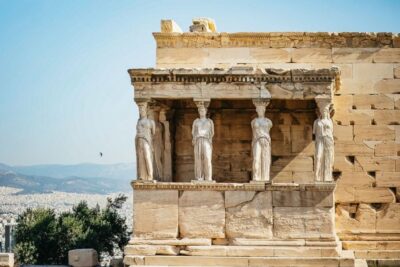
Acropolis, Parthenon & Acropolis Museum Guided Tour
Read our verdict →
Acropolis: Acropolis and Parthenon Guided Walking Tour
Read our verdict →
Acropolis monuments & Parthenon Walking Tour with Optional Acropolis Museum
Read our verdict →
Athens All Included: Acropolis and Museum Guided Tour with Ticket
Read our verdict →Browse the lists this tour appears in