
Review · ACROPOLIS TOURS
Parthenon & Acropolis Guided Tour in Spanish -Option Tickets
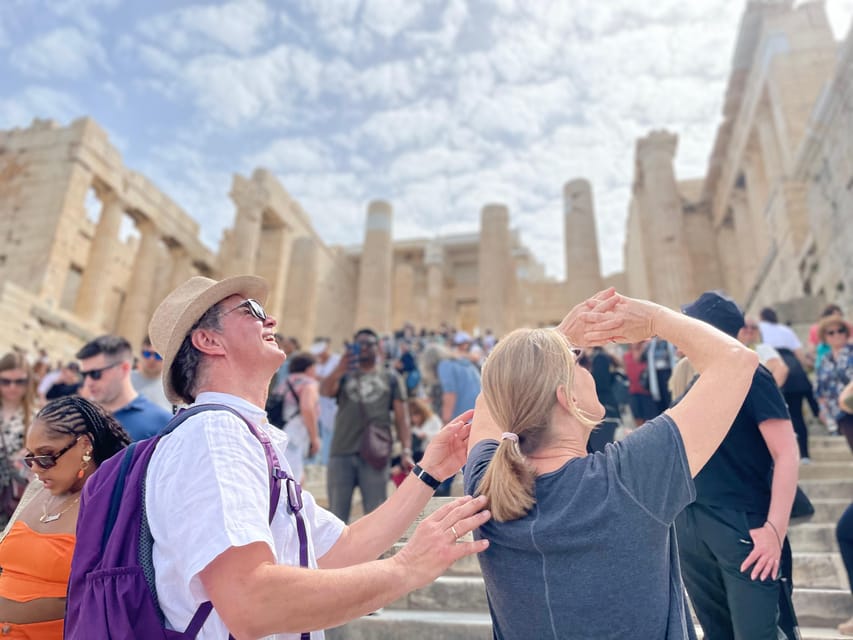
The best part of this two-hour Acropolis tour in Spanish is its route through nearly every major monument on the hill. You begin at the Theatre of Dionysus and finish above Athens, with the Parthenon, Caryatids, ancient sanctuaries, and sweeping city views along the way.
I like the early start, which can mean cooler air and fewer people, and I like the mix of history and Greek mythology. Guides such as Efi and Simon are praised for clear explanations, lively storytelling, and a good pace. The main drawback is that two hours passes quickly, so you will hear a lot but may want extra time afterward to look closely at the stones and take photographs.
Key points to know before you book
- Spanish from start to finish: The tour is led exclusively in Spanish by an official, certified guide.
- Early entry from the southern slope: Starting early helps you manage the heat and reach the monuments before the busiest part of the day.
- The full Acropolis route: You see the Theatre of Dionysus, Asklepieion, Odeon of Herodes Atticus, Propylaea, Temple of Athena Nike, Parthenon, and Erechtheion.
- A strong mythology thread: The guide explains the contest between Athena and Poseidon, along with the olive tree and water source linked to Athens.
- Headphones included: You can hear the guide while walking between monuments and around busy viewing areas.
- Time at the summit: The guided portion ends at the top, where you may remain for photos and 360-degree views.
Why an early Spanish tour works well at the Acropolis
The Acropolis is not simply one temple. It is a hilltop complex filled with theaters, sanctuaries, gateways, temples, and remains from different periods. Without context, you can easily spend your visit admiring marble columns without knowing what each building meant.
This tour gives you a clear path and a Spanish-speaking guide to connect the pieces. The explanations cover both documented history and the myths tied to the site, so you hear why Athena became the city’s patron goddess and why Poseidon also claimed the hill.
I especially like the early timing. Athens can be very hot, and much of the Acropolis offers little shade. Starting in the morning gives you a better chance of enjoying the climb before the strongest sun. One guide, Efi, is specifically praised for finding shaded spots and timing the route well during hot weather.
The meeting point is at the Tourist Information Center near the southern entrance, across from the Acropolis Museum and close to the Acropolis metro stop. That makes the start practical if you are staying in central Athens or arriving by metro. Look for the TOP TOURS GREECE sign.
At $33 per person, the tour is reasonably priced for a two-hour guided visit, particularly if you select the option that includes the entrance ticket. Check the booking choice carefully, since the ticket is included only when that option is selected. The fee also includes headphones, which matter when you are standing in an open archaeological site with other groups nearby.
More Acropolis tickets and guided visits:
- Athens: Acropolis & up to 5 Archaeological Sites Combo Pass
★ 4.4 · 12,619 reviews - Athens: Acropolis Ticket with Optional Audio or Live Guide
★ 4.2 · 11,055 reviews - Athens: Acropolis, Parthenon & Acropolis Museum Guided Tour
★ 4.8 · 9,316 reviews
Beginning at the Theatre of Dionysus
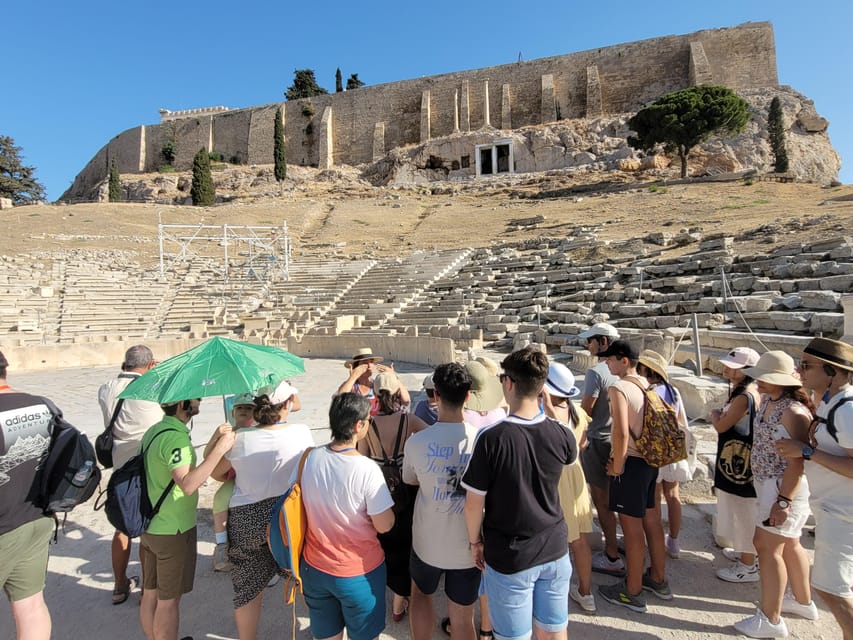
The first stop is the Theatre of Dionysus, cut into the southern slope of the Acropolis. The guided visit here lasts about 10 minutes.
This is a fine place to begin because it connects the Acropolis to everyday Athenian culture. The theater could hold around 17,000 spectators and was dedicated to Dionysus, the god associated with wine and theater. You are not starting with a quiet pile of ruins. You are starting in a place built for public performance, civic gatherings, and shared storytelling.
The guide helps you picture the scale of the theater and explains why theater mattered in ancient Athens. This opening also gives you a useful contrast: the lower southern slope was a place of public life, while the summit held the city’s most important temples.
The Asklepieion and ancient ideas about healing
Next comes the Asklepieion of Athens, with about 10 minutes of explanation.
The sanctuary was dedicated to Asclepius, the god of medicine. Findings connected with health and healing make this stop useful for understanding how ancient Athenians thought about illness and recovery. It is easy to rush past this area on the way uphill, but the guide gives it a purpose within the larger story of the Acropolis.
I like that the route includes smaller or less famous places rather than treating the Parthenon as the only thing worth seeing. The Asklepieion shows another side of ancient life, one concerned with the body and the search for treatment.
Looking up at the Odeon of Herodes Atticus
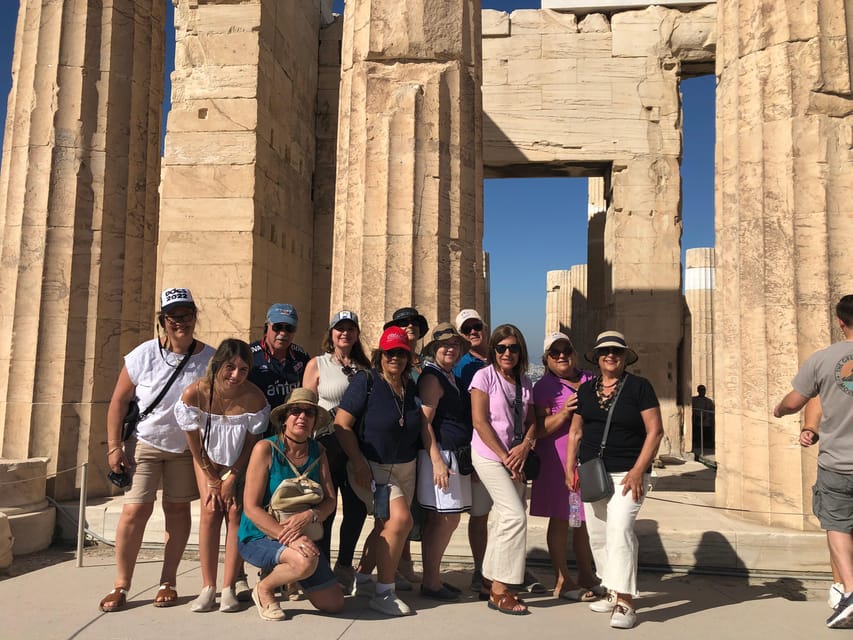
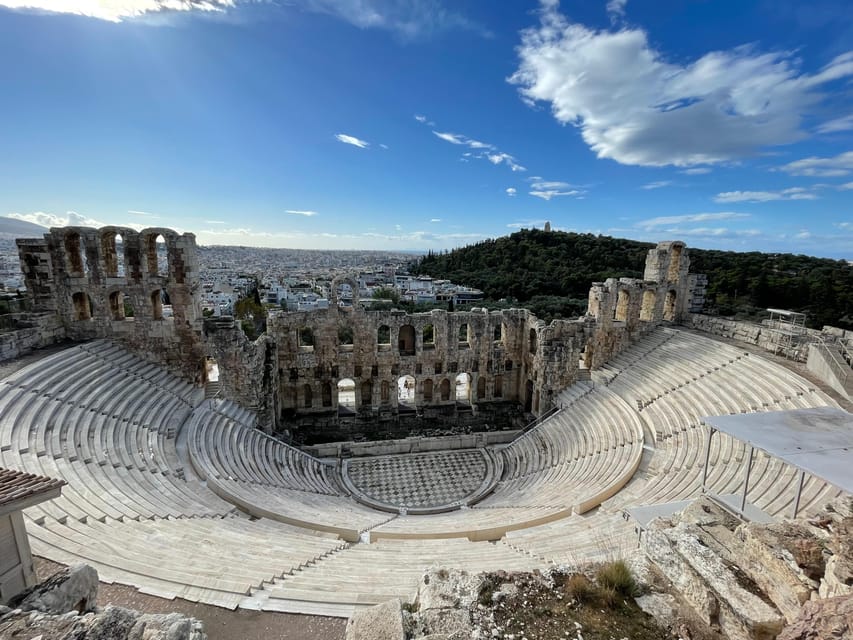
The Odeon of Herodes Atticus receives another 10-minute explanation. This grand stone theater still hosts concerts, which gives the ancient structure a rare connection to modern Athens.
The building once had a roof, a detail that helps you understand how different it was from the open Theatre of Dionysus. Today, its curved seating and dark stone create one of the most striking views on the lower approach to the Acropolis.
You will not have a performance during this tour, but knowing the venue remains in use adds meaning to the visit. Ancient buildings here are not all silent museum pieces. Some continue to serve the city.
A few more Athens options worth putting side by side
- Athens: Acropolis and Parthenon Guided Walking Tour
★ 4.6 · 5,882 reviews - Athens, Piraeus, and Coastline: Blue Hop-On Hop-Off Bus
★ 3.9 · 4,849 reviews - Greek Food Walking Tour in Athens
★ 5.0 · 4,740 reviews - Athens: City Sightseeing Hop-On Hop-Off Bus Tour
★ 4.3 · 4,520 reviews
Passing through the Propylaea
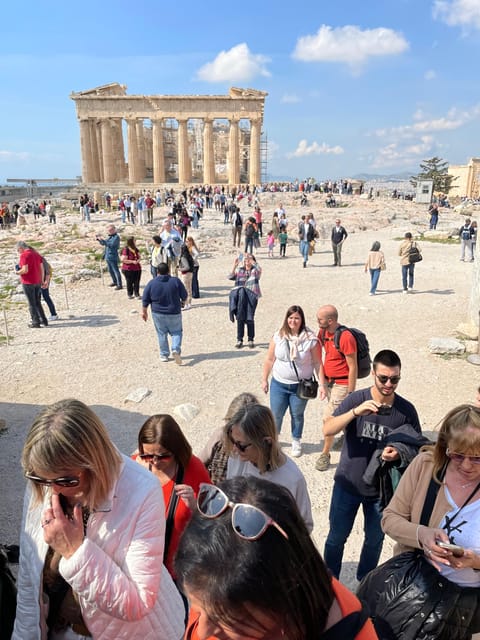
The Propylaea is the monumental gateway to the Acropolis. The guided stop lasts about 10 minutes, and this is where the route begins to feel more ceremonial.
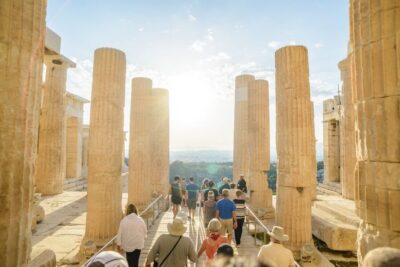
The gateway uses both Doric and Ionic architectural styles. Your guide explains how the entrance framed the approach to the sacred hill and why its design mattered. The climb and the stone underfoot also become more noticeable here, so wear shoes suitable for walking over uneven surfaces.
The Propylaea is a good place to listen carefully rather than rush toward the Parthenon. It was designed to shape your arrival, and the guide helps you understand that the approach itself was part of the experience.
The Temple of Athena Nike
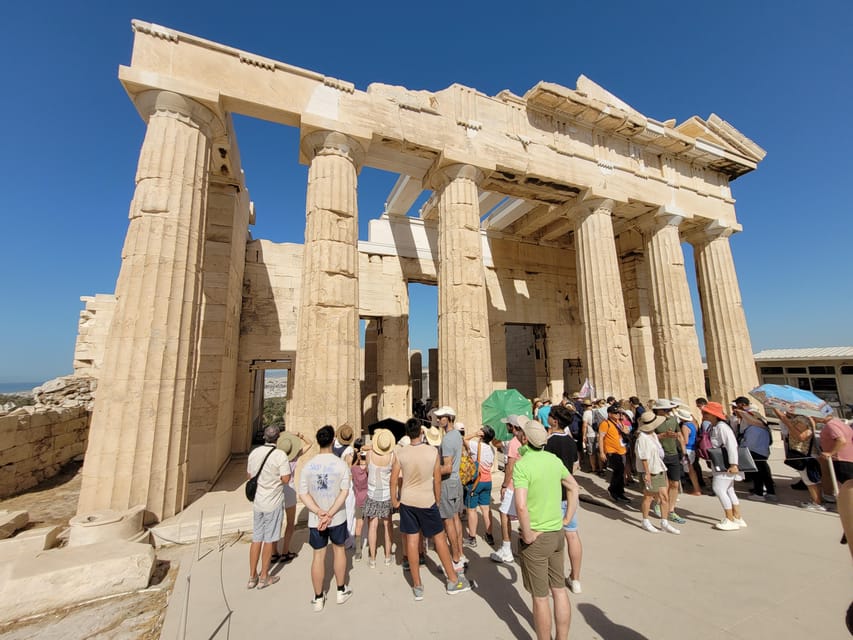
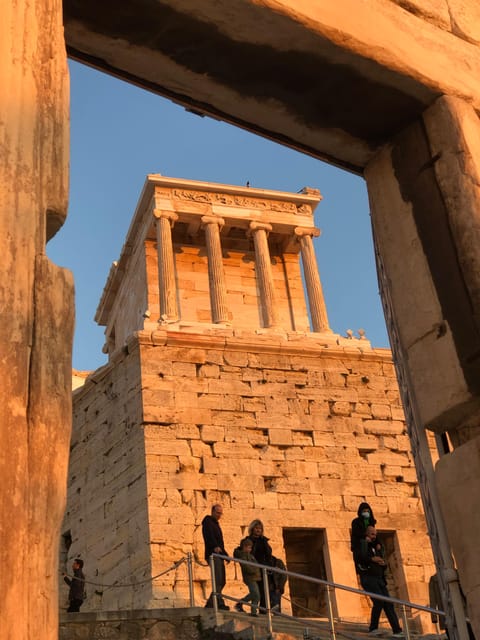
The Temple of Athena Nike receives about five minutes. It is a short stop, but the building carries great importance because it honored Athena in her role as a bringer of victory.
The temple sits near the entrance, where its position made it an important part of the arrival sequence. The guide’s explanation links the small temple to the larger identity of Athens and to the city’s devotion to Athena.
Because this stop is brief, you will not get the same amount of detail as at the Parthenon or Erechtheion. That is a fair trade in a two-hour route that tries to cover the entire complex.
The Parthenon in its full setting
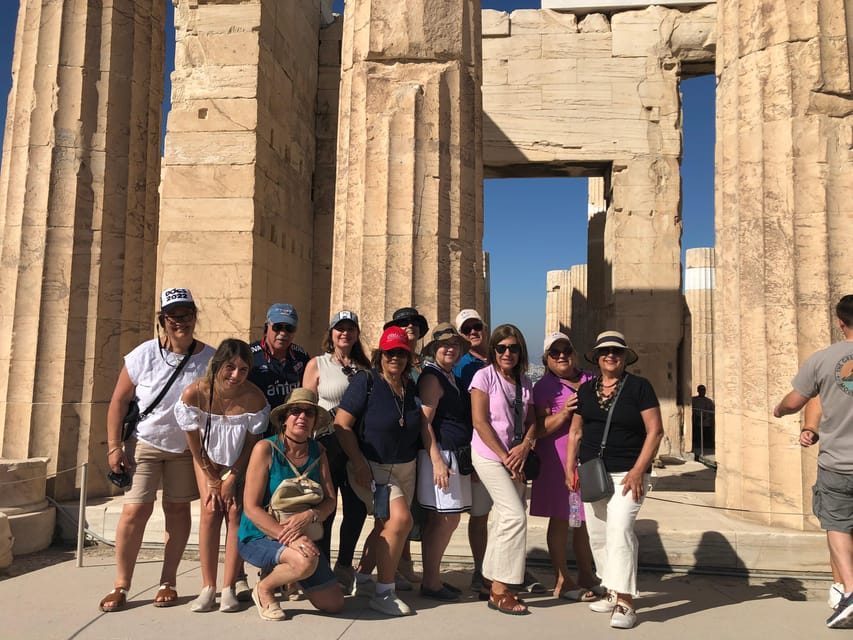
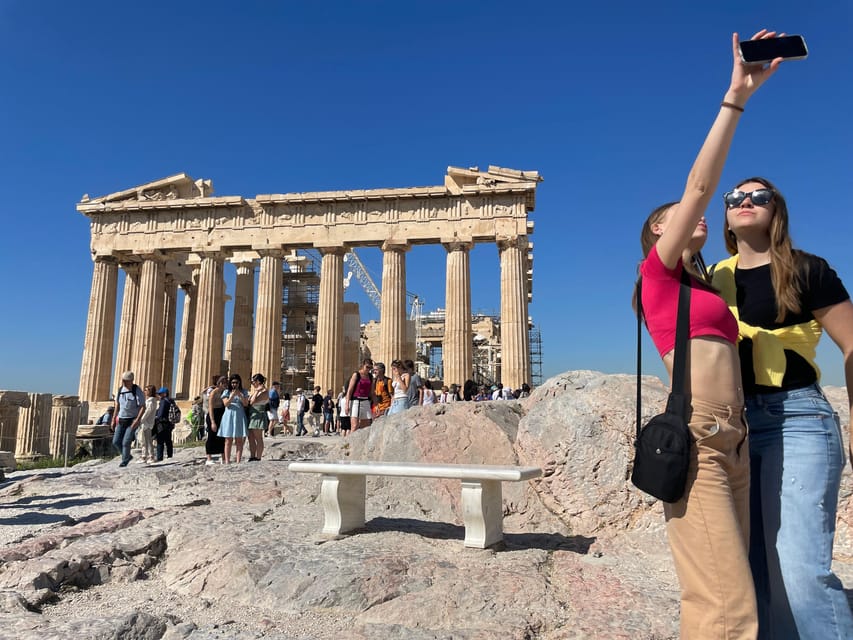
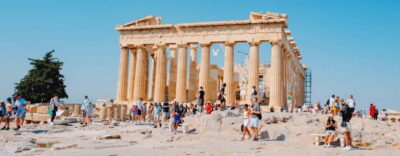
The Parthenon receives the longest explanation, about 20 minutes. Built in honor of Athena, the city’s protective goddess, it is the main reason many people come to the Acropolis.
The guide discusses its design, purpose, and place in ancient Athens. You hear why it is often considered one of the most harmonious temples of the ancient world, while also learning to look beyond the famous front view. The columns, proportions, sculptural decoration, and elevated position all contributed to its effect.
The building is partly ruined, and restoration work is visible. That can disappoint anyone expecting a complete ancient temple, but the surviving structure still gives you a strong sense of its original authority. From this height, you also see why the Acropolis was such a powerful symbol for the city.
The best way to use this part of the tour is to listen first and photograph second. The guide’s explanations give the columns and stones a meaning that photographs alone cannot provide. After the guided portion, you have time at the top to take the wider shots you may have postponed.
The Erechtheion and the famous Caryatids
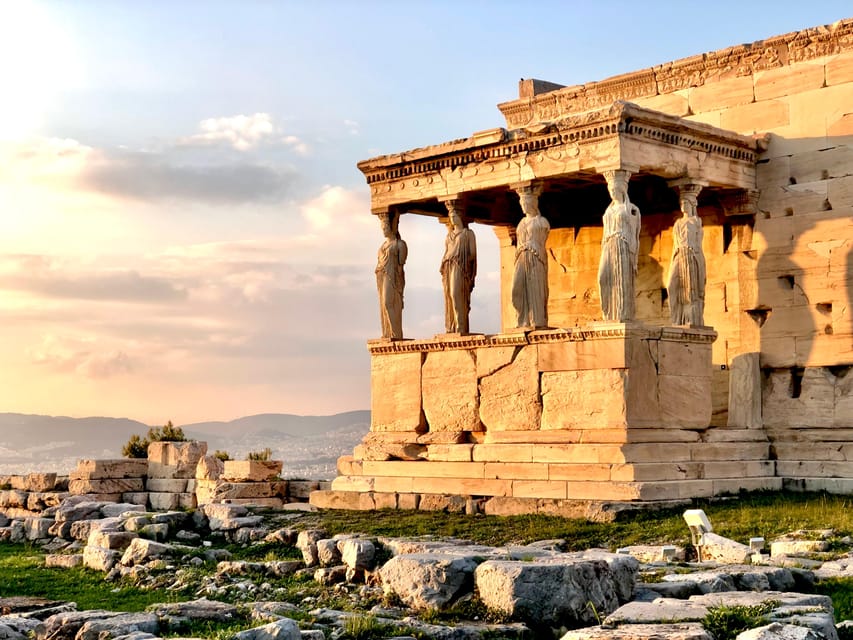
The Erechtheion receives about 10 minutes, followed by another 10 minutes focused on the Porch of the Caryatids.
This temple is linked to the ancient contest between Athena and Poseidon for the protection of Athens. The story says Athena offered the olive tree, while Poseidon provided a source of water. The marks and features associated with this contest give the building a different feel from the more orderly Parthenon.
The Caryatids are the visual highlight. These female-shaped columns support the porch in place of ordinary pillars, combining structural purpose with sculpture. Your guide explains their role and helps you notice the details in their posture, clothing, and arrangement.
The original Caryatids are not all exposed on the hill, so do not expect to see every ancient figure in its original condition. Still, the porch remains one of the most memorable sights on the Acropolis. You will want time here for photographs, although the area can become crowded and movement may be controlled.
How the two-hour pace feels
The listed guided stops add up to about 85 minutes, leaving the rest of the two-hour tour for walking between monuments, managing the uphill route, and pausing at viewpoints. That is a sensible structure for the Acropolis.
Several people praise the pace as neither too long nor too short. I can see why. You receive explanations at the major locations without spending an entire morning in the heat. The route is active, though, and you should expect a fair amount of walking and standing.
The guides are also praised for keeping children engaged, using stories instead of giving only dates and architectural terms. Efi, in particular, is described as animated and able to make the material easy to follow. Simon is also singled out for his calm, clear style and strong command of Greek culture.
If you want to examine every block, inscription, and restoration detail, this tour will feel fast. If you want a well-organized introduction that covers the main monuments, the timing is useful.
Views from the top and time after the tour
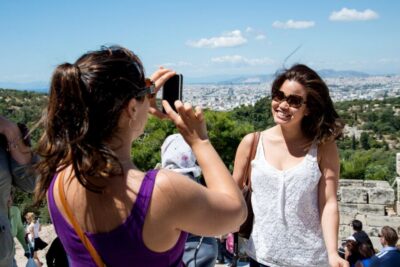
The tour finishes at the summit rather than returning you to the starting point. This is convenient because you can stay as long as you like to photograph the Parthenon, the city, and the surrounding views.
The Acropolis offers a 360-degree outlook over Athens. From the top, the site feels connected to the modern city below, not isolated from it. This is also your chance to step away from the group and take in the hill at your own pace.
Bring your camera, but protect it from the heat and keep your hands free for the climb. Food and drinks are not allowed, and bags are not allowed under the stated rules. Baby strollers, non-folding wheelchairs, and electric wheelchairs are also not permitted. The activity is not suitable for wheelchair users.
The tour does not include hotel pickup, transfers, food, or drinks. You make your own way to the southern entrance, which is simple from the Acropolis metro stop but worth planning before your start time.
Who will get the most from this tour
I would choose this experience if you want the Acropolis explained in Spanish and prefer a guide who can tie architecture, politics, mythology, and daily life together. It suits first-time visitors who want to see the major monuments without working out the route alone.
It is also a good choice for a short stay in Athens. In two hours, you cover the essential archaeological sights and still have time afterward for the Acropolis Museum or another central Athens stop.
Families can benefit from the storytelling and shorter format, especially if children lose interest during long museum visits. The early start and shade breaks are useful in summer, though the ground remains uneven and the heat can still be strong.
I would think twice if you need step-free access, want a private experience, or prefer to wander silently with unlimited time at each monument. This is a scheduled walking tour with a planned route, not a flexible visit.
Should you book the Spanish Acropolis tour?
Book it if you want a clear Spanish explanation of every major Acropolis stop, early access, and a moderate two-hour route at a fair price. The strongest features are the guide quality, the mythology woven into the history, the included headphones, and the chance to remain at the summit afterward.
Before booking, confirm that you selected the ticket-included option if you need admission arranged. Arrive at the Tourist Information Center by the southern entrance, bring practical walking shoes, and plan for sun exposure.
For Spanish-speaking visitors who want more than a quick look at the Parthenon, this is a solid, well-paced introduction to Athens’ most important ancient site.
FAQ
How long does the Acropolis tour last?
The tour lasts two hours.
What language is the tour conducted in?
The live guided tour is conducted in Spanish.
Where does the tour begin?
It begins at the Tourist Information Center next to the southern entrance of the Acropolis, across from the Acropolis Museum and near the Acropolis metro stop.
How can I identify the meeting point?
The guide will hold a TOP TOURS GREECE office sign.
Does the tour include an Acropolis entrance ticket?
The entrance ticket is included when you choose the ticket-included option during booking.
Which monuments are visited?
The route includes the Theatre of Dionysus, Asklepieion of Athens, Odeon of Herodes Atticus, Propylaea, Temple of Athena Nike, Parthenon, Erechtheion, and Porch of the Caryatids.
Are headphones provided?
Yes. Headphones are included so you can hear the guide clearly.
Can I remain at the Acropolis after the guided tour?
Yes. The tour ends at the top of the hill, where you can stay for photographs and views.
Is the tour suitable for wheelchair users?
No. The activity is not suitable for wheelchair users, and non-folding and electric wheelchairs are not permitted.
Can I cancel the booking?
You can cancel up to 24 hours in advance for a full refund. A reserve-now, pay-later option is also available.
New on the Athens shelf
- Acropolis of Athens, Parthenon and Acropolis Museum private tour with dinner★ 5.0 · 77 reviews
- Small-Group Wine Tour in Athens with Tasting★ 5.0 · 33 reviews
- Private Athens Transfer Airport/Port -Greek Tours-Hourly service★ 5.0 · 88 reviews
- VIP Private Guided Tour of Athens Acropolis & Plaka in a Sidecar★ 5.0 · 108 reviews
- Athens Moonlight Waling Tour with Drinks and Meze Dishes★ 5.0 · 259 reviews
- Private Athens Landmarks Layover Tour★ 4.5 · 41 reviews
- Departure Transfer from Athens City to Athens Airport★ 5.0 · 41 reviews
- Classic Athens Food Tour with Local Drink & Market Visit★ 5.0 · 34 reviews
Acropolis Tours, compared.
Acropolis & up to 5 Archaeological Sites Combo Pass
Read our verdict →
Acropolis, Parthenon & Acropolis Museum Guided Tour
Read our verdict →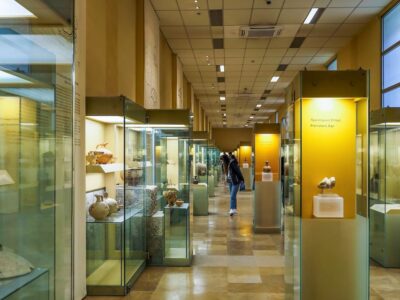
Acropolis: Acropolis and Parthenon Guided Walking Tour
Read our verdict →
Acropolis monuments & Parthenon Walking Tour with Optional Acropolis Museum
Read our verdict →
Athens All Included: Acropolis and Museum Guided Tour with Ticket
Read our verdict →Browse the lists this tour appears in