
Review · ANCIENT SITES
Athens: Women in Ancient Greece Guided Walking Tour
Ancient Athens is often told through generals, philosophers, and citizen assemblies. This walk changes the subject. It asks what the city looked like to its women, from the household duties of ordinary residents to the bold careers of Sappho, Aspasia, and Agnodice. The female point of view gives familiar sights a fresh purpose.
I like two things right away: the route reaches major places such as the Ancient Agora and Pnyx without turning into a standard monument checklist, and the guide connects mythology to real social rules. Guides such as Maelle also make the walk conversational, asking questions and welcoming discussion. The main drawback is practical: you will walk uphill and climb steps, with no entry to the archaeological sites, so this is not a good fit for wheelchair users or anyone with serious mobility or heart concerns.
Key points to know before you book

- A different Athens story: Learn about women’s work, rights, family duties, education, and public roles rather than hearing only about famous men.
- A strong route: The walk links Monastiraki, Hadrian’s Library, Plaka, the Ancient Agora, Pnyx, and Filopappou Hill.
- Myth meets daily life: Athena, Penelope, Demeter, and Pandora help explain how Greek ideas shaped women’s place in society.
- Good guide style: Maelle is praised for her humor, warmth, questions, and ability to handle wider questions about ancient Athens.
- Two hours at $44.04: The price is reasonable if you want interpretation and discussion, though it does not include archaeological admission.
- Plan for heat and hills: Bring water, sunscreen, and a hat. The route includes steps and uneven walking.
Why this tour changes the usual Athens story
Most first-time walks through Athens focus on the Acropolis, democracy, temples, and male philosophers. Those subjects matter, but they leave large gaps. This tour tries to fill one of them by asking what women could do, what they could not do, and how much their lives differed by class, family, and place.
That distinction matters. Ancient Greek women were not one single group with one shared experience. A mythical goddess, a wealthy Athenian wife, a poor worker, a foreign resident, and an enslaved woman occupied very different worlds. The tour’s subject allows those differences to come forward instead of treating women as a footnote.
You will hear about daily routines as well as exceptional figures. Sappho represents poetry and intellectual achievement. Aspasia opens discussion about women connected to public life and ideas. Agnodice brings medicine and the challenge of entering a field normally closed to women. These are not just inspiring names. They help you consider why some women became known and why so many others disappeared from the written record.
The guide also uses mythology as a window into social expectations. Athena, Penelope, Demeter, and Pandora are not presented only as colorful characters. Their stories raise questions about wisdom, loyalty, motherhood, labor, curiosity, blame, and power. That makes the walk useful even if you already know the basic myths.
More Ancient Sites in Athens
- Athens: Acropolis & up to 5 Archaeological Sites Combo Pass
★ 4.4 · 12,619 reviews - Athens: Ancient Greek Theater Performance
★ 4.7 · 2,481 reviews - Athens: National Archaeological Museum Ticket & Audio Guide
★ 4.3 · 1,330 reviews
Starting in Monastiraki with a clear meeting point
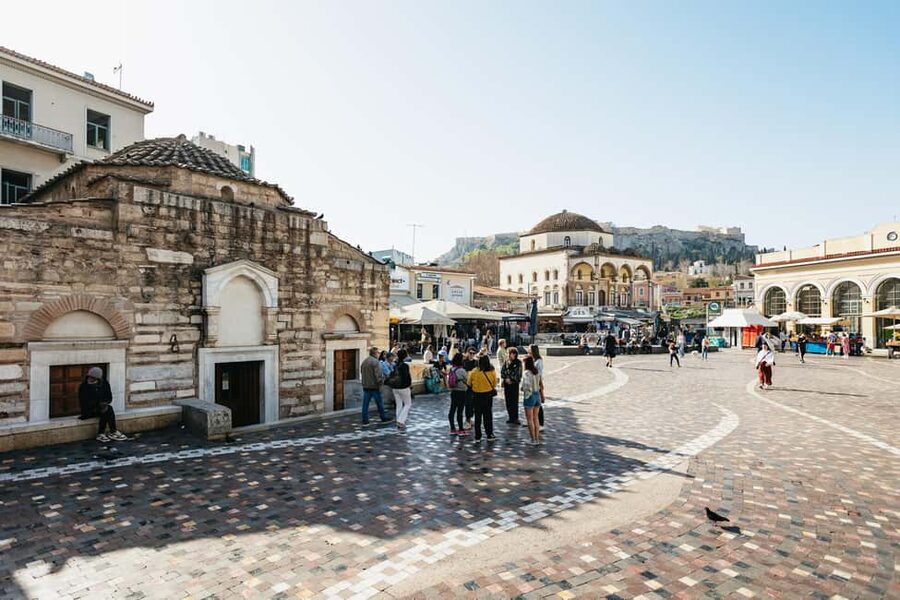
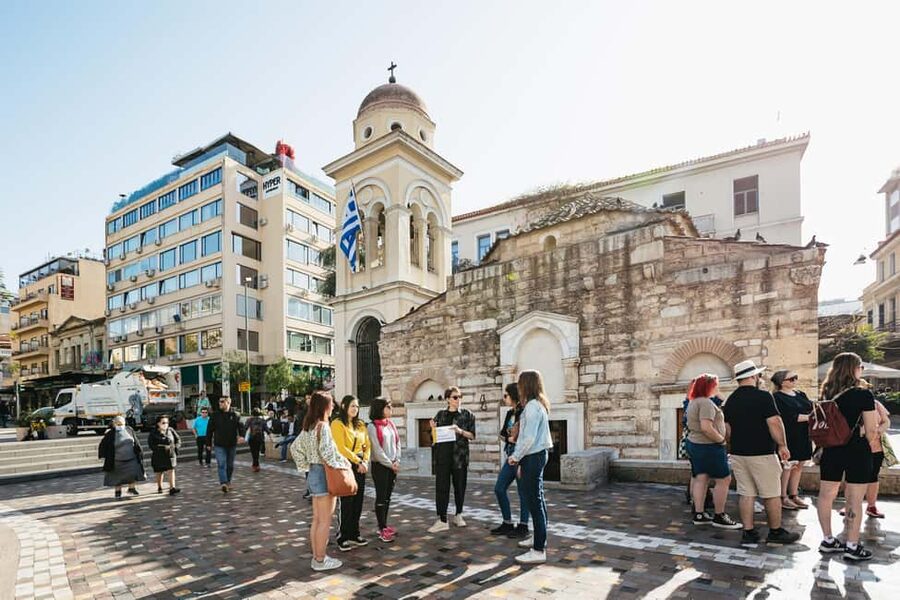
The tour begins in Monastiraki Square, in front of the Church of the Virgin Mary Pantanassa. Look for the guide holding a sign marked Women in Ancient Greece. This is a busy central area, so allowing a little extra time to locate the church and guide is sensible.
Monastiraki is a fitting starting point. It places you in the middle of modern Athens before the guide turns your attention toward the ancient city. The opening stop is brief, but it helps set up the central question: how do we recover women’s lives when the surviving monuments and written accounts were usually created by men?
The route is a walking tour, not a vehicle-based sightseeing trip. You need comfortable shoes and enough energy for two hours outside. In warm weather, shade may not always be available, although Maelle is specifically praised for finding shaded places to pause on a hot day.
Hadrian’s Library and the Plaka connection
The walk continues toward Hadrian’s Library, where you receive a short explanation of the site and its place in ancient Athens. The archaeological remains are viewed from outside, since entrance tickets are not included. That is an important distinction if you are hoping to explore the monuments at close range.
From here, the route moves through Plaka. The neighborhood gives the talk a lived-in setting rather than keeping it among ruins alone. You will hear about women’s roles while walking through streets that connect present-day Athens with the city’s ancient core.
The value of this part is not simply the buildings you see. It is the way the guide uses the surroundings to discuss home life, family expectations, and the difference between public and private space. In ancient Athens, public power was tied closely to citizenship, and women’s access to that power was sharply limited. A walk through the city makes that division easier to picture.
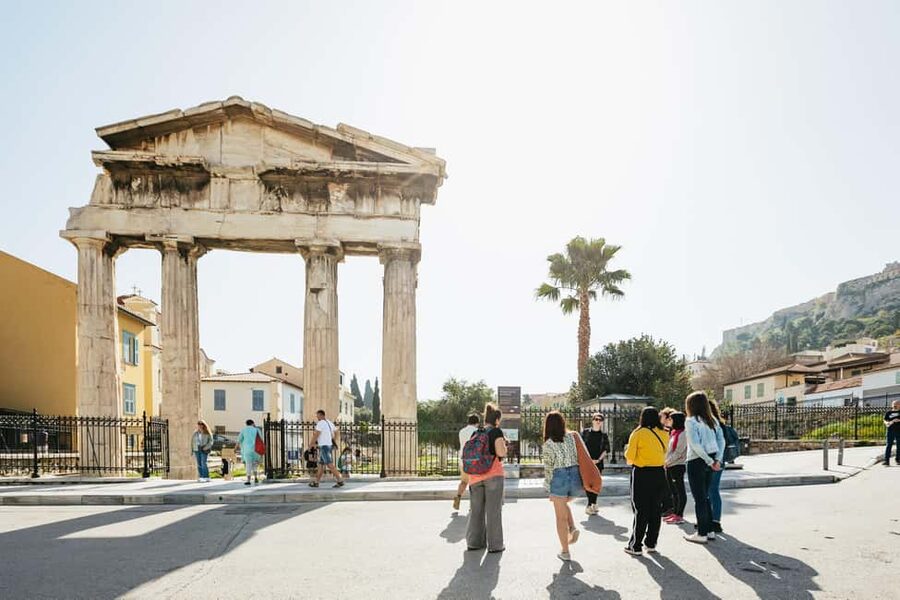
The Gate of Athena Archegetis and stories behind the myths

At the Gate of Athena Archegetis, the focus turns toward the relationship between religion, civic life, and female figures. Athena was the city’s patron goddess, yet the social freedoms available to actual Athenian women were far narrower than the goddess’s power might suggest.
That contrast is one of the tour’s most useful ideas. A society could honor powerful female deities while restricting real women’s choices. The guide uses stories of Athena and other figures to show how mythology could support ideals of courage, wisdom, marriage, motherhood, obedience, or danger.
The tour also brings in less familiar stories, including the tale of kidnapped Spartan girls and the mysterious women’s festival in Athens. These episodes give the discussion texture. You are not simply hearing a list of laws or household duties. You are hearing stories that reveal fear, ritual, gender expectations, and the ways women could act within rules set by others.
There is also a secret stop listed along the route. Its exact details are not provided in advance, which is part of the appeal, but you should not expect a major archaeological site or an included admission. It is best understood as one more place for the guide to add local context.
More Walking Tours in Athens
- Athens: Acropolis and Parthenon Guided Walking Tour
★ 4.6 · 5,882 reviews - Greek Food Walking Tour in Athens
★ 5.0 · 4,740 reviews - Acropolis: Acropolis and Parthenon Guided Walking Tour
★ 4.7 · 3,442 reviews - Acropolis monuments & Parthenon Walking Tour with Optional Acropolis Museum
★ 5.0 · 2,678 reviews
The Ancient Agora from a woman’s point of view

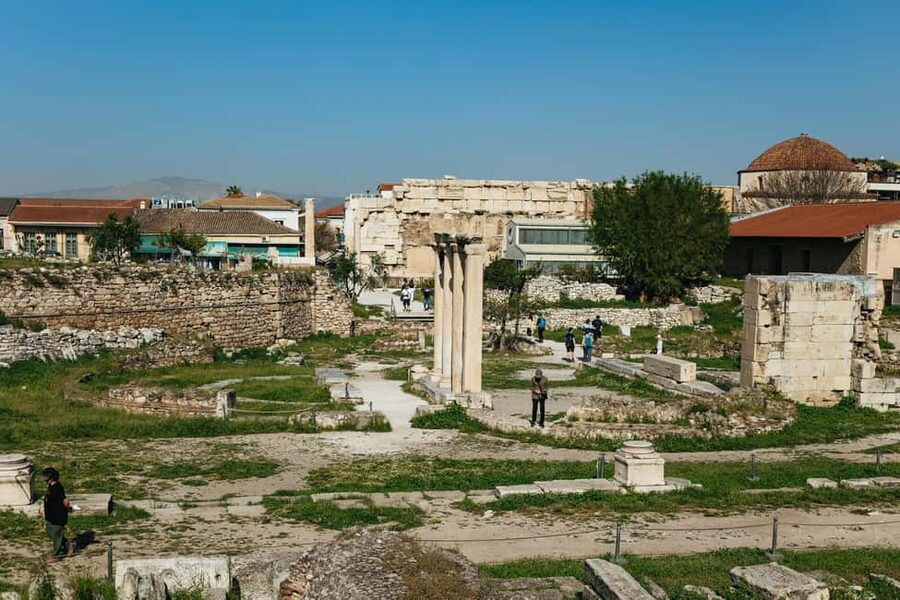
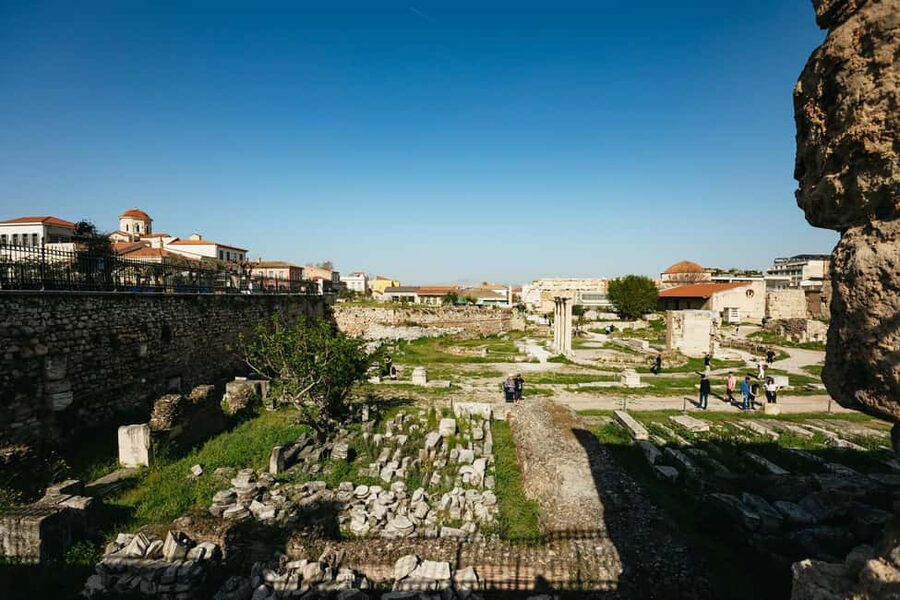
The Ancient Agora is one of the strongest stops because it is usually explained as the heart of civic and commercial Athens. Here, the tour asks who was allowed to take part in that public life and who was present mainly as family, worker, resident, or outsider.
The Agora is closely tied to the idea of democracy, yet the democratic community was limited. Women did not enjoy the same political rights as male citizens. The tour makes that contradiction easier to grasp: the birthplace of a political system celebrated for citizen participation was also a place where half the population had no equal vote.
The guide also helps separate legal status from lived experience. A woman’s daily work, financial position, family connections, and origin could shape her life as much as gender did. That wider view keeps the discussion from becoming too simple.
You will see the site from outside rather than entering the archaeological grounds. If you have already booked a separate Agora visit, this tour can add useful interpretation. If you are expecting an archaeological excavation walk, the lack of admission may disappoint you. The real product here is the explanation, not access behind the gates.
Pnyx and the limits of ancient democracy
The route then reaches Pnyx, where the first democratic votes were cast. This is one of the most thought-provoking places on the walk because the physical setting makes the political story feel immediate.
From Pnyx, the guide can connect the mechanics of voting with the people excluded from it. Ancient democracy was a major political development, but it did not mean equal participation for everyone living in Athens. Women, enslaved people, and others outside the citizen body did not share the same political rights.
That is why this stop works especially well on a women-focused tour. You are not asked to reject the importance of democracy. Instead, you are encouraged to look at its boundaries. The conversation can also connect ancient inequalities with questions that still matter today, a point several participants found thought-provoking.
The tour’s discussion style is a real advantage here. Maelle is praised for asking questions rather than delivering an unbroken speech. If you enjoy conversation and want to raise wider questions about mythology, politics, or modern society, this format should suit you. If you prefer a tightly scripted lecture with no discussion, the open style may feel less predictable.
The view toward the Acropolis and Filopappou Hill
After Pnyx, the route includes a viewpoint and then continues toward Filopappou Hill. You will have opportunities to look toward the Acropolis, but this is not an Acropolis entry tour and does not replace a visit inside the monument.
Filopappou Hill gives the walk a scenic finish. The view adds a useful pause after the heavier material about restrictions, exclusion, and unequal power. It also helps you see how closely the ancient sites sit within modern Athens.
The hill section is also where you should pay attention to the physical demands of the route. Steps and uphill walking are part of the experience. The activity is specifically not suitable for wheelchair users or people with mobility impairments, and it is also not recommended for people with heart problems. Bring water, wear sun protection, and do not treat the two-hour duration as a sign that the route is effortless.
The stated end is back at the meeting point, while the route information also lists a kiosk on Rovertou Galli 69 among the drop-off locations. Confirm the exact finish when you meet the guide, especially if you have a timed booking afterward.
The guide makes the difference
The subject is strong on its own, but the guide’s approach will shape the experience. Maelle receives especially warm praise for her command of the material, friendly personality, humor, and ability to turn the walk into a discussion. She is also described as able to answer broader questions about ancient Greece instead of staying rigidly inside the tour title.
That matters because women’s history often depends on incomplete evidence. A good guide needs to explain what is known, what is suggested, and what remains uncertain. The strongest parts of this experience appear to come from that balance, with stories presented in an engaging way but linked to larger questions about evidence and interpretation.
The tour is offered in English or French. A private group option is available, though the regular price shown is $44.04 per person. The included small gift is a pleasant extra, but it should not be the reason you book. The real value is the guide’s interpretation and the chance to discuss a part of ancient Athens that standard sightseeing often skips.
Is $44.04 good value for two hours?
At $44.04 per person, this is not the cheapest way to walk around central Athens. You can see many of the same streets and viewpoints without paying for a guide. The price makes more sense if you want a focused subject, clear storytelling, and a route that links several sites into one argument.
You are paying for access to a specialist point of view rather than archaeological entry. Tickets to the Ancient Agora and other sites are not included, and the main monuments are seen from outside. If your priority is going inside every ruin, spend your budget on site admission and consider this tour as an addition.
For a first visit, I would place this walk after you have gained a basic sense of the Acropolis and Agora, or alongside a standard Athens sightseeing plan. It supplies context that a general city tour may not cover. It is also a strong choice for anyone who has already seen the famous monuments and wants a less familiar subject.
The two-hour length is convenient. You can fit it into a morning or afternoon without giving up a full day. Free cancellation up to 24 hours ahead and the reserve-now, pay-later option also reduce the risk of adding it to a changing schedule.
Who will enjoy this walk most?
This tour suits you if you like social history, mythology, ancient politics, and questions without easy answers. It is particularly useful for visitors who feel that standard Athens tours spend too much time on famous men and too little on ordinary life.
It can work well for friends on a city break, families with older children who enjoy history, and solo visitors who prefer a guide-led conversation. The tour is not restricted to women, despite its title. Anyone interested in how societies organize power, family, work, and citizenship can get something from it.
You may want to skip it if your main goal is a fast photo tour, interior access to ruins, or a flat route. It is also not suitable for wheelchair users, people with mobility impairments, or people with heart problems. The route requires steps and uphill walking, and Athens sun can be demanding.
Practical tips for a better morning or afternoon
Wear shoes with good grip. You will move through city streets, historic areas, and hill paths, so comfort matters more than style.
Carry water, sunscreen, and a sun hat. These are listed as essential items, not just nice extras. If you are sensitive to heat, choose a cooler starting time when available and take advantage of shaded pauses.
Do not book this as your only Acropolis experience. The tour gives you views and context, but it does not include entry to the Acropolis or other archaeological sites. Pair it with separate monument visits if you want the full physical experience.
Come ready to ask questions. The best use of the tour is not simply collecting names such as Sappho, Aspasia, and Agnodice. It is thinking about why some women are remembered as exceptions and why the daily lives of most women left fewer records.
Should you book Women in Ancient Greece?
Book it if you want Athens to be more than temples, philosophers, and democratic ideals. The route is manageable in two hours, the subject is unusual, and the guide-led discussion adds real value to familiar places. The stories of Sappho, Aspasia, Agnodice, and the women connected to Greek myth give you a better sense of how gender shaped ancient life.
Skip it if you need site entry, a flat walk, or a broad introduction that covers every period of Greek history. For most history-minded visitors who can handle steps, I think the $44.04 price is fair, especially when you treat it as an interpretation tour rather than an archaeological ticket.
FAQ
Where does the Women in Ancient Greece tour start?
Meet your guide on Monastiraki Square, in front of the Church of the Virgin Mary Pantanassa. The guide will hold a sign saying Women in Ancient Greece.
How long does the walking tour last?
The tour lasts two hours. Starting times depend on availability when you book.
Which languages are available?
The tour is offered in English and French.
Does the price include entry to the Acropolis or archaeological sites?
No. Tickets to archaeological sites are not included, and the main sites are viewed from outside.
Is the route suitable for wheelchair users?
No. The route includes steps and is not suitable for wheelchair users or people with mobility impairments. It is also not recommended for people with heart problems.
What should I bring?
Bring water, sunscreen, and a sun hat. Comfortable walking shoes are also a sensible choice because the route includes steps and uphill sections.
New on the Athens shelf
- Acropolis of Athens, Parthenon and Acropolis Museum private tour with dinner★ 5.0 · 77 reviews
- Small-Group Wine Tour in Athens with Tasting★ 5.0 · 33 reviews
- Private Athens Transfer Airport/Port -Greek Tours-Hourly service★ 5.0 · 88 reviews
- VIP Private Guided Tour of Athens Acropolis & Plaka in a Sidecar★ 5.0 · 108 reviews
- Athens Moonlight Waling Tour with Drinks and Meze Dishes★ 5.0 · 259 reviews
- Private Athens Landmarks Layover Tour★ 4.5 · 41 reviews
- Departure Transfer from Athens City to Athens Airport★ 5.0 · 41 reviews
- Classic Athens Food Tour with Local Drink & Market Visit★ 5.0 · 34 reviews
Ancient Sites, compared.
Acropolis & up to 5 Archaeological Sites Combo Pass
Read our verdict →

National Archaeological Museum Ticket & Audio Guide
Read our verdict →
Ancient Corinth Day Trip with Canal & VR Guide
Read our verdict →
Private Biblical Tour Ancient Corinth & Isthmus Canal from Athens
Read our verdict →
National Archaeological Museum Ticket w/ Opt. Audio
Read our verdict →
Ancient Olympia: Archaeological Site and Museum Entry Ticket
Read our verdict →
Delphi: Archaeological Site & Museum Ticket with Audio Tours
Read our verdict →Browse the lists this tour appears in