
Review · ANCIENT SITES
Small-Group Women History in Ancient Greece Walking Tour
Ancient Athens is often told through male citizens, philosophers, soldiers, and lawmakers. This walking tour shifts the view to women’s daily lives, from marriage and education to slavery, political influence, medicine, poetry, and myth. You hear about Athena, Penelope, Pandora, Sappho, Aspasia, and Agnodice while moving through the old city with guide Maelle.
I like the tour’s small group limit of 12, which gives the discussion room to breathe, and I like that it adds a missing layer to the Acropolis and Agora story without taking you inside another archaeological site. The main drawback is that it is a serious walking tour with hills and uneven ground, ending on Philopappos Hill, so it is not a good fit if mobility is a concern.
Key points at a glance
- A rare women-centered view of Athens: Explore marriage, education, public life, slavery, mythology, and political influence through female experiences.
- Maelle leads a thoughtful route: Her presentation connects ancient stories with questions about women’s lives today.
- Nine stops, no archaeological admission: You see major sites from the outside, including Hadrian’s Library, the Agora, Areopagus, and Pnyx.
- A compact two-hour walk: The route covers central Athens and ends with an Acropolis view from Philopappos Hill.
- Small groups matter here: With no more than 12 people, it is easier to hear the guide and ask questions.
- Plan for hills and weather: Good weather is required, and the tour is not recommended for people with mobility issues.
Why this Athens walk tells a different story
The most useful thing about this tour is its subject. Ancient Greek history is often presented as if the city belonged to everyone. In practice, the political rights of Athens belonged to a narrow group of male citizens. Women, enslaved people, foreigners, and children lived within that society but did not share the same public power.
This route asks you to notice who is missing from the famous picture. At the Pnyx, you learn about the birthplace of Athenian democracy, where only male citizens voted. At the Agora, you consider how public life worked for women, female slaves, and courtesans. At Hadrian’s Library, the topic turns to education for girls and women.
I like the way the tour joins ordinary life to famous names. Athena is not treated only as a statue or symbol. Penelope and Pandora become part of a larger discussion about expectations placed on women. Historical figures such as Sappho, Aspasia, and Agnodice show that women could become poets, philosophers, political influences, or doctors, even when the rules of society worked against them.
The tour is not a standard roll call of monuments. The buildings and hills provide the setting, while the main subject is the people who used, avoided, or were excluded from those spaces.
More Ancient Sites in Athens
- Athens: Acropolis & up to 5 Archaeological Sites Combo Pass
★ 4.4 · 12,619 reviews - Athens: Ancient Greek Theater Performance
★ 4.7 · 2,481 reviews - Athens: National Archaeological Museum Ticket & Audio Guide
★ 4.3 · 1,330 reviews
Monastiraki begins the story
You meet at Monastiraki Square, at Pl. Monastirakiou 2. This is a practical starting point near public transportation and close to the center of Athens. The opening stop lasts about 10 minutes, giving Maelle a chance to set the scene before the group begins its walk.
Monastiraki is a useful place to start because it sits at the meeting point of modern Athens and the ancient city. You are not simply looking at ruins in isolation. You are beginning in a working part of Athens and then peeling back the layers.
Since the tour starts in a busy square, arrive with enough time to find the guide. A mobile ticket is accepted, and booking confirmation arrives at the time of purchase. The group can include up to 12 people, a size that suits a conversation-based tour better than a large flag-following procession.
Hadrian’s Library and women’s education
The next stop is Hadrian’s Library, where the focus turns to education. You learn what girls and women could study in ancient Athens and how access to learning differed from the idealized image of Greece as a society devoted to education.
This is one of the tour’s most useful corrections. Ancient Athens produced famous philosophers and writers, but that does not mean education was equally open to all. Looking at the library in this context helps you separate the achievements of the wider culture from the opportunities available to women.
The stop lasts about 10 minutes and is viewed from outside, with no admission to the site included. That keeps the tour moving and the price down, but it also means you should not book this experience expecting extended visits inside the monuments.
Marriage, Eros, and the expectations placed on women

At the Holy Church of the All-Great Taxiarchs and the Virgin Mary Gregorousa, the discussion shifts to marriage in Athens and Sparta. You also hear about Eros, the passionate form of love.
This stop helps show that marriage was not simply a private romance. It was tied to family expectations and social roles, and those roles could differ between Athens and Sparta. The inclusion of Eros adds a useful contrast between social duty and personal feeling.
For me, this is the kind of subject that makes a walking tour worthwhile. A guide can use the surrounding streets and buildings as prompts, then explain ideas that are difficult to see in stone. You are not just hearing dates. You are considering how relationships were understood and what choices women had within them.
More Historical Tours in Athens
- Historic Athens: Small Group Electric Bike Tour
★ 4.9 · 740 reviews - The History of Athens: Greek Mythology Private Tour
★ 5.0 · 138 reviews - Athens Highlights by E-Bike: Small-Group Historic Tour
★ 5.0 · 131 reviews - Athens: Small-Group E-Bike Tour of Historic Highlights
★ 4.9 · 119 reviews
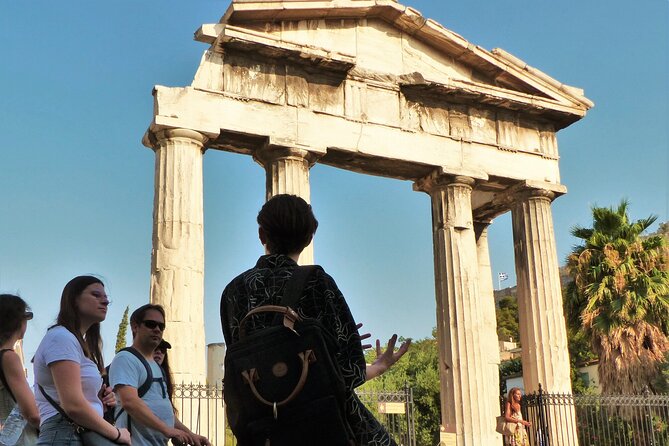
Athena at the Gate of Athena Archegetis
At the Gate of Athena Archegetis, the tour returns to married life in ancient Athens and Sparta, then brings in the myths connected with Athena. The goddess is an especially good figure for this discussion because she represents power, strategy, and civic identity, yet she is also a mythological figure shaped by a society controlled by men.
The contrast between an influential female deity and the restricted lives of many real women makes the mythology more interesting. You can ask what Athena represented to the city and how that ideal compared with women’s actual status.
This is also a good point to remember that the tour moves between mythology and documented social history. Athena, Pandora, and Penelope belong to stories and traditions. Sappho, Aspasia, and Agnodice are discussed as historical or historical-linked figures. The value comes from seeing how both myth and real life shaped ideas about women.
A women-only festival at Dioskouron
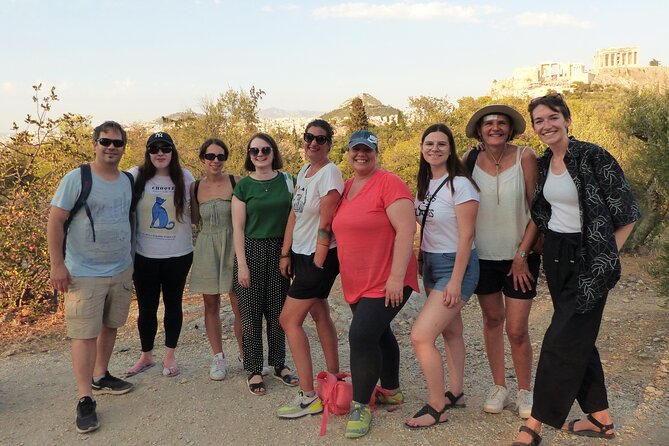
Dioskouron brings one of the route’s more unusual subjects: a mysterious ancient festival dedicated exclusively to women. The stop lasts about 10 minutes.
This part breaks up the familiar Athens narrative. Instead of focusing only on laws, marriage, or exclusion from politics, the tour considers a female space and a female religious event. It is a reminder that women were not absent from ancient society. They took part in rituals, family life, work, and cultural traditions, even when they were shut out of formal politics.
The short stop is enough to introduce the festival without turning the walk into a lecture. If you enjoy lesser-known historical details, this may be one of the most memorable moments on the route.
The Agora, seen from the outside
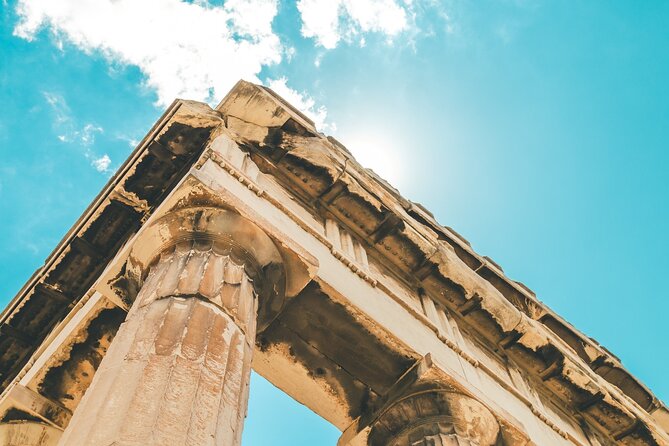
At the Ancient Agora, you look toward the marketplace and center of Athenian public life. The tour does not enter the archaeological site, but the outside view still gives the guide a strong setting for discussing women in public space.
Here the subject becomes especially direct. You learn about the lives of female slaves and courtesans, as well as the restrictions placed on women in the city. The Agora was a place where business, politics, and public contact met, yet women did not enjoy the same freedom to use it as male citizens did.
This stop adds necessary complexity. The phrase ancient Athenian democracy can sound broad and generous until you ask who could vote, speak, own power, or move freely in public. The tour keeps that question in view without pretending that all women had the same experience.
Because you only see the Agora from outside, I would pair this tour with a separate visit to the archaeological site if the ruins themselves are a priority. This walk is about interpretation and perspective, not a full site visit.
Areopagus and the cost of challenging the rules
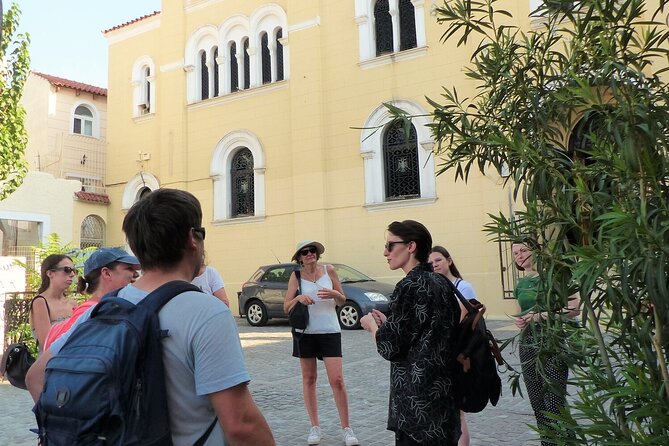
At Areopagus, you learn about the place where the worst sinners were tried in ancient times. The stop also introduces the story of a woman who risked a death sentence to change women’s rights.
This is a strong setting for the theme of resistance. The stone and height of Areopagus give the story a physical sense of judgment and danger. You are asked to think about what happens when someone challenges the rules of a society that has decided women should remain in a narrow role.
The stop lasts about 10 minutes. The terrain around Areopagus can be uneven, so take the mobility warning seriously. Even people who are comfortable walking in Athens should wear shoes with a firm grip.
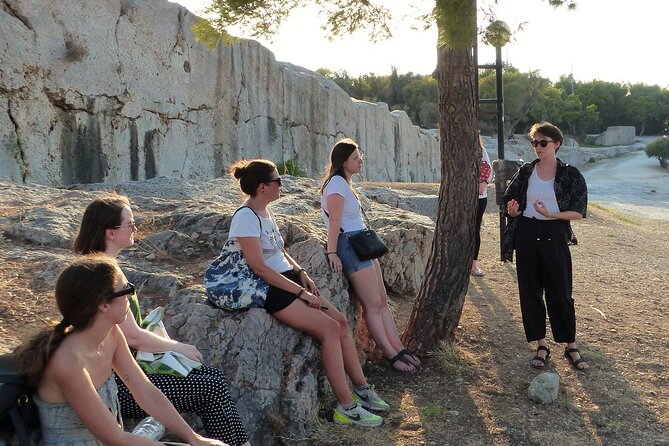
The Pnyx and women near political power
At the Pnyx, the tour reaches one of its clearest historical contrasts. This is where democracy began in Athens, but only male citizens could vote. Women were excluded from that formal political role.
The story does not end with exclusion. You also hear about a woman who influenced Athenian politics during the Golden Age. Aspasia is central to the tour’s appeal, especially for anyone interested in the gap between official power and informal influence.
This is a useful distinction. A person may lack a vote yet still shape ideas, relationships, policy, or public debate. The discussion of Aspasia, described as a philosopher and companion of Pericles, gives the Pnyx a human angle. You are not only looking at where men gathered to vote. You are asking who else helped shape the world those men governed.
The Pnyx also reinforces the tour’s larger point: history often records the institutions but leaves out the people who lived around them.
Philopappos Hill closes with the Acropolis view
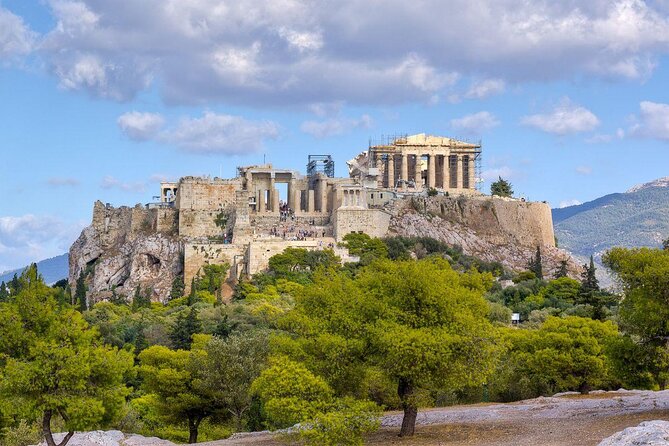
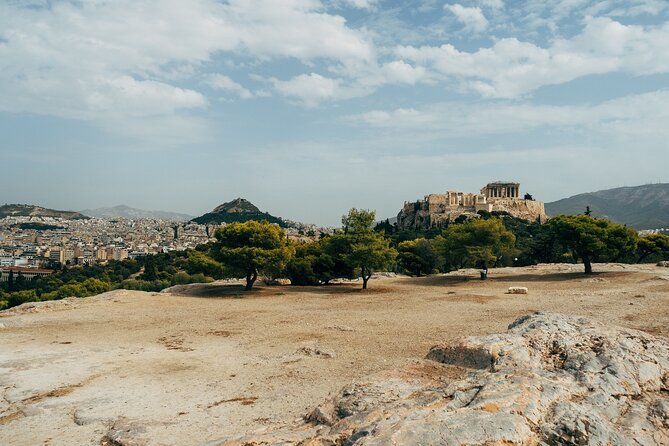
The final stop is Philopappos Hill, also called the Hill of the Muses. You finish beneath the trees with a view toward the Acropolis, a fitting end to a tour about memory, stories, and the people left out of traditional accounts.
The stated walking time at this stop is about 10 minutes, but reaching it involves an uphill route. The reward is the view rather than another museum or monument. From here, the Acropolis becomes a visual reminder of the city whose social rules you have been examining.
The end point is on Philopappos Hill, near the center and within walking distance of public transportation. You can continue exploring on foot or make your way to the metro. The tour does not return you to Monastiraki, so plan your next stop from Philopappos Hill rather than assuming you will finish where you began.
What the two-hour format gives you
Two hours is enough time to cover the route without turning the experience into an all-day commitment. You get nine stops, several major Athens landmarks, and a clear subject running through the whole walk.
The tradeoff is depth. Each location receives roughly 10 to 15 minutes, so you will hear a focused explanation rather than a long seminar on every figure. If you want extensive archaeological detail, this is not the right replacement for a museum visit or a dedicated Acropolis tour.
I see the compact format as a strength for a first or second day in Athens. It gives you a fresh frame for places you may already plan to visit. It also works well as a companion to a standard ancient-sites tour, since it is less likely to repeat the usual focus on temples, battles, and male leaders.
The value of $44.71
At $44.71 per person, the price is reasonable for a two-hour, small-group experience in central Athens, especially because the group limit is 12. You are paying for a specialized theme and a guide-led interpretation rather than entrance tickets.
No admission fees are included because the route views the sites from outside. That can feel like a limitation if you want to enter Hadrian’s Library or the Agora, but it also means you can choose and pay for those archaeological sites separately according to your interests.
The tour is often booked about 37 days ahead, so I would not leave it until the last minute if your dates are fixed. Group discounts are available, which may help if you are booking for several people.
The strongest value is the subject. Standard sightseeing can tell you where the Agora was and what the Pnyx meant. This walk helps you ask who was allowed into those spaces, who had power there, and who was left out.
Who should book this walk
I would recommend it to anyone who wants more than the familiar male-centered version of Greek history. It is particularly well suited to history students, families with older children, and people who enjoy mythology but want to connect it with real social conditions.
A 15-year-old with an interest in women’s rights could get a lot from the discussion, especially because the tour links ancient restrictions with themes that still matter today. The approach is also broad enough for people who simply want a different way to understand Athens.
You should think twice if your main goal is entering monuments. You should also avoid it if hills, uneven surfaces, or two hours of walking would be difficult. The experience requires good weather, and poor weather can lead to a rescheduled date or full refund.
Free cancellation is available until 24 hours before the start time. Changes or cancellations inside that window are not accepted for a refund.
Should you book the Women’s History in Ancient Greece walk?
Book it if you want a thoughtful, focused look at how women lived, worked, loved, worshipped, and pushed against the limits of ancient society. Maelle’s presentation is repeatedly praised for being warm, well prepared, funny, inclusive, and easy to follow, and the tour’s five-star rating from 38 reviews supports that picture.
I would place it early in an Athens visit if you want a fresh lens for later visits to the Acropolis, Agora, and museums. Just remember what you are buying: a two-hour outdoor conversation with landmark views, not an archaeological-site admission tour.
For $44.71, the combination of a small group, a rare subject, and a strong final view over the Acropolis makes this a sound choice for curious walkers who want Athens to include more than its most famous men.
FAQ
How long does the tour last?
The walking tour lasts approximately two hours.
Where does the tour begin?
It begins at Pl. Monastirakiou 2 in Monastiraki, Athens.
Where does the tour end?
It ends at Philopappos Hill, which is close to central Athens and has access to public transportation.
Does the tour enter the ancient archaeological sites?
No. The route passes major locations and views the Ancient Agora from outside. Admission tickets are not included.
How large is the group?
The tour has a maximum of 12 participants.
Is the tour suitable for people with mobility issues?
It is not recommended for people with mobility issues because the route includes walking and hills, ending at Philopappos Hill.
Can I cancel for a full refund?
Yes. You can cancel at least 24 hours before the local start time for a full refund. If poor weather cancels the experience, you will be offered another date or a full refund.
More Walking Tours in Athens
- Athens: Acropolis and Parthenon Guided Walking Tour
★ 4.6 · 5,882 reviews - Greek Food Walking Tour in Athens
★ 5.0 · 4,740 reviews - Acropolis: Acropolis and Parthenon Guided Walking Tour
★ 4.7 · 3,442 reviews - Acropolis monuments & Parthenon Walking Tour with Optional Acropolis Museum
★ 5.0 · 2,678 reviews
New on the Athens shelf
- Ceramic and Pottery Creative Workshop with Two Local Artists★ 4.0 · 57 reviews
- Athens: Greek Wines Tasting with Sommelier and Acropolis Views★ 5.0 · 88 reviews
- Acropolis of Athens, Parthenon and Acropolis Museum private tour with dinner★ 5.0 · 77 reviews
- Small-Group Wine Tour in Athens with Tasting★ 5.0 · 33 reviews
- Private Athens Transfer Airport/Port -Greek Tours-Hourly service★ 5.0 · 88 reviews
- VIP Private Guided Tour of Athens Acropolis & Plaka in a Sidecar★ 5.0 · 108 reviews
- Athens Moonlight Waling Tour with Drinks and Meze Dishes★ 5.0 · 259 reviews
- Private Athens Landmarks Layover Tour★ 4.5 · 41 reviews
Ancient Sites, compared.
Acropolis & up to 5 Archaeological Sites Combo Pass
Read our verdict →

National Archaeological Museum Ticket & Audio Guide
Read our verdict →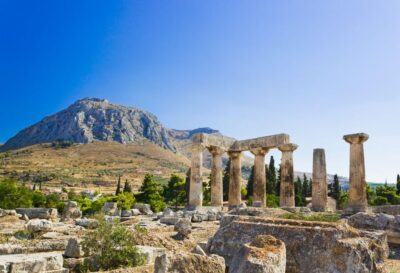
Ancient Corinth Day Trip with Canal & VR Guide
Read our verdict →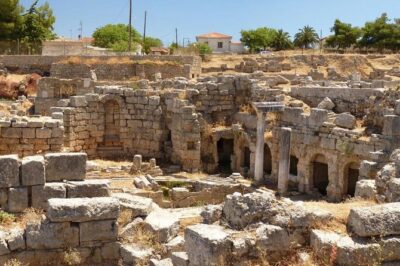
Private Biblical Tour Ancient Corinth & Isthmus Canal from Athens
Read our verdict →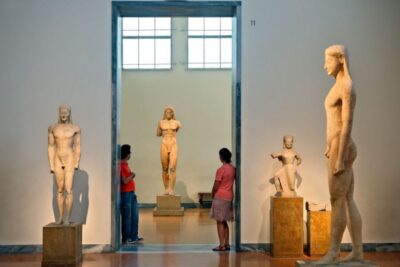
National Archaeological Museum Ticket w/ Opt. Audio
Read our verdict →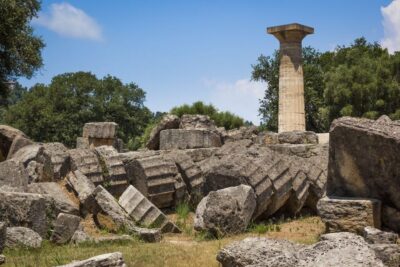
Ancient Olympia: Archaeological Site and Museum Entry Ticket
Read our verdict →
Delphi: Archaeological Site & Museum Ticket with Audio Tours
Read our verdict →Browse the lists this tour appears in