
Review · CORINTH TOURS
Biblical Corinth Taste Faith & History with wine & Oil Tasting
Corinth gives you an unusually broad slice of Greece in a short outing: an ancient trade city, a modern canal, the route used to move ships overland, a site linked to Saint Paul, and a fortress high above the plain. The private ride from Athens makes the day easy, and guides such as Nikos, Panos, Andreas, and Periklis have been especially good at turning a car journey into a moving history lesson.
I like the small private group format, with a sedan for one to three people or a minivan for four to seven. I also like the flexibility: drivers have adjusted routes for lunch, extra photo stops, and even a bungee jump. The main caution is that the $190.46 price does not cover every major cost. Entrance fees, lunch, wine tasting, oil-tasting food, and an optional licensed guide are extra.
Key points to know before booking
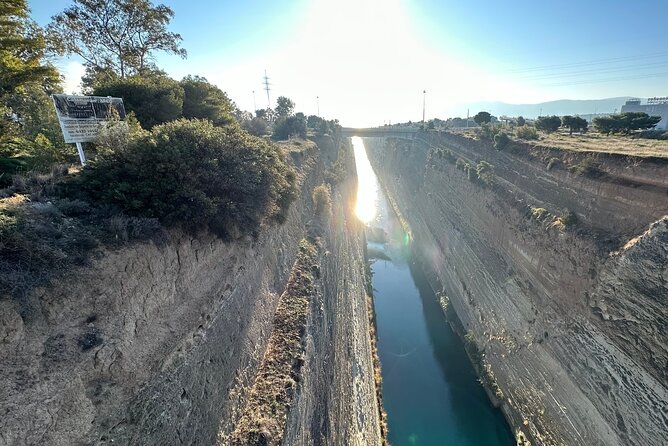
- See the Corinth Canal and ancient Diolkos together: One is a 19th-century engineering feat, the other an ancient track for hauling ships over the isthmus.
- Follow the Corinth of Saint Paul: Isthmia and Ancient Corinth connect the physical sites to the New Testament story.
- Reach Acrocorinth for the best view: The fortress sits on a huge rock above the ancient city and the route into the Peloponnese.
- Expect a driver-led tour: Your English-speaking driver explains the places, but a licensed guide costs an additional €140 per person if requested.
- Budget for add-ons: Site admissions are listed at €15 per person, while wine tasting costs €15 and oil-tasting finger food costs €80 per person.
- Check opening days carefully: Ancient Corinth was closed on one Tuesday during a film production, leaving one of the main stops unavailable.
Why Corinth makes a strong half-day trip from Athens

Corinth is not simply a collection of old stones outside Athens. Its location explains its importance. The narrow isthmus joins mainland Greece to the Peloponnese, so Corinth controlled a land bridge, two nearby gulfs, trade routes, and access into southern Greece.
The ancient city grew wealthy through commerce and agriculture. By 400 BC, it had a population of about 90,000, a remarkable size for the ancient world. Rome destroyed the city in 146 BC, then rebuilt it in 44 BC. The Roman version later became the provincial capital of Greece.
That mix gives you several different stories in one day. You can look at the canal and think about modern shipping. At Diolkos, you see how ancient people solved the same transport problem without modern machinery. At Ancient Corinth, you walk through Greek and Roman remains. At Acrocorinth, you see why armies fought for this narrow gateway.
The religious story matters too. Saint Paul spent time in Corinth, and the city appears in Acts and in the First and Second Letters to the Corinthians. The tour gives that story a physical setting rather than leaving it as a name on a page.
More trips in the footsteps of St Paul:
- Biblical Tour Letters ToThe Corinthians St Paul’s Footsteps 6Hour
★ 5.0 · 1,065 reviews - Private Biblical Tour Ancient Corinth & Isthmus Canal from Athens
★ 5.0 · 762 reviews - Private Tour of Apostle Paul’s Footsteps in Ancient Corinth
★ 5.0 · 275 reviews
A private ride with room to change the plan
Pickup is offered from an Athens hotel, apartment, or port. At a hotel, the driver waits in the lobby. At an apartment, the meeting point is the building entrance. Port pickup takes place at the gate, with a name sign. Airport pickup is also possible for an additional €60 per person.
The vehicle depends on your group size. One to three people travel in a luxury sedan. Four to seven use a minivan. Both options include air conditioning, WiFi, bottled water, fuel, and tolls. Child seats can be requested in advance.
This setup is a major part of the tour’s appeal. You are not placed on a large bus with a fixed script. The driver can stop for photographs, suggest a lunch spot, and adjust the schedule. One group even changed the plan to allow time for a bungee jump before visiting Acrocorinth.
You should still remember that this is mainly a driver-led experience. The driver explains the sites and local history, but the standard package does not include a licensed guide. If you want formal guiding inside the archaeological areas, request one ahead of time and budget the extra €140 per person.
The Corinth Canal: a short stop with a big idea
The first stop is the Corinth Canal, where the modern waterway cuts through the isthmus. It links the Gulf of Corinth with the Saronic Gulf and turns the Peloponnese into, technically, an island.
You have about 15 minutes here, so think of it as a photo and orientation stop rather than a full visit. The canal is impressive because of what it changed. Before it opened in the late 19th century, ships had to sail around the Peloponnese, adding about 185 nautical miles to the journey.
The idea was ancient. Periander, the tyrant of Corinth, is credited with considering a canal around 602 BC. The technology was not ready for such a project, so the practical answer was the Diolkos.
Diolkos: the ancient shortcut for ships
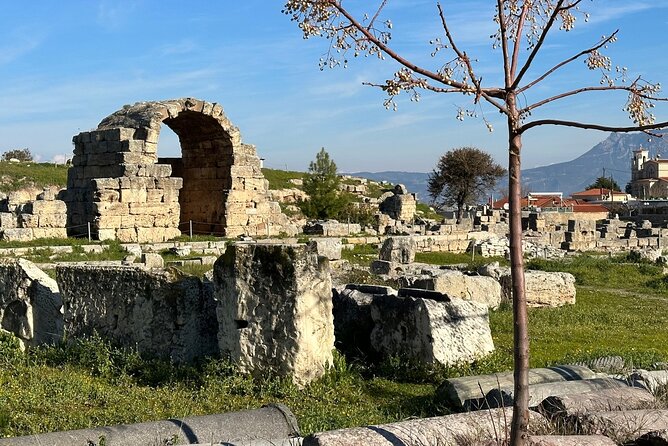
The Diolkos is one of the most unusual parts of the route. This paved trackway allowed boats to be moved overland across the isthmus. It covered roughly 6 to 8.5 kilometers and operated from about 600 BC until the middle of the first century AD.
The system combined water transport and overland hauling in a way that resembles a very early railway. It helped move goods, and in wartime it allowed naval forces to shift between the two gulfs without sailing around the peninsula.
You get about 20 minutes here. That is enough to understand the basic design and why Corinth became such a powerful commercial center. The site may not deliver the visual punch of a temple, but it rewards anyone who enjoys practical ancient engineering.
More Wine Tours in Corinth:
- Santorini Wine Adventure with 12 Wine Tastings, Tapas and Sunset
★ 5.0 · 1,715 reviews - Tour and Wine Tasting in Mykonian Land
★ 5.0 · 1,357 reviews - Santorini Wine Stories: Sunset Tour with Tasting & Dinner
★ 5.0 · 1,285 reviews - Athens: Classic Cooking Class with Market Visit and Wine
★ 5.0 · 1,101 reviews
Isthmia and the world of the Isthmian Games
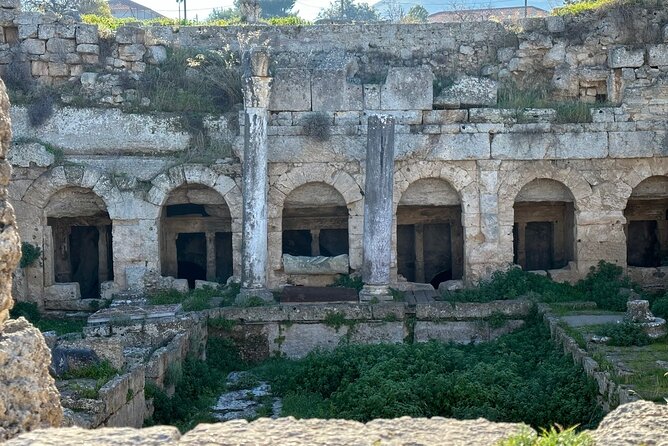
The next stop shifts from transport to sport and religion. Isthmia hosted the Isthmian Games, the second most important athletic contests in the ancient Greek world after the Olympic Games at Olympia.
The location was strategic. Isthmia sat where the Peloponnese met central Greece, bringing athletes, officials, visitors, and traders through the same narrow corridor. The connection to Saint Paul adds another layer. The tour presents his work in the region and his association with the games, along with the tradition that he worked as a tent maker while preaching to people connected with the event.
You spend about 30 minutes here, followed by a 20-minute visit to the Archaeological Museum of Isthmia. The museum contains a useful range of objects, including a marble pediment from the first Temple of Poseidon, glass panels from Alexandria, a statue in the type of Zeus, commercial amphorae, animal figurines, weapons, and offerings.
The museum is especially valuable if you want more than broad ruins. The glass pieces show harbor scenes, plants, animals, ships, and figures such as Homer and Plato. They help you picture the trade networks that supported Corinth and Isthmia.
Admission is not included, so factor in the listed entrance charge before you go.
Ancient Corinth: the central visit
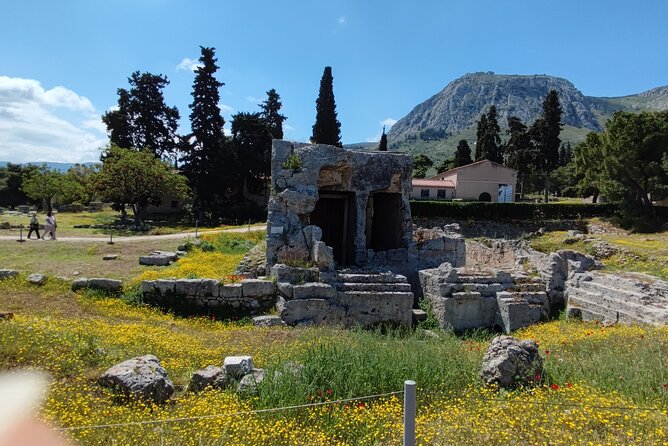
Ancient Corinth is the heart of the outing. You get about an hour at the archaeological site, followed by another 30 minutes in the Archaeological Museum of Corinth and 15 minutes at the Temple of Apollo.
The site lets you see how Greek and Roman Corinth overlapped. The Roman rebuilding followed the destruction of the earlier city, and the remains reflect both periods. Important features include the Lechaion Road, the agora, the Fountain of Peirene, the basilica, the stoa, the Odeion, and the Hadgimoustafa spring.
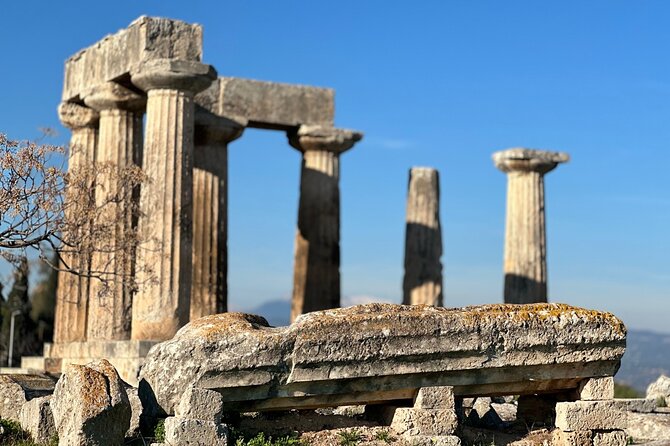
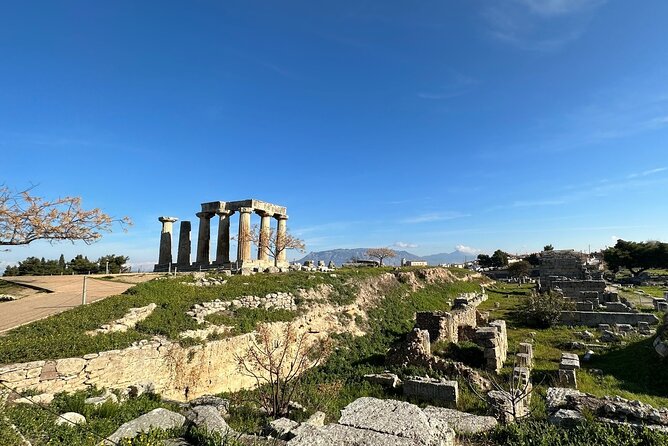
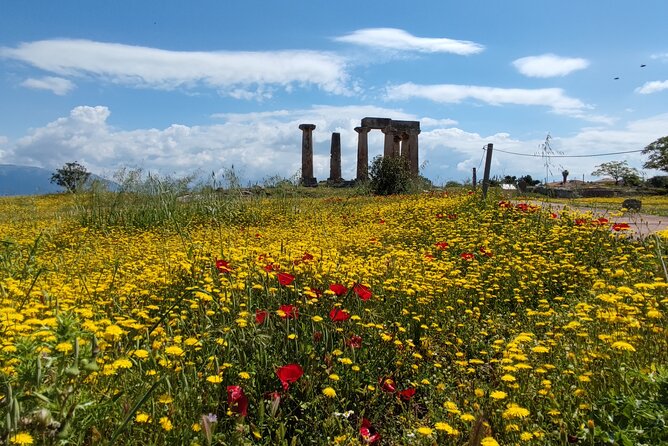
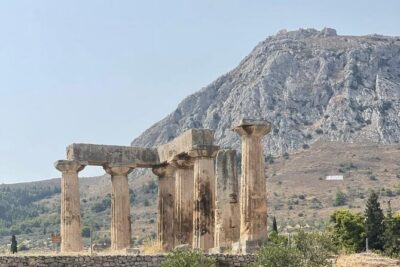
The Temple of Apollo is the visual anchor. Built around 550 BC, it is one of the earliest Doric temples in the Peloponnese and mainland Greece. Its monolithic columns are unusual because each column was made from a single piece of stone.
The museum helps fill in the details that the open site cannot. It was built in 1931 and 1932 to display finds from the excavations. After looking at roads, fountains, temples, and public buildings outside, you can use the museum to understand the objects and styles found there.
A practical warning matters here: check the opening schedule before you pay. Ancient Corinth was closed on a Tuesday during a film production, and the tour continued without its main archaeological stop. The company said the closure schedule was not available in advance, but you should still confirm current conditions, especially if Ancient Corinth is your chief reason for booking.
Lunch, shopping, and a flexible middle break
The schedule allows about 45 minutes for lunch and shopping in Ancient Corinth. The meal is not included, and the driver can suggest a place. This is useful because a private tour does not force you to eat at a set restaurant or spend a long time over lunch.
You should keep expectations realistic. Forty-five minutes is a short meal break, not a leisurely afternoon. If you want a slower lunch, more shopping, or a longer visit at the ruins, ask whether the route can be adjusted. The private format gives you some room, but the overall tour lasts about five hours.
Acrocorinth: the strongest final view
Acrocorinth is the high point, both literally and often emotionally. This monolithic rock served as the acropolis of ancient Corinth and later as a fortress. Its secure water supply and commanding position made it a final defensive post for southern Greece.
The fortress controlled the isthmus, which meant it could help block land access into the Peloponnese. That strategic role becomes clear when you look down toward the ancient city and the narrow route between mainland Greece and the peninsula.
The scheduled visit lasts about 30 minutes. That gives you time for the main view and a quick sense of the fortress, but not an unhurried exploration of every corner. One guest who booked the tour specifically said the castle was so impressive that a full-day version would have been better. If Acrocorinth is your main goal, ask about extending the tour rather than trying to squeeze it into the shortest schedule.
The view is one of the tour’s best rewards. You can connect the ancient city below, the isthmus, and the wider route into the Peloponnese in one glance.
Wine and olive oil tasting: attractive extras, not automatic inclusions
The title highlights wine and oil tasting, but you should read the cost details carefully. Wine tasting is listed at €15 per person. Oil-tasting finger food is listed at €80 per person, which is a substantial extra charge and worth confirming before booking.
The tasting can give the day a more relaxed local-food element after the ruins. One person described the wine portion as a pleasant balance to the educational parts of the outing. Still, the supplied schedule does not identify a separate tasting stop or explain how long either tasting lasts.
Ask the operator exactly what is included, where the tasting takes place, and whether the oil charge applies to the whole group or per person. Do not assume that tasting is covered by the headline tour price.
What the $190.46 price really buys you
At $190.46 per person, this is not a budget bus excursion. You are paying for a private vehicle, Athens pickup and return, fuel, tolls, air conditioning, WiFi, bottled water, and a flexible driver-led route.
For two or three people, the price can make sense because you gain privacy and control without paying for a full private guide from the start. For a group of four to seven, the minivan format may offer stronger value because the transport cost is spread across more people.
The price becomes less attractive once you add everything. Entrance fees are not included, with €15 per person listed for the attractions and Ancient Corinth separately identified at €15. Lunch is extra. Wine tasting adds €15 per person. Oil-tasting finger food adds €80 per person. A licensed guide costs another €140 per person, and airport pickup costs €60 per person.
Before booking, ask for the exact current total. The fee information lists attractions in more than one place, so you want to know which admissions are covered by the stated €15 and which are not.
The driver can make or break the day
The strongest part of this experience is the human side of the transport. Nikos is described as entertaining and willing to offer choices. Panos is praised for explaining the ruins when the site information was limited. Andreas helped with a custom plan involving a bungee jump, while Periklis added historical context during the drive, including the Battle of Marathon.
Christos is also specifically praised for answering questions and sharing practical tips. You are not guaranteed a particular driver, so treat these names as examples of the service style rather than a promise. If a certain driver matters to you, ask the company before confirming.
The drivers are not just silent chauffeurs. Their explanations can help connect the canal, the ancient trade routes, Saint Paul, the games at Isthmia, and the fortress above Corinth. But if you want formal archaeological interpretation, the optional licensed guide is the safer choice.
Who should book this Corinth tour?
I would choose this outing if you want to see several Corinth highlights without arranging a rental car or public transport. It suits couples, families, and small groups who value door-to-door service and want the day adjusted around lunch, photographs, or another activity.
It is also a good fit for people interested in Saint Paul, ancient engineering, Greek and Roman ruins, or military history. The combination of Diolkos, Isthmia, Ancient Corinth, and Acrocorinth gives you more range than a simple ruin visit.
I would hesitate if you want a slow archaeological day. The five-hour schedule covers a lot, and several stops last only 15 to 30 minutes. You may prefer a longer private itinerary if the museum collections, Acrocorinth, or Ancient Corinth deserve more time.
The tour also needs careful checking before departure. Confirm that Ancient Corinth, its museum, Isthmia, and Acrocorinth are open on your date. Ask for a full price including admissions and any tastings. Free cancellation is available up to 24 hours before the start time, but changes or cancellations inside that window are not refunded.
Should you book it?
Book this tour if you want private transport, flexible stops, and a wide introduction to Corinth in one manageable day. The canal, Diolkos, Saint Paul connections, ancient ruins, museum objects, and Acrocorinth view make a strong combination.
Skip it or extend it if your priority is a slow, guide-led archaeological study. The basic package is driver-led, several costs sit outside the advertised price, and five hours can feel tight. For most small groups leaving Athens, though, it is a practical way to reach Corinth and understand why this narrow strip of Greece mattered so much.
FAQ
How long does the Corinth tour last?
The tour lasts approximately five hours, including visits to the Corinth Canal, Diolkos, Isthmia, Ancient Corinth, and Acrocorinth.
Is pickup from Athens included?
Yes. Pickup and drop-off are offered from an Athens hotel, Airbnb residence, or port. Airport pickup is available for an additional €60 per person.
How many people can join the private tour?
Groups of one to three people travel in a luxury sedan. Groups of four to seven use a minivan. Only your group participates.
Is a licensed tour guide included?
No. The standard experience includes an English-speaking tour driver. A licensed guide can be requested for an additional €140 per person, depending on availability.
Are entrance fees included?
No. Entrance fees are listed separately, including €15 per person for the attractions and €15 for the Archaeological Site of Ancient Corinth.
Are lunch and tastings included?
No. Lunch is not included. Wine tasting is listed at €15 per person, while oil-tasting finger food is listed at €80 per person.
Can I cancel for a full refund?
You can cancel at least 24 hours before the experience start time for a full refund. Cancellations or changes made less than 24 hours in advance are not refunded, and poor-weather cancellations may be moved to another date or fully refunded.
More Historical Tours in Corinth
- Historical Delphi One Day Tour with Arachova Stop & Expert Guide
★ 4.5 · 1,247 reviews - Historic Athens: Small Group Electric Bike Tour
★ 4.9 · 740 reviews - Naxos Half Day History and Culture Guided Tour
★ 5.0 · 491 reviews - Naxos: Half-Day Guided History and Culture Sightseeing Tour
★ 4.7 · 435 reviews
More Food Tours in Corinth
- Greek Food Walking Tour in Athens
★ 5.0 · 4,740 reviews - Athens: Street Food Tasting Tour
★ 4.9 · 2,557 reviews - Small Group Greek Traditional Food Tour in Athens 20+ Tastings
★ 5.0 · 1,759 reviews - Crete: Sunset or Morning Quad with Local Products Tasting
★ 4.9 · 1,135 reviews
New on the Corinth shelf
- The Apostle Paul’s Missionary Journey in Athens and Corinth★ 5.0 · 50 reviews
- Ancient Corinth, Sanctuary of Hera, Blue Lake & Canal from Athens★ 5.0 · 26 reviews
- Biblical Tour Letters to The Corinthians – St Paul’s Footsteps★ 5.0 · 60 reviews
- Ancient Olympia (birth place of Olympic Games) & Corinth Canal, Private Day Tour★ 5.0 · 28 reviews
- Biblical Corinth: St. Paul and His Letters to the Corinthians★ 5.0 · 70 reviews
- Footsteps of Apostle Paul from Athens to Corinth, Private Day Tour★ 5.0 · 54 reviews
- Ancient Corinth Half Day Private Tour from Athens★ 5.0 · 34 reviews
- Corinth Canal Cruise, Ancient Corinth & Acrocorinth Private tour★ 5.0 · 36 reviews
Corinth Tours, compared.
Ancient Corinth Day Trip with Canal & VR Guide
Read our verdict →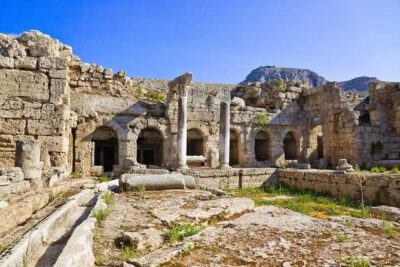
Biblical Tour Letters ToThe Corinthians St Paul’s Footsteps 6Hour
Read our verdict →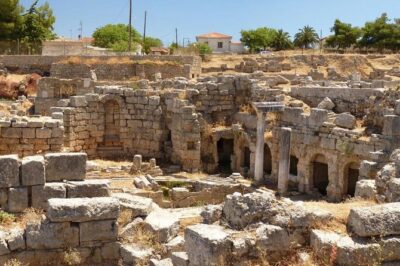
Private Biblical Tour Ancient Corinth & Isthmus Canal from Athens
Read our verdict →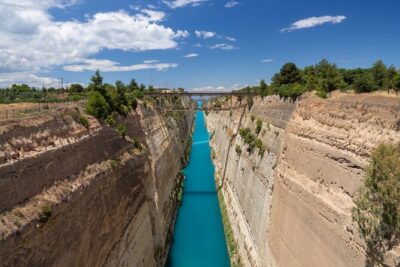
Private Tour of Apostle Paul’s Footsteps in Ancient Corinth
Read our verdict →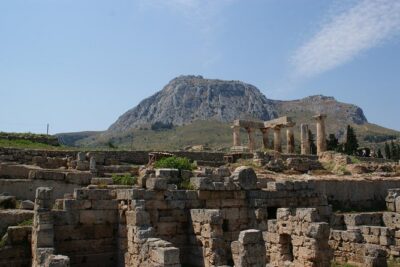
Corinth Half-Day Trip from Athens with Entrance Tickets
Read our verdict →
Sea Kayak Epidavros – Ancient Sunken City Tour
Read our verdict →
Browse the lists this tour appears in