Review · GUIDED
Athens: Guided Urban Street-Art Tour
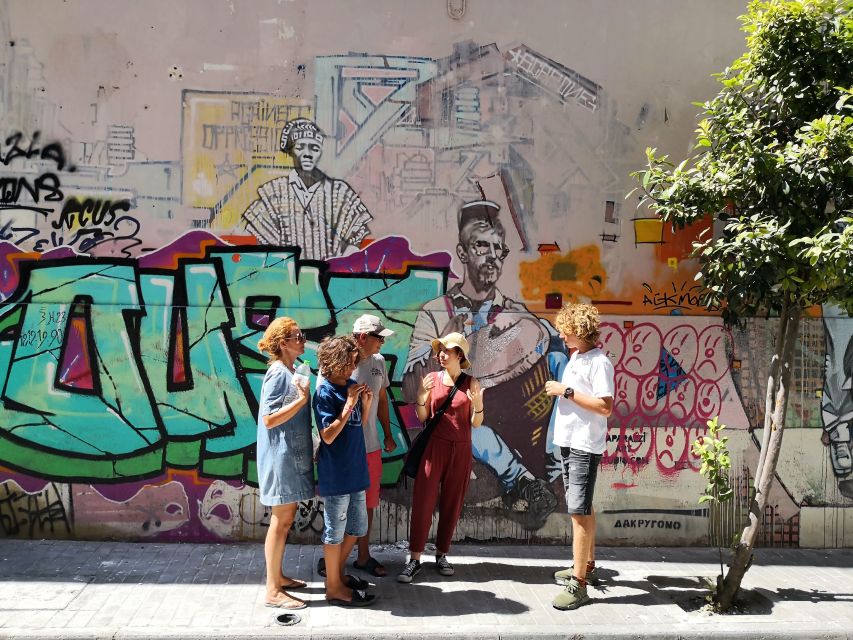
Athens puts its modern story on walls. This two-hour walk follows murals, graffiti, and smaller works from Monastiraki through Psyri, Sarri, Omonoia, and Metaxourgeio, showing you a side of the city that ancient ruins cannot. I especially like the way guides such as Penelope, Eleni, Katerina, Greg, and Pascal explain the social and political messages behind the images, rather than treating the art as background for photographs.
I also like that the route moves through real neighborhoods, including small alleys and courtyards, instead of sticking to the usual monuments. You get a useful look at how Greece’s financial crisis and changing city life shaped its artists. The main drawback is simple: this is a fairly brisk walk, and summer heat can make the two hours tiring, especially for children or anyone who prefers a slower pace.
Key points to know before booking
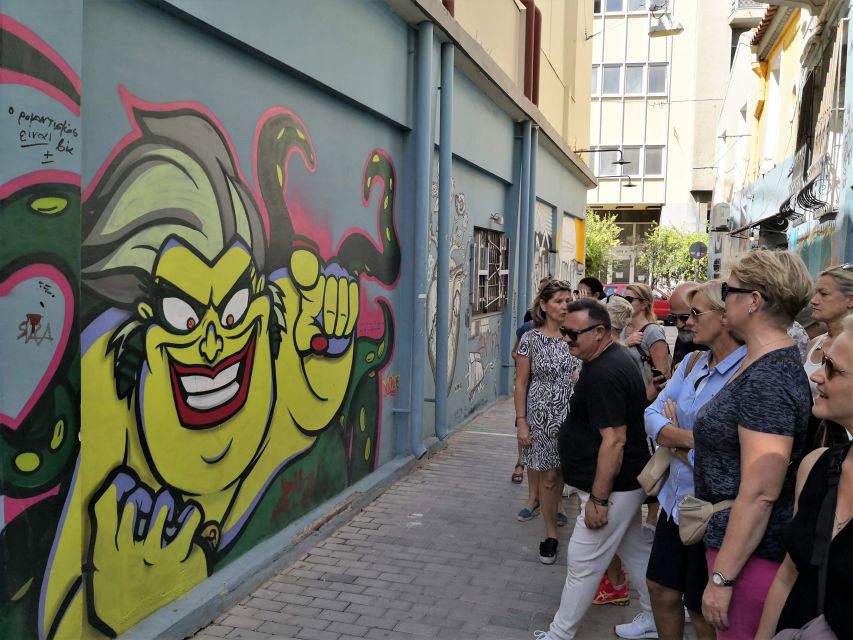
- A modern Athens route: Walk from Monastiraki to Metaxourgeio through Psyri, Sarri, and Omonoia.
- Art with context: Learn how political events, social pressures, and Greece’s financial crisis appear in murals and graffiti.
- Strong English-speaking guides: Penelope, Eleni, Katerina, Greg, and Pascal have all led this experience.
- A real neighborhood walk: Expect narrow lanes, courtyards, local streets, and areas you may not reach on a classical Athens tour.
- Two hours on foot: The route includes frequent walking at a decent pace, with stops to look, ask questions, and take photos.
- Good value for art lovers: At $47 per person, the price pays for interpretation and local insight, not just a list of painted walls.
Why Athens street art deserves two hours
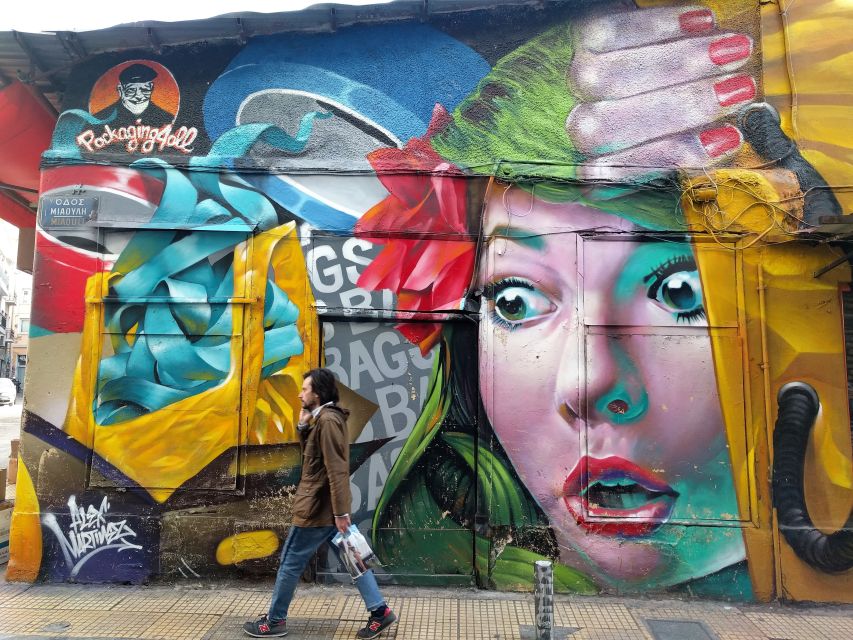
If you spend several days in Athens looking mainly at temples, museums, and archaeological sites, this tour gives you a useful change of focus. The city’s walls act like an open-air noticeboard. Artists respond to politics, money troubles, social tension, local identity, and everyday life with images that can be funny, angry, poetic, or difficult to decode.
You are not simply shown a large mural and told who painted it. The guide explains the visual language: repeated symbols, political references, different techniques, and the difference between an illegal tag, a commissioned mural, and a carefully planned piece. That context matters because street art can look random when you first see it.
I like the fact that the walk treats the art as part of Athens, not as a separate attraction. You pass cafés, apartment blocks, shops, side streets, and working neighborhoods. The setting helps you understand why a particular wall matters and how the city’s changing districts affect the work being made there.
The experience is also a useful introduction for people who do not usually follow graffiti. You do not need to know artists’ names or recognize styles before arriving. Your guide helps you look up, scan the edges of buildings, and notice work that you might otherwise pass without seeing.
A few more Athens options worth putting side by side
- Athens: Acropolis & up to 5 Archaeological Sites Combo Pass
★ 4.4 · 12,619 reviews - Athens: Acropolis Ticket with Optional Audio or Live Guide
★ 4.2 · 11,055 reviews - Athens: Acropolis, Parthenon & Acropolis Museum Guided Tour
★ 4.8 · 9,316 reviews
Starting beside Monastiraki metro
The meeting point is at Athinas 7, in front of the Lonis pastry shop, next to the Monastiraki metro station exit on Athinas Street. This is a practical starting point because Monastiraki is easy to reach and already places you close to several central districts.
Look for the pastry shop rather than expecting a large tour sign. If you arrive by metro, use the Athinas Street exit. It is worth arriving with enough time to find the correct exit, especially if you are unfamiliar with Monastiraki’s busy streets and several nearby entrances.
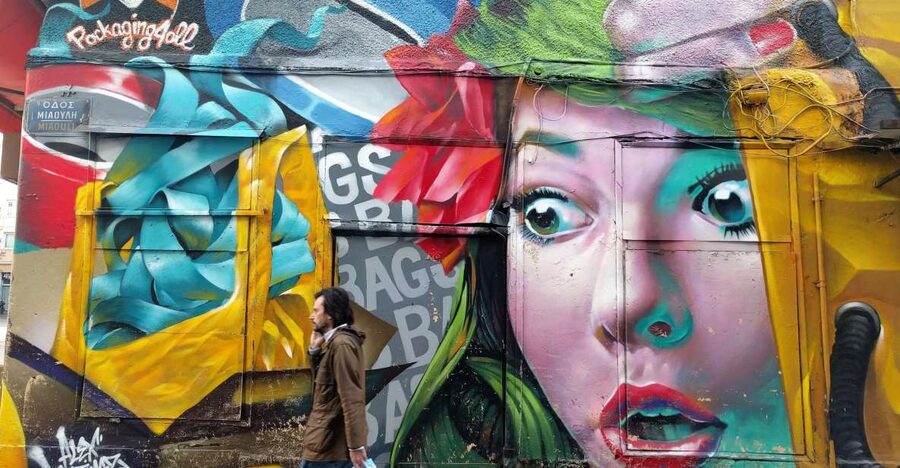
The first walk takes you toward Monastiraki and then onward into Psyri. This opening stretch helps set the tone. You begin in one of central Athens’s best-known areas, then move away from the postcard version of the city and into streets where art appears on shutters, walls, garages, and building sides.
The guide may point out work that is easy to miss at eye level. One useful lesson from the walk is to look above shopfronts and along side walls, not just straight ahead. Some pieces are large and obvious. Others reveal themselves only when you slow down and study the surrounding buildings.
Psyri, where art and nightlife meet
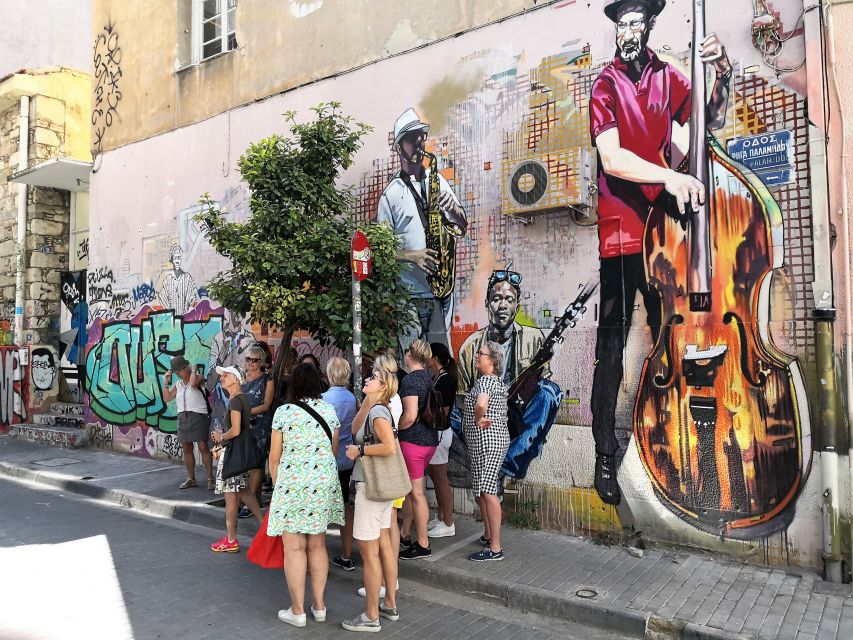
The route allows about 40 minutes for the walk through Psyri, making this one of the main sections of the experience. Psyri is a lively central district with a mix of restaurants, bars, small businesses, old buildings, and narrow streets. That variety gives street artists plenty of surfaces and plenty of subjects.
Here, your guide can explain how the neighborhood has changed and how its character affects the art. Some works may be commissioned, while others reflect the rougher, less controlled side of urban expression. The point is not to decide that one type is better. It is to understand the different intentions behind each piece.
Psyri is also where the guide’s local connection becomes especially useful. Greg, who has been described as an artist himself, has led walks that focus on his affection for the neighborhood and Athens’s art scene. A guide with that sort of personal interest can help you see more than a sequence of colorful walls.
You should expect to stop often. The guide may discuss an artist’s method, the age or condition of a work, and how one image connects to wider events in Greece. Some pieces will have changed, faded, or been painted over by the time you arrive. That is part of street art’s nature, and it means the route is about understanding the scene as much as collecting a fixed list of murals.
Platia Iroon and the move toward Sarri
After Psyri, the route continues toward Platia Iroon, with roughly ten minutes of walking. This section provides a short transition between major stops and keeps the experience rooted in the city rather than turning it into a gallery tour.
From there, you walk for about 15 minutes toward Sarri. Small streets and side routes are central to the experience. You may pass through places you would not choose on a first visit because they are not major sightseeing targets, yet they help show how street art is spread through the city.
The guide’s job here is partly translation. Images can carry local references that are not obvious to an English-speaking visitor. A symbol, slogan, or portrait may connect to a political dispute, a period of hardship, or a broader feeling about city life. Asking questions is encouraged, and guides such as Penelope and Katerina have been praised for explaining ideas clearly and involving the group.
This is also a good place to keep your expectations realistic. Street art is not arranged like a museum collection. There may be a spectacular mural beside a rough tag, a work with a clear message beside one that remains mysterious, or a piece altered by weather and later painting. The contrast is part of what makes the walk feel like an encounter with a living city.
Close by, and nothing like it:
- Athens: Acropolis and Parthenon Guided Walking Tour
★ 4.6 · 5,882 reviews - Athens, Piraeus, and Coastline: Blue Hop-On Hop-Off Bus
★ 3.9 · 4,849 reviews - Greek Food Walking Tour in Athens
★ 5.0 · 4,740 reviews - Athens: City Sightseeing Hop-On Hop-Off Bus Tour
★ 4.3 · 4,520 reviews
Omonoia and the harder side of the city
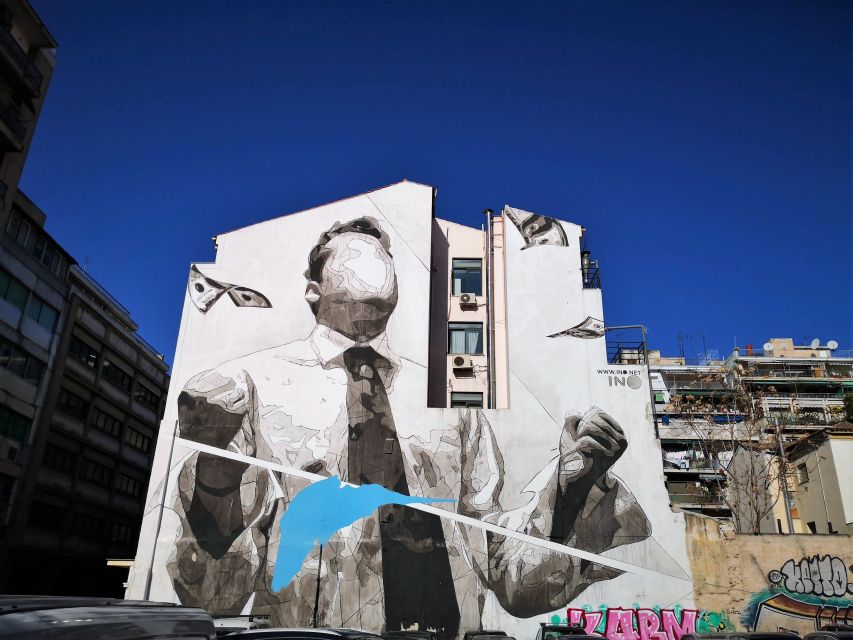
The route then takes you toward Omonoia, with about 15 minutes of walking. Omonoia is an important central Athens area, and the transition helps place the art within the city’s wider social setting.
The tour does not present Athens as a polished stage set. You see parts of the center that can feel rougher, more worn, or less familiar to a first-time visitor. That may be uncomfortable for some people, but it is also why the experience offers something different from a standard central-city stroll.
This is where the discussion of Greece’s financial crisis becomes especially useful. The art can reflect unemployment, economic pressure, political frustration, migration, and anger at institutions. The guide explains these subjects without reducing every wall to a single political slogan.
Expect the guide to separate fact from interpretation. A good street-art explanation should tell you what is known about the artist and work, then allow room for your own response. Guides including Eleni, Greg, and Pascal have been praised for linking art with modern Greek society and the changes Athens has experienced.
If you are traveling with older relatives or anyone who needs frequent breaks, tell the guide early. The walking pace has been described as steady, though there are stops to rest, observe, and ask questions. One group specifically appreciated having enough time at each work, while another had to end early during hot weather.
Metaxourgeio and the final works
The final major section takes about 30 minutes as you move into Metaxourgeio. The walk ends at Metaxourgeio Square, so you finish in a different part of central Athens from where you began.
Metaxourgeio is known on this route for its strong concentration of urban art and its mix of old structures, side streets, and changing city life. The final stretch gives the guide room to bring together the themes introduced earlier: artistic technique, political expression, neighborhood change, and the difference between local and international artists.
You may see both wild and commissioned work. That distinction matters. A commissioned mural can be large, polished, and intended to remain in place. Uncommissioned work may be quicker, rougher, or more openly confrontational. Both can tell you something about who controls public space and how artists use it.
Several guides have used tablets or other visual material to add background during the walk. That can help when a work is hard to interpret or when the original image has changed. The final discussion also gives you a chance to ask about artists you found especially interesting and to receive suggestions based on your own taste.
Metaxourgeio Square is a useful finish because you are not returned to the starting point. Plan your next move before the tour begins, especially if you have a dinner reservation or another timed activity. The route is designed as a point-to-point neighborhood walk, not a circular trip back to Monastiraki.
What the guides add to the experience
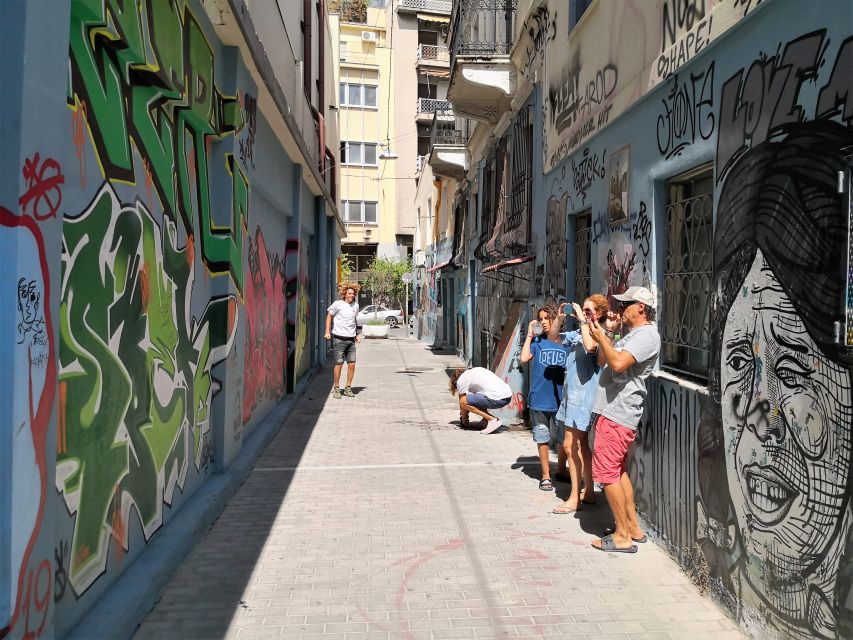
The strongest part of this tour is the guide’s explanation. The art itself is free to see across Athens, but the guide gives you a way to read it.
Penelope appears often among the available guides and is described as warm, energetic, clear, and attentive to different interests. She has offered route choices and checked that groups were comfortable with the plan. For a private group or a small family party, that flexibility can make the walk feel more personal.
Eleni has led tours focused on the artists and the cultural differences between neighborhoods. Katerina is known for an engaging presentation and clear English. Greg has been praised for his interest in Athens, modern Greek society, and the local art scene, while Pascal has brought broad experience with street art and the techniques artists use.
You should not assume you will receive a particular guide unless your booking confirms it. The important point is that the experience depends heavily on the person leading it. The available guides are expected to speak English and explain the art, but each may emphasize different neighborhoods, artists, or political themes.
For the best result, ask questions. Tell the guide if you care most about technique, political art, local artists, international names, photography, or neighborhood history. The tour works well as a conversation, not just a lecture.
Walking pace, weather, and group size
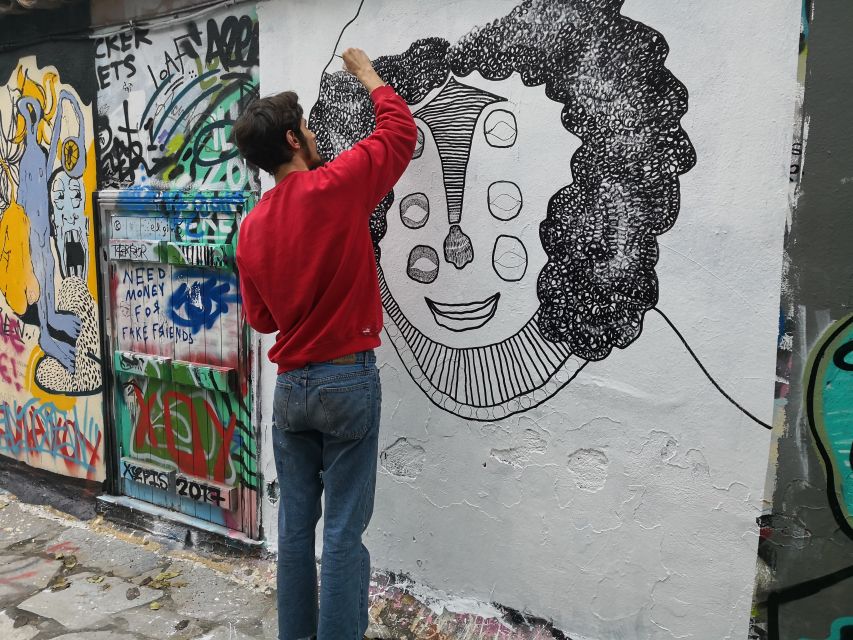
Two hours sounds short, but this is a substantial city walk. The route includes several separate walking sections, with the longest listed stretch taking about 40 minutes through Psyri. You will stop regularly, yet you should wear comfortable shoes and be ready to walk on ordinary city streets.
Athens can be hot, and heat was enough for one family to finish early. In warm months, an earlier or later start may be more comfortable if those times are offered. Carry water, since food and drinks are not included.
Winter can be a pleasant time for this experience. A small winter group may have more space to ask questions and more direct contact with the guide. In busy periods, a larger group may feel less personal, though private and small-group options are available.
The route includes alleys and courtyards, so it is not a formal museum visit with guaranteed smooth flooring or indoor shelter. The supplied information does not promise a specific accessibility arrangement. If you have mobility concerns, ask before booking and explain what you need.
Is $47 a fair price?
At $47 per person, this is not the cheapest way to see walls in Athens. You can walk through Psyri or Metaxourgeio on your own without paying an admission fee.
The value comes from the interpretation. You are paying for two hours with an English-speaking guide who can identify artists, explain techniques, connect images with Greek politics and social events, and lead you through areas you might not explore confidently alone. If you care about art or modern Athens, that can justify the cost.
The price makes less sense if you only want quick photographs of large murals. This is not designed as an Instagram stop-by-stop outing. One guide specifically framed it as a serious art experience rather than a selfie tour, and that is the right expectation.
Private or small-group options may suit you if you want more time for questions or have particular interests. A standard group should work well for most people, especially if you enjoy learning through conversation and do not mind a steady pace.
Who should book this Athens walk?
I would put this near the top of your list if you have already seen the Acropolis and want to understand present-day Athens. It is also a strong choice for repeat visitors, art students, photographers, and anyone curious about political expression in public space.
Families can enjoy it, but keep the weather and walking time in mind. A teenager interested in drawing, design, or social issues may find it more engaging than another formal history tour. Younger children may lose interest during longer explanations.
This experience suits you if you like local context more than a checklist. You will hear about Greek artists and foreign artists who have worked in Athens, but the focus remains on what the works mean and how they relate to the city.
I would choose something else if your time in Athens is extremely limited and you have not yet visited the city’s major archaeological sites. I would also skip it if you want a relaxed café walk with little explanation. The pace is active, and the subject matter can be serious.
Should you book it?
Book this tour if you want to see Athens through its current concerns rather than only through its ancient past. The combination of murals, side streets, modern Greek politics, neighborhood change, and a strong English-speaking guide gives you a useful view of the city’s present tense.
Choose a cooler time of day, wear comfortable shoes, and arrive at the Lonis pastry shop beside Monastiraki metro. If possible, request a small group or private format when personal questions and a slower exchange matter to you. At $47, it is worthwhile for curious art lovers and repeat visitors, but less useful for anyone seeking only quick photos.
FAQ
Where does the Athens street-art tour begin?
It begins at Athinas 7, in front of the Lonis pastry shop, next to the Monastiraki metro station exit. If you arrive by metro, use the Athinas Street exit.
Where does the tour finish?
The walk ends at Metaxourgeio Square. Hotel pickup and drop-off are not included.
How long does the experience last?
The tour lasts two hours. The route includes Monastiraki, Psyri, Platia Iroon, Sarri, Omonoia, and Metaxourgeio.
What language is the tour offered in?
The live tour guide speaks English.
Are food and drinks included?
No. Food and drinks are not included in the price.
Can I cancel the booking?
You can cancel up to 24 hours in advance for a full refund. The reserve-now, pay-later option lets you keep your plans flexible and pay nothing at the time of booking.
New on the Athens shelf
- Small-Group Wine Tour in Athens with Tasting★ 5.0 · 33 reviews
- Acropolis of Athens, Parthenon and Acropolis Museum private tour with dinner★ 5.0 · 77 reviews
- Private Athens Transfer Airport/Port -Greek Tours-Hourly service★ 5.0 · 88 reviews
- VIP Private Guided Tour of Athens Acropolis & Plaka in a Sidecar★ 5.0 · 108 reviews
- Athens Moonlight Waling Tour with Drinks and Meze Dishes★ 5.0 · 259 reviews
- Private Athens Landmarks Layover Tour★ 4.5 · 41 reviews
- Departure Transfer from Athens City to Athens Airport★ 5.0 · 41 reviews
- Classic Athens Food Tour with Local Drink & Market Visit★ 5.0 · 34 reviews
Guided, compared.

Cape Sounio & Poseidon Temple Trip with Audio Guide
Read our verdict →
Mythology of Delphi, Museum and Arachova Guided Tour
Read our verdict →
Acropolis, Parthenon & Acropolis Museum Guided Tour
Read our verdict →
Acropolis: Acropolis and Parthenon Guided Walking Tour
Read our verdict →