Review · ATHENS TOURS
Philosophy and Democracy tour of Athens
Athens makes more sense when you connect its stones to its ideas. This walking tour follows the city’s ancient meeting places, cemeteries, markets, and hills while asking how philosophy and democracy shaped the world you live in today. Guide Panos is especially good at turning big subjects into clear, lively stories.
I like the route for two reasons: it visits important sites beyond the Parthenon, and it links them into one story instead of treating each ruin as an isolated photo stop. I also like the small-group limit of 15, which gives you a better chance to ask questions and hear the guide clearly.
The main consideration is the walking. The tour lasts about three and a half hours, includes several outdoor sites, and has little time at each stop. Bring water, wear comfortable shoes, and expect a thoughtful walking lesson rather than a slow archaeological tour.
Key points at a glance
- Kerameikos sets the theme: An ancient cemetery and pottery district introduce Pericles’ famous speech about Athenian democracy.
- Pnyx Hill is the high point: You see the place linked with the earliest form of direct democracy, along with views toward the Acropolis.
- The Agora brings philosophy to life: Socrates, Plato, Pericles, and other major figures are tied to the streets where debate took place.
- Panos is the central strength: He explains philosophy, politics, and history in a clear, humorous way, with room for questions.
- The route fills in Athens beyond the Acropolis: Hadrian’s Library, the Roman Agora, the Tower of the Winds, Plaka, and the flea market add layers to the city.
- The price is reasonable: At $50.81 per person, the tour offers a long guided walk through several major sites, though entrance fees are not included.
Why this Athens walk is different
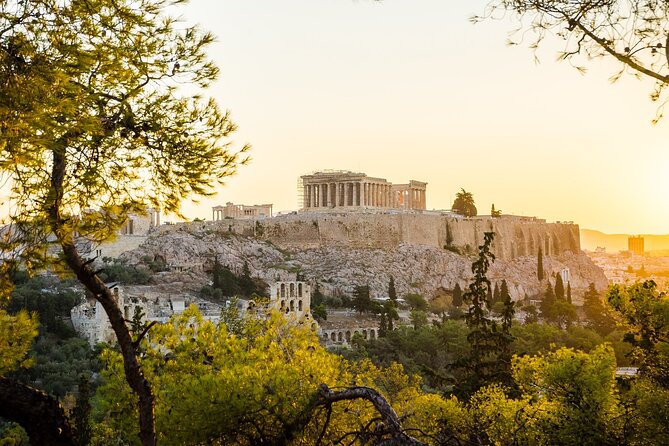
Many first visits to Athens revolve around the Acropolis. That is sensible, but it can leave you with a collection of magnificent ruins and no clear idea of how the city functioned. This tour takes a wider view.
You walk through places tied to burial, trade, public debate, Roman rule, science, philosophy, and modern street life. The theme is not simply ancient Greece. It is the connection between ideas and places. A cemetery becomes a setting for Pericles’ words. The Agora becomes a place where public life and philosophical questions met. Pnyx Hill becomes a physical reminder that citizens once gathered to decide matters for themselves.
Panos is the named guide associated with this experience. The strongest praise focuses on his ability to make difficult subjects easy to follow, his humor, and his enthusiasm for both Greek history and Western political thought. That matters here. A tour about democracy can become a lecture. A tour about philosophy can become a string of names. The guide’s job is to make the subjects usable, not merely impressive.
The group can include up to 15 people. That is not a private tour, but it is small enough to make conversation possible. Several parts of the route invite questions, and the guide’s clear speaking voice means you should not need special listening equipment.
A few more Athens options worth putting side by side
- Athens: Acropolis & up to 5 Archaeological Sites Combo Pass
★ 4.4 · 12,619 reviews - Athens: Acropolis Ticket with Optional Audio or Live Guide
★ 4.2 · 11,055 reviews - Athens: Acropolis, Parthenon & Acropolis Museum Guided Tour
★ 4.8 · 9,316 reviews
Kerameikos, where pottery and public memory meet
The tour begins near the Statue of Theseus and heads to Kerameikos, one of Athens’ most important archaeological areas and one that many visitors miss. The name comes from keramos, meaning ceramic, because pottery workshops once operated here.
Kerameikos also served as Athens’ cemetery for many centuries. That gives the site a quieter, more reflective mood than the central monuments. The remains connect ordinary burial customs with the lives of prominent Athenians who were laid to rest here.
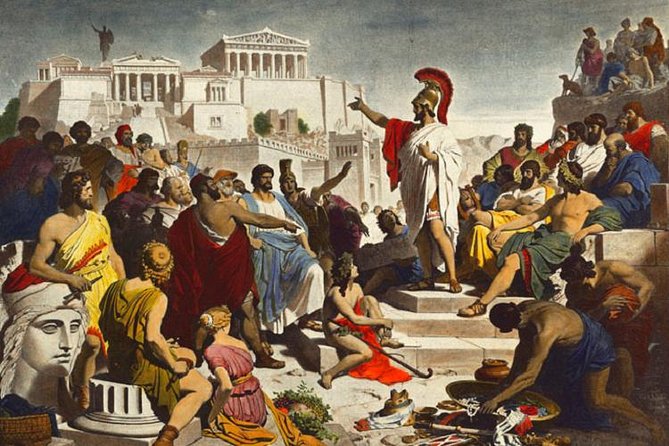
The political connection is just as important. Pericles delivered his famous funeral speech here for the first Athenian casualties of the Peloponnesian War. The speech praised the city’s values and its form of government. On this tour, that speech becomes the opening example of how Athens presented democracy to itself.
You spend about 15 minutes at Kerameikos, and the admission fee is not included. That short time is enough for context and orientation, but it is not a full archaeological visit. If you want to study every monument, inscription, and pathway, plan to return on your own.
The flea market and the feel of present-day Athens
The walk then passes through the Athens flea market at an easy pace. This is a useful change of rhythm. After ancient graves and political speeches, you see the city as it functions now, with shops, street life, and the everyday texture of central Athens.
The stop lasts about 15 minutes and does not require an admission ticket. Do not expect a long shopping session. The value is in seeing how the modern city occupies the same broad center as the ancient and Roman settlements.
The guide also provides suggestions for where to eat, drink, and continue exploring. These tips can be helpful after the tour, since the route ends in a central area rather than returning you to your starting point.
Hadrian’s Library and the Roman Agora
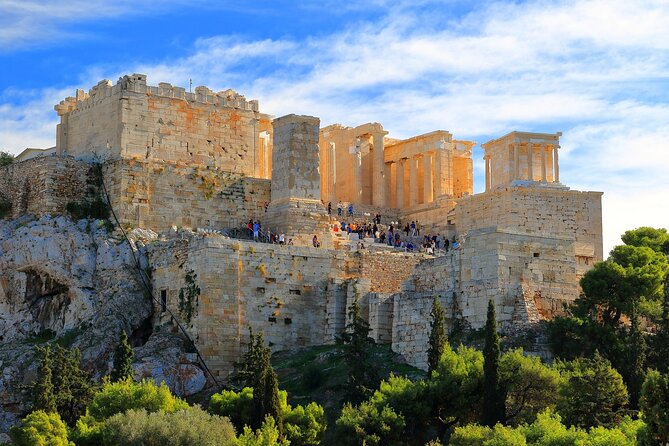
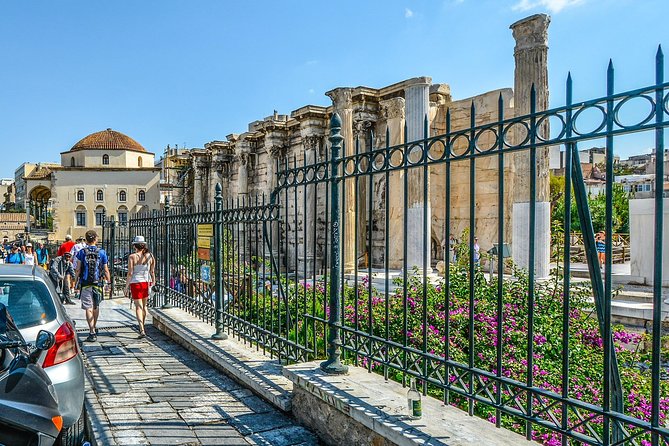
Hadrian’s Library was built by the Roman Emperor Hadrian in AD 132 on the north side of the Acropolis. Its presence shows how Athens continued to matter under Roman rule, even as political power shifted elsewhere.
You have about 15 minutes here, and admission is not included. The stop works best as part of the larger story. Athens was not frozen in its fifth-century BC glory. It continued to be used, rebuilt, and reshaped by later rulers.
The Roman Agora lies north of the Acropolis and east of the Ancient Agora. It provides another look at the city under Roman influence. The route gives you roughly 15 minutes here as well, with admission separate from the tour price.
This quick-stop approach is useful if you want an overview of Athens’ main historical layers. It is less suitable if you want long, quiet periods at each monument. I would think of the tour as a guided introduction, with the option to revisit your favorite site later.
Close by, and nothing like it:
- Athens: Acropolis and Parthenon Guided Walking Tour
★ 4.6 · 5,882 reviews - Athens, Piraeus, and Coastline: Blue Hop-On Hop-Off Bus
★ 3.9 · 4,849 reviews - Greek Food Walking Tour in Athens
★ 5.0 · 4,740 reviews - Athens: City Sightseeing Hop-On Hop-Off Bus Tour
★ 4.3 · 4,520 reviews
The Tower of the Winds, Athens’ ancient weather station
The five-minute stop at the Tower of the Winds is brief but memorable. This octagonal building was made by the astronomer Andronicus of Kyrristos in the first century BC.
It served as a wind indicator, a clock, and a weather station. Its clock was solar, but a hydraulic system could produce a sound each hour on cloudy days. The comparison to a combination of Big Ben and a meteorological station helps explain why the structure mattered to daily life.
Admission is not included. The short visit reflects the stop’s role in the route: you learn what to look for, hear the historical point, and keep moving through the city.
The walk also passes through Plaka, the scenic neighborhood below the Acropolis, with narrow streets and small houses. The route information does not assign a fixed time here, so treat Plaka as part of the walk rather than a separate neighborhood tour.
The Ancient Agora and the people who shaped Athens
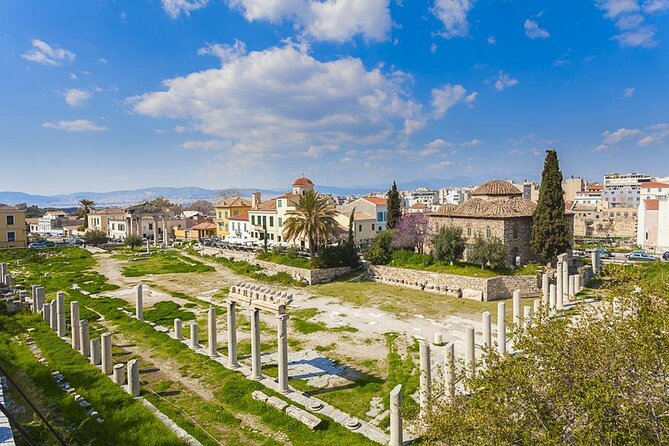
The Ancient Agora is the intellectual and civic center of the walk. This was the heart of Athens, where citizens, politicians, philosophers, and workers moved through the same public space.
The names associated with it are a remarkable list: Socrates, Plato, Solon, Themistocles, Pericles, Thucydides, Sophocles, and Aristophanes. The point is not that all these figures held the same views. The point is that Athens created places where public argument, political action, theater, education, and commerce could overlap.
You spend about 20 minutes here, with admission not included. That is enough to understand the Agora’s role and connect it to the day’s theme. It is not enough for a full archaeological examination, especially if you want to see every building and inscription.
The guide’s strongest role comes here. Names and dates can blur together, but the setting helps you understand how debate was part of urban life. Philosophy was not only something studied in a classroom. It grew from questions asked in public, among citizens who disagreed.
A tribute to Socrates
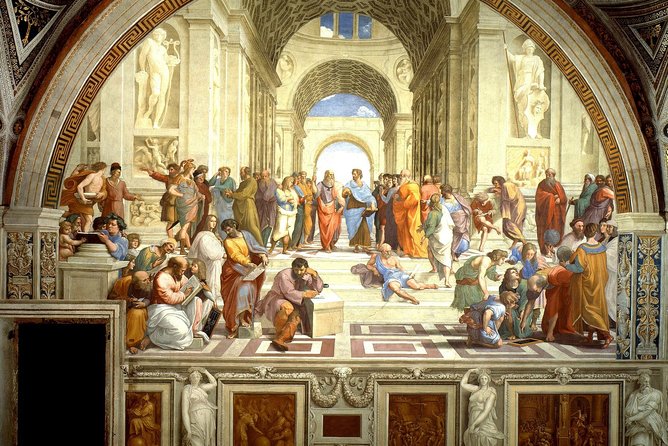
The stop known as the Prison of Socrates is brief, about 10 minutes, and admission is free. The site is treated as a tribute to the philosopher rather than as a long formal museum visit.
Socrates remains central to the tour because he represents the habit of questioning assumptions. His connection to Athens also raises a useful tension: a city that celebrated public debate could still condemn one of its most famous questioners.
The stop is less about seeing a dramatic building than about pausing over the person and the ideas. If you expect a large, fully interpreted prison complex, keep your expectations modest. The value comes from the guide’s explanation and the connection to the wider story.
Pnyx Hill, the clearest link to democracy

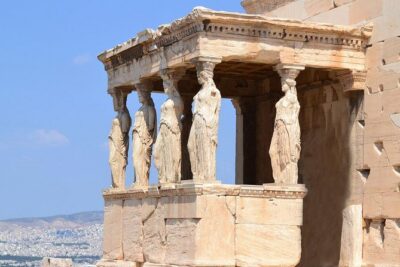
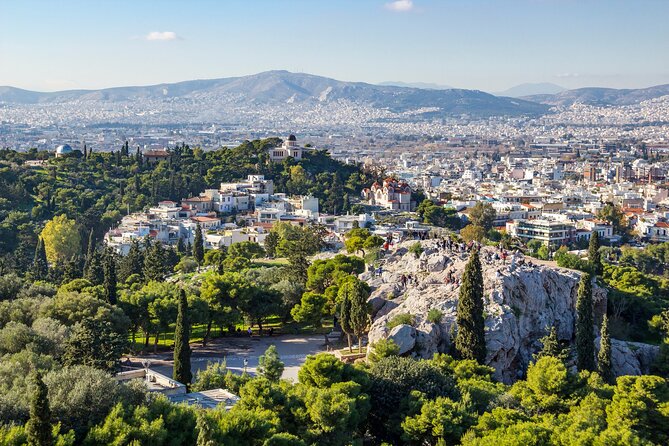
Pnyx Hill is the tour’s strongest stop for understanding Athenian democracy. It is considered the cradle of democracy because citizens gathered here to make decisions about their future.
The site is free and receives about 30 minutes, the longest scheduled stop on the route. That extra time makes sense. You need a moment to take in the setting, hear how the assembly worked, and connect the physical hill to the political ideas discussed throughout the morning.
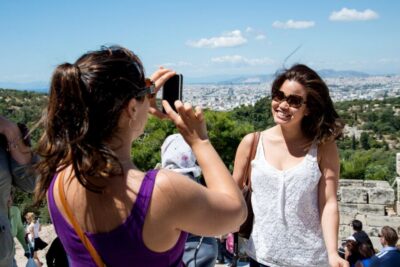
The views toward the Acropolis and Athens add a practical reward. You are not only hearing about the city’s political life. You are looking across the same urban center that shaped it.
The tour compares ancient and modern democracies. That comparison is one of its best features, but it should not be treated as a claim that the two systems were identical. The guide helps you consider what changed, what remained, and who was included or excluded in the ancient system.
What the pace and group size mean for you
The advertised duration is about three hours and 30 minutes. In practice, you should set aside the full morning. One detailed account places the start at 9:30 a.m. and the finish around 1 p.m., with a refreshment and restroom break at a kiosk partway through the route.
That break is useful, but you should still bring a bottle of water. Athens can be hot, and this is an outdoor walking experience. Comfortable shoes are essential. You will not be racing from site to site, but the route covers enough ground that footwear matters.
The group limit is 15 people. If you prefer a private guide, this is not that. If you want a group small enough for questions and personal attention, it is a sensible middle ground.
The tour is offered in English and uses a mobile ticket. Service animals are allowed, and it is near public transportation. Most people can participate, but the walking and outdoor setting may be tiring for anyone who needs frequent rest.
Is $50.81 a fair price?
At $50.81 per person, the tour is priced below many private history walks and offers about three and a half hours of guided time. You are paying for the route design and the guide’s explanation, not just admission to monuments.
Entrance fees to Kerameikos, Hadrian’s Library, the Roman Agora, the Tower of the Winds, and the Ancient Agora are not included. That is the key price detail. Check your plans and budget for separate tickets if you want to enter the archaeological areas rather than view them from the route.
Even with those extra costs, the tour can be good value if you want a clear framework for Athens. It covers more ground than a single-site visit and gives you ideas for what to study later. It is less good value if you only want to enter monuments and explore them at your own speed.
The tour is often booked well ahead, with an average booking lead time of about 36 days. That suggests you should reserve early if the date matters, especially during a busy Athens visit.
Who should book this walk?
I would choose this tour early in an Athens stay if you enjoy history, political ideas, philosophy, or urban archaeology. The route can help you understand later visits to the Acropolis and other ancient sites.
It also suits families with older children and teenagers who can follow a discussion. The material is aimed at adults, but younger participants have enjoyed the combination of stories, places, and questions. The guide’s humor helps keep the subject from becoming too formal.
This is not the best choice if you want a relaxed photo walk, a dedicated food tour, or a full visit inside every archaeological site. It is also not ideal for anyone who finds three and a half hours of walking difficult.
The tour ends at Theorias 21 in Athens, near the Acropolis area. It does not return you to the Statue of Theseus, so plan your next stop from the finishing point.
Cancellation and weather details
Free cancellation is available up to 24 hours before the experience starts, based on local time. Cancellations made less than 24 hours ahead are not refunded, and late changes are not accepted.
The walk depends on good weather. If poor weather causes cancellation, you are offered another date or a full refund. The experience also requires a minimum number of participants, so a cancellation for that reason brings the same choice of another date or a full refund.
Should you book the Philosophy and Democracy tour?
Book it if you want Athens to become more than a collection of famous ruins. The strongest part is the way Kerameikos, the Agora, Socrates, and Pnyx Hill fit into one story about public life and ideas.
Panos is a major reason to choose it. His clear explanations, humor, and ability to connect ancient thought with modern political questions suit the subject well. The tour also gives you useful food, drink, and sightseeing suggestions for the rest of your stay.
Skip it if you want a slow, detailed visit inside each site or if you dislike long walks. For everyone else, the $50.81 price is reasonable for a small English-speaking group, a carefully linked route, and a morning that can change how you understand Athens.
FAQ
How long does the Philosophy and Democracy tour of Athens last?
The tour lasts approximately 3 hours and 30 minutes. One scheduled version begins at 9:30 a.m. and ends around 1 p.m., including a short break.
What language is the tour offered in?
The tour is offered in English.
How many people can join the tour?
The group can include a maximum of 15 travelers.
Where does the tour begin?
The meeting point is the Statue of Theseus in Athens, Greece.
Where does the tour end?
The tour ends at Theorias 21, Athens 105 58, Greece.
Are admission tickets included?
No. Admission tickets are not included for Kerameikos, Hadrian’s Library, the Roman Agora, the Tower of the Winds, or the Ancient Agora. The flea market, Prison of Socrates, and Pnyx Hill are listed as free stops.
Is the tour suitable for most people?
Most people can participate, and service animals are allowed. You should be prepared for several hours of walking and outdoor sightseeing.
Can I cancel for a full refund?
Yes. You can cancel at least 24 hours before the start time for a full refund. Cancellations or changes made less than 24 hours before the start time are not accepted for a refund.
What happens if bad weather cancels the tour?
You are offered a different date or a full refund if poor weather causes the tour to be canceled. The same options apply if the minimum number of participants is not met.
New on the Athens shelf
- Acropolis of Athens, Parthenon and Acropolis Museum private tour with dinner★ 5.0 · 77 reviews
- Small-Group Wine Tour in Athens with Tasting★ 5.0 · 33 reviews
- Private Athens Transfer Airport/Port -Greek Tours-Hourly service★ 5.0 · 88 reviews
- VIP Private Guided Tour of Athens Acropolis & Plaka in a Sidecar★ 5.0 · 108 reviews
- Athens Moonlight Waling Tour with Drinks and Meze Dishes★ 5.0 · 259 reviews
- Private Athens Landmarks Layover Tour★ 4.5 · 41 reviews
- Departure Transfer from Athens City to Athens Airport★ 5.0 · 41 reviews
- Classic Athens Food Tour with Local Drink & Market Visit★ 5.0 · 34 reviews
Athens Tours, compared.
Acropolis & up to 5 Archaeological Sites Combo Pass
Read our verdict →

Athens, Piraeus, and Coastline: Blue Hop-On Hop-Off Bus
Read our verdict →